


Osservatore Romano (06/15/1966)
 See also: Abolition of the Index of Prohibited Books.
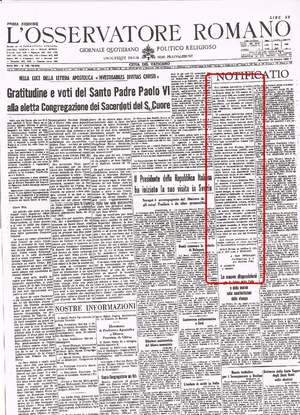
On December 7, 1965, on the eve of the conclusion of the Second Vatican Council, Saint Paul VI issued an apostolic letter in the form of a motu proprio (on his own initiative) in which he reformed the Holy Office. He traces its history. The Congregation for the Doctrine of the Faith (CDF) replaced it. There is no longer any question of the Index of Prohibited Books. Some were upset by this.
On June 14, 1966, Cardinal Alfredo Ottaviani, reinstated in his functions, questioned the Sovereign Pontiff on the meaning to be given to this omission,[1] then formalized its suppression. The Index "no longer has the force of ecclesiastical law with the related censorship." The Osservatore Romano of June 15, 1966, published the text of the "Notification" in Latin. Indeed, since the notification is an official act of the Holy See, it is recorded as such in the Acta Apostolicae Sedis (A.A.S. for short) and proclaimed in Latin. This notification is entitled Notificatio de Indicis librorum prohibitorum conditione, and referenced Acta Apostolicae Sedis (AAS) 58/445 of June 14, 1966. It was surely later translated into various languages including French, which we reproduce in the rest of this article for commentary purposes.
English text of the notification
SACRED CONGREGATION FOR THE Doctrine OF THE FAITH - Notification on the abolition of the index of prohibited books Notificatio de Indicis librorum prohibitorum conditione, referenced Acta Apostolicae Sedis (AAS) 58/445 of June 14, 1966.
After the publication of the Motu proprio "Integrae servandae" dated December 7, 1965, many questions were asked of the Holy See inquiring about the status of the Index of Prohibited Books, which the Church had until now used to protect the integrity of faith and morals, according to the divine mandate.
To answer these questions, this Sacred Congregation for the Doctrine of the Faith, after consulting with the Holy Father, indicates that its Index retains its moral value insofar as it calls upon the conscience of the faithful - as natural law itself requires - to guard against writings that may endanger faith and good morals. But the Index no longer has the force of ecclesiastical law along with the censures attached to it.
That is why the Church trusts the mature conscience of the faithful, especially Catholic authors and publishers and those responsible for the education of youth. But it firmly relies on the vigilant solicitude of each Ordinary and each Episcopal Conference, who have the right and the duty to monitor and prevent harmful books, as well as, where appropriate, to disapprove and condemn them.[2]
In the spirit of the Motu proprio «Integrae servandae» and the decrees of the Second Vatican Ecumenical Council, the Sacred Congregation for the Doctrine of the Faith will endeavor, if necessary, to communicate with Ordinaries throughout the Catholic world to assist them when it comes to judging books or promoting healthy culture in the face of the bad, coordinating its efforts with institutes and universities.
But if doctrines and thoughts contrary to the principles of faith and morals are spread in one way or another, and if their authors, after being invited humanely, refuse to correct their errors, the Holy See will exercise its right and duty to disapprove such writings, even publicly, in order to safeguard the salvation of souls with the firmness that is fitting.
Finally, measures will be taken to ensure that the Church's judgment on publications reaches the faithful.
Given in Rome, at the palace of the Holy Office, June 14, 1966.
+ A. Card. Ottaviani
Pro-Prefect of the Sacred Congregation for the Doctrine of the Faith
+ P. Parente
Secretary
English text of the implementing decree
It can be seen that the wording of the notification left room for interpretation: it seemed to give with one hand what it took away with the other. Moreover, did this suppression concern works manifestly containing heresies? It was therefore necessary to clarify the interpretation of the text, which Cardinal Ottaviani did in an Implementing Decree published on November 15, 1966. The conclusion, laconic as it was, was unambiguous: the abolition concerns all consequences for all works.
SACRED CONGREGATION FOR THE Doctrine OF THE FAITH - DECREE Decretum de interpretatione «Notificatio» die 14 iunii 1966 circa «Indicem» librorum prohibitorum), November 15, 1966" AAS 58/1186.
"After the publication of the "Notification" of June 14, 1966 (see above) concerning the "Index" of prohibited books, this Sacred Congregation for the Doctrine of the Faith was asked whether canon 1399, which ipso iure forbids certain books,[3] and canon 2318, which imposes penalties on those who violate laws on censorship and prohibition of books[4] remained in force.
These questions having been posed at the plenary assembly on Wednesday, October 12, 1966, the most eminent Fathers charged with Safeguarding matters of faith decided that the answer should be:
1) No to both questions, by virtue of ecclesiastical law; however, the value of moral law, which absolutely forbids putting faith and good morals in danger, must be inculcated anew;
2) that those who incurred the censures mentioned in canon 2318[4] should be considered absolved of them, by the mere fact of the abrogation of this canon.
At the Audience granted on June 14, 1966, to the Cardinal Pro-Prefect of this Sacred Congregation for the Doctrine of the Faith, the Sovereign Pontiff Paul VI deigned to approve the said decree, and ordered that it be published.
Given in Rome, at the seat of the Congregation for the Doctrine of the Faith, November 15, 1966."
+ A. Card. Ottaviani
Pro-Prefect
+ P. Parente
Secretary
Notes and references
- ↑ Cardinal Ottaviani was only Pro-Prefect of the congregation (= Deputy Prefect). The Integrae Servandae indeed stipulates that the new congregation is "presided over by the Sovereign Pontiff, it will be directed by a Cardinal-Secretary, assisted by an Assessor, a Substitute and a Promoter of Justice."
- ↑ The directives of the Sovereign Pontiff are more positive than this focus on condemnation, which is a trace of old reflexes. Paul VI said in his motu proprio: "But because perfect love casts out fear (1 John 4:18), the protection of the faith will be better ensured by an office charged with promoting the Doctrine, which will give new strength to the heralds of the Gospel, while correcting errors and gently bringing back to the right path those who have strayed."
- ↑ The canon 1399 of the 1917 Code of Canon Law (in force at the time) forbids "by the very law itself" 12 categories of publications. Maria Valtorta's work falls under category no. 5: "n5) [...] books and brochures recounting new apparitions, revelations, visions, prophecies, miracles, or advocating new devotions, even if they are presented as private devotions; all books of this nature are forbidden if published without prior examination by ecclesiastical censorship as provided for by canon 1385 §1." The abolition of canon 1399 entails de jure the abolition of the Index pertaining to Maria Valtorta.
- ↑ 4.0 4.1 Canon 2318 (1917 Code) encompasses authors, publishers, and readers of apostate, heretical or schismatic books. Moreover, authors and publishers of books of the Holy Scriptures or their commentary notes without prior approval.