


Benedict XVI and Maria Valtorta
.jpg)
Josef Ratzinger, born April 16, 1927 in Marktl and died December 31, 2022 in the Vatican, was a German Catholic prelate. Prefect of the Congregation for the Doctrine of the Faith during the pontificate of John Paul II, he was elected pope on April 19, 2005 under the name Benedict XVI. He is involved in the Maria Valtorta dossier in three respects:
- As Prefect of the Congregation for the Doctrine of the Faith, he had to rule twice in writing on the writings of Maria Valtorta (1985 and 1993). An unchanged opinion to this day (2025). He recalled and explained the value and place of private revelations (2000).
- Having become Pope Benedict XVI, he codified this domain (2008, 2010).
- In the last year of his pontificate, he proclaimed the beatification of two well-known supporters of the work of Maria Valtorta (2012).
He thus consolidated the magisterial foundation of private revelations and determined the framework in which the work of Maria Valtorta fits within the Church.
As Prefect of the Congregation[edit | edit source]
Joseph Ratzinger participated as a "peritus"[1] at the Second Vatican Council, where he was considered a reformer and worked on the reform of the Holy Office (nicknamed the "Supreme" because of its importance). A congregation re-founded as the Congregation for the Doctrine of the Faith to which Pope John Paul II entrusted him as Prefect in 1981. He held this post from November 25, 1981 to May 13, 2005, the date on which he was enthroned as pope.
Letter of January 31, 1985 to Cardinal Giuseppe Siri[edit | edit source]
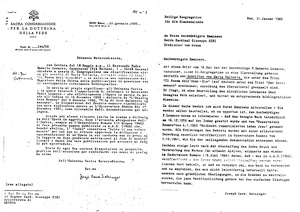
In 1985, four years after his appointment, he had to rule on Maria Valtorta at the request of a religious from the Diocese of Genoa. He responded to Cardinal Giuseppe Siri, archbishop of the place. In this letter, Cardinal Josef Ratzinger advises against the dissemination of the work of Maria Valtorta based on the dossier he discovered. He considered it unhealthy, not absolutely, but for the category of the "most vulnerable" faithful. It is assumed that he alludes to poorly informed readers who would confuse the work of Maria Valtorta with the canonical Gospel, a theme on which he would later insist.
This leaked letter was widely used by opponents, who refer to it to justify the permanence of the condemnation of the work, beyond the abolition of the index, and its harmfulness. This point of view can be justified considering this sole letter, out of context, but subsequently Cardinal Josef Ratzinger had the opportunity to read the work of Maria Valtorta himself over the course of a year and to authorize its dissemination within the framework of prudent reading advocated by the Church for all private revelations.
Text of the letter[edit | edit source]
| Original Italian text | Indicative English translation |
|---|---|
| SACRA CONGREGAZIONE PER LA DOTTRINA DELLA FEDE
00193 Roma, 31 gennaio 1985 Prot. N. 144/58
con lettera del 18. Maggio p.p., il Reverendo Padre Umberto Losacco, Cappuccino (Via Montani, 1 - 16148 Genova) chiedeva a questa S. Congregazione una chiarificazione circa gli scritti di Maria Valtorta, raccolti sotto il Tituslo "Il Poema dell'Uomo-Dio" e se esisteva una valutazione del Magistero della Chiesa sulla pubblicazione in questione con il corrispettivo riferimente bibliografico. In merito mi pregio significare all'Eminenza Vostra -la quale valutera l'opportunità di informare il Reverendo Padre Losacco - che effettivamente l'Opera in parola fu posta all'Indice il 16 Dicembre 1959 e definita da "L'Osservatore Romano" del 6 Gennaio 1960, "Vita di Gesu malamente romanzata". Le disposizioni del Decreto vennero ripubblicate con nota esplicativa ancora su L'Osservatore Romano del 1 Dicembre 1961, come rilevabile dalla documentazione qui allegata. Avendo poi alcuni ritenuto lecita la stampa e diffusione dell'Opera in oggetto, dopo l'avvenuta abrogazione del l'Indice, sempre su l'Osservatore Romano (15 Giugno 1966) si fece presente quanto pubblicato su A.A.S. (1966) che, benché abolito, l’"Index" conservava "tutta la sua valore morale" per cui non si ritiene opportuna la diffusione e raccomandazione di un'Opera la cui condanna non fu presa al vano leggero ma dopo ponderate motivazioni al fine di neutralizzare i danni che tale pubblicazione può arrecare ai fedeli più sprovveduti. Grato di ogni Sua cortese disposizione in proposito, profitto dell'occasione per confermarmi con sensi di profonda stima dell'Eminenza Vostra Reverendissima Dev.mo Joseph card. Ratzinger |
SACRED CONGREGATION FOR THE DOCTRINE OF THE FAITH
00193 Rome, January 31, 1985 Prot. No. 144/58 Most Reverend Eminence, By letter dated May 18 last, Reverend Father Umberto Losacco, Capuchin (Via Montani, 1 – 16148 Genoa), asked this Holy Congregation for clarification regarding the writings of Maria Valtorta, collected under the title "The Poem of the Man-God", and whether there existed an assessment by the Magisterium of the Church on the publication in question with the corresponding bibliographic reference. In this regard, I have the honor to inform Your Eminence - who will evaluate the opportunity to inform Reverend Father Losacco - that the work in question was indeed placed on the Index on December 16, 1959, and defined by "L’Osservatore Romano" of January 6, 1960 as a "poorly romanticized Life of Jesus". The provisions of the Decree were republished with an explanatory note again in "L’Osservatore Romano" of December 1, 1961, as evident from the documentation attached herewith. Subsequently, as some considered it lawful to print and distribute the work in question after the abolition of the Index, it was stated again in "L’Osservatore Romano" (June 15, 1966) and published in the A.A.S. (1966) that, although abolished, the "Index" retains "all its moral value", therefore it is not considered appropriate to disseminate or recommend a work whose condemnation was not lightly undertaken but after careful consideration in order to neutralize the harm that such publication could cause to the most vulnerable faithful. Grateful for any courteous disposition on this matter, I take this opportunity to remain with profound esteem Your Eminence Most Reverend Devotedly, Joseph Card. Ratzinger |
Value and basis of this letter[edit | edit source]
Cardinal Ratzinger provides only three official documents: the comment on the placement on the Index (1960), the extension to the new edition (1961) and the decree of suppression of the Index (1966). He attaches a personal authoritative opinion which can be summarized as follows: he advises against disseminating the work of Maria Valtorta, fearing the impact of this life of Jesus on the "most vulnerable" readers, which is a pastoral concern but not a doctrinal one[2]. He offers no judgment on the work other than full credibility to what was reported by the two Osservatore Romano articles, the second, a brief note, (December 1, 1961, p. 1) does not judge doctrine or morals, but the scientific value of the work: "la quale non ha alcun valore scientifico (which has no scientific value)" and extends the placement on the Index for the same disciplinary reasons (but not doctrinal[3]): canon 1398 §2 and canon 1399 §5 of the 1917 Code. Yet Cardinal Josef Ratzinger will rely (as some opponents do) on the passage of the Notification abolishing the Index which specifies that the "Index retains its moral value". But the text adds, (in the omitted part): "in the sense that it asks the consciences of the faithful - as is required by natural law itself - to keep away from writings that can endanger faith and good morals." From the verbal imprimatur of Pius XII to the written encouragement of Pope Francis, including the cohort of saints, theologians and exegetes - all readers - can it reasonably be argued that they would not have perceived "endangering faith and good morals" if it existed to any degree?
Cardinal Josef Ratzinger found nothing to this effect when he personally discovered the work of Maria Valtorta. One can therefore deduce that he based his pastoral opinion only on the content of the dossier he found. Indeed, the dossier opened in 1945 by the Holy Office (Prot no. 355/45) no longer appears at this time. It was replaced in 1958 by a new one (Prot. no. 144/58) which seems to contain only unequivocal documents supporting the placement on the Index[4].
Erroneous attribution of a 1988 letter[edit | edit source]
A letter from the Congregation for the Doctrine of the Faith (CDF) to a Canadian faithful woman[5], dated September 9, 1988 and written by Josef Clemens, the personal secretary of the cardinal, which presented Maria Valtorta’s work in a very critical light, has been wrongly attributed to Cardinal Josef Ratzinger (and therefore to his authority). The letter stated (according to the citation):"It is true that the Poem of the Man-God by Maria Valtorta was placed on the Index in 1959 and described by L'Osservatore Romano (Jan 6, 1960) as a completely romanticized version of the life of Jesus[6]. The Index has since been suppressed, but the reasons for the original censorship remain valid; this work is a collection of childish fantasies, historical and exegetical errors, all set in a subtly sensual vein[7]."The quotation attributed to Cardinal Ratzinger by Yves Chiron[5] is neither his nor from the Osservatore Romano,[8], but probably[9] from Father Giovanni Caprile in Civiltà Cattolica dated July 1, 1961 (issue 2665) who wrote about the second edition:
"(This work is) a monument of childishness, fantasies and historical and exegetical falsehoods, diluted in a subtly sensual atmosphere, due to the presence of a swarm of women following Jesus. A monument, in short, of pseudo-religiosity."There is thus a double shift:
- presenting as a magisterial act what is only an expert opinion (would the opposite favorable opinion be equally acceptable?)
- creating a confusion between official acts of the Holy See (AAS) and unsubstantiated positions.
"This error was introduced by the Franciscan father Benedict Joseph Groeschel (July 23, 1933 - October 3, 2014) on page 58 of his book A Still Small Voice: A Practical Guide on Reported Revelations (Ignatius Press, 1993), before being spread by Marco Corvaglia in Italy, in the first edition of his book Medjugorie, È tutto falso (Anteprima Edizioni, 2007, 283 pages), and by Yves Chiron in France, in his religious information letter Aletheïa no. 260 of July 17, 2017. Marco Corvaglia had the honesty to correct this error in the re-edition of his book and on his website. It was then taken up by the press agency I.MEDIA (made up of five people covering Vatican news), in its dispatch of March 4, 2025, which was in turn duplicated by many French-speaking Christian newspapers without verification (Aleteia, Famille Chrétienne, La Croix, RCF, Cathobel, Cathberne, etc.). These articles were written in a few hours by people who knew neither the history of Maria Valtorta nor her texts."
1990s: discovery of the work and conditional imprimatur[edit | edit source]
On June 30, 1992, Maria Valtorta’s publisher, Emilio Pisani, had the opportunity to visit the Holy Office Palace where a prelate from the Secretariat of State informed him that "Upstairs" the opinion on Maria Valtorta had changed and that her life of Jesus could be considered "like a good book". The fact was as unexpected as it was enigmatic: what motivated this reversal and what was meant by a "good book"? Here is what the publisher reports:[10]"On June 30, 1992 - i.e., the same year as the letter from the secretary of the CEI - I had the only occasion in my life to enter the Holy Office Palace. I accompanied a religious of the Society of St. Paul, who was provincial superior in Canada. These Fathers distributed there the editions in English and French of the Work of Maria Valtorta.It was therefore necessary to identify what had motivated this official position reversal of the Congregation for the Doctrine of the Faith communicated by the Conference of Italian Bishops, and in what scope it now inscribed the work of Maria Valtorta. The latter had enjoyed a vague situation since the abolition of the Index.Arriving in Rome, this religious had made an appointment with one of his confreres, who was part of the secretariat of the Congregation for the Doctrine of the Faith. He received us both and, since we were talking about Valtortian subjects, he confided.
He said he himself had suggested to Msgr. Tettamanzi to write the letter to the CEV following a "new position" of the Congregation regarding the Work of Maria Valtorta. These exact words were that "Upstairs" it had been decided that it could be read "like a good book", like others such as Quo Vadis and Ben Hur."
The correspondence with "L’Homme Nouveau"[edit | edit source]
The question remained all the more since Msgr. Roman Danylak, posted in Rome, affirmed in his imprimatur letter of February 13, 2002, that Cardinal Ratzinger "in private letters recognized that this work is free from errors of Doctrine or morals," which amounted to a "Nihil obstat" from the Congregation for the Doctrine of the Faith, heir of the Holy Office.
It was only around the 2010s that the probable cause was located. It dated twenty years earlier, at the time of the episode reported by Emilio Pisani.
In the early 1990s, Cardinal Josef Ratzinger came to know Maria Valtorta better through one of the periodicals he liked to read: L’Homme Nouveau, then directed by Marcel Clément. The abbé Andrew Richard regularly published articles there on the Italian mystic. Marcel Clément received one day a letter from Cardinal Ratzinger: he wanted to verify some points on the theology of marriage that seemed Jansenist to him in Maria Valtorta. Marcel Clément then convened the editorial staff to suspend, pending examination, all articles on Maria Valtorta as well as sales done in his shop. One year later, the Prefect thanked L’Homme Nouveau for its obedience and declared that, after verification, nothing opposed continuing the publications and dissemination.
This correspondence is currently (2025) in the archives of Marcel Clément (other copies are in those of the Congregation), but two direct collaborators have testified to the accuracy of the facts[11].
The letter of May 6, 1992, and its explanation in the one of April 17, 1993[edit | edit source]
According to what was reported by a member of the secretariat of the Congregation for the Doctrine of the Faith (CDF) to Emilio Pisani, he had suggested to the Conference of Italian Bishops (CEI) to write the letter of May 6, 1992 requesting the publisher "in the perspective of an authentic service to the faith of the Church", to warn readers of Maria Valtorta to consider it as a literary work. But in a letter from Cardinal Josef Ratzinger, dated April 17, 1993, to Msgr. Raymond J. Boland, Bishop of Birmingham, Alabama, we learn that the CEI letter was on his initiative and that it reflected his position regarding the writings of Maria Valtorta. The secretary thus had to report to his hierarchy, which seems normal.
Text of the letter from Msgr. Raymond J. Boland[edit | edit source]
| Original text | Indicative French translation |
|---|---|
| Mr. Terry Colafrancesco
Mount Cherithas of Birmingham P.O. Box 120 4647 Highway 280 East Birmingham, AL 35242 Dear Mr. Colafrancesco: His Eminence, Joseph Cardinal Ratzinger, in a letter which I received from the Congregation of the Doctrine of the Faith this week, has asked me to inform you about the position of the Church regarding the writings of Maria Valtorta called The Poem of the Man-God. The Cardinal wants you to know that the Congregation in the past has issued certain "Notes" on this subject for the guidance of the faithful and these were published in L'Osservatore Romano. In the light of the recent recurrance [sic] of interest in the work, the Congregation has come to the conclusion that a further clarification to the "Notes" previously issued is now in order. Thus it has directed a particular request to the Italian Bishops' Conference to contact the publishing house which is concerned with the distribution of the writings in Italy in order to see to it that in any future reissue of the work "it might be clearly indicated from the very first page that the 'visions' and 'dictations' referred to in it are simply the literary forms used by the author to narrate in her own way the life of Jesus. They cannot be considered supernatural in origin." The implications of this most recent decision of the Holy See (Prot.N. 144/58 i, dated April 17, 1993) are obvious insofar as those who use, publish or Saltl the writings in question should know and clearly express the judgment of the Holy See as indcated in the underlined section of my previous paragraph. Hoping that this letter will serve as an authoritative response to the question which you addressed to His Eminence Cardinal Ratzinger in your letter of July 21, 1992, I am, Sincerly in Christ, (Signed) Most Rev. Raymond J. Boland, D.D. Bishop of Birmingham in Alabama |
Monsieur Terry Colafrancesco Mount Cherithas de Birmingham - B.P. 120 - 4647 Highway 280 - East Birmingham, AL 35242
Cher Monsieur Colafrancesco, Son Éminence, le Cardinal Joseph Ratzinger, dans une lettre que j’ai reçue cette semaine de la Congrégation pour la Doctrine de la Foi, m’a chargé de vous informer de la position de l’Église concernant les écrits de Maria Valtorta intitulés Le Poème de l’Homme-Dieu. Le Cardinal tient à ce que vous sachiez que la Congrégation a publié par le passé certaines « Notes » sur ce sujet, à l’intention des fidèles, et que celles-ci ont été diffusées dans L’Osservatore Romano. Au vu du regain d’intérêt récent pour cet ouvrage, la Congrégation a estimé nécessaire d’apporter une clarification supplémentaire aux « Notes » précédemment émises. Elle a donc adressé une demande particulière à la Conférence épiscopale italienne afin qu’elle contacte la maison d’édition responsable de la diffusion de ces écrits en Italie. L’objectif est de veiller à ce que, dans toute réédition future de l’œuvre, il soit clairement indiqué, dès la première page, que les « visions » et « dictées » mentionnées ne sont que des formes littéraires utilisées par l’auteure pour raconter à sa manière la vie de Jésus. Elles ne sauraient être considérées comme d’origine surnaturelle. Les implications de cette décision récente du Saint-Siège (Prot. N. 144/58 i, en date du 17 avril 1993) sont évidentes : ceux qui utilisent, publient ou diffusent les écrits en question doivent connaître et exprimer clairement le jugement du Saint-Siège, tel qu’énoncé dans la section soulignée du paragraphe précédent. En espérant que cette lettre servira de réponse officielle à la question que vous aviez adressée à Son Éminence le Cardinal Ratzinger dans votre courrier du 21 juillet 1992, je vous prie d’agréer, cher Monsieur, l’expression de ma considération distinguée dans le Christ. Signé : Msgr. Raymond J. Boland, D.D. Évêque de Birmingham en Alabama (Cette lettre de Msgr. Boland est reproduite avec l’aimable autorisation de Mount Cherithas de Birmingham.) |
This letter, reproducing correspondence from Cardinal Josef Ratzinger, legitimizes the CEI letter dated May 6, 1992 as expressing "the position of the Church." This position was reiterated 33 years later by the Dicastery in its statement of February 22, 2025. Therefore, the position of the Church has remained at this status quo, which must be analyzed comparatively and in light of the texts governing private revelations.
- The Church does not forbid the dissemination of this work nor its reading. In this it breaks with the placing on the Index and its supporters who ostracize the work and its readers.
- The Church does not ask for modifications and does not denounce a harmful work. It only limits how it is to be considered.
The Church does not write "are not of supernatural origin" but "cannot be considered as". Why this fine semantic repetition in the three formulations (1992, 1993, 2025)?
In this respect, the Dicastery’s statement (which no longer speaks of the Index) provides an important insight that earlier documents (1992 and 1993) did not: "In its long tradition, the Church does not accept apocryphal Gospels and similar texts as normative, because it does not recognize their divine inspiration, referring to the reliable reading of the inspired Gospels." What the Church says therefore was not specially created, but simply applied to the case of Maria Valtorta.
The Church recognizes as normative and reliable only the writings included in the canon of Scripture[12]. Apocryphal books are not recognized as divinely inspired and so cannot serve as a norm of faith or morals, even if they may contain interesting historical or spiritual elements.[13]. Being of "long tradition", they are considered as mere literary forms used by their authors to narrate the life of Christ in their own way, without Church attributing them any normative character. In other words, if the Church officially recognized the divine origin of Maria Valtorta’s work, it would make it a canonical book having universal authority. Given its content (visions of the life and teachings of Jesus), it would leave the domain of private revelations to join public Revelation, which the Church formally excludes as Jesus does in Maria Valtorta.[14]
Does this insurmountable red line prevent the work of Maria Valtorta from having, within the Church, a place commensurate with its popularity and the benefits provided by its reading?
What place within the Church?[edit | edit source]
The contours of this place within the Church have begun to be outlined by Pope Francis. In his letter of encouragement to the Maria Valtorta Foundation of Viareggio (February 24, 2024), as well as in related writings which explain it[15], the Sovereign Pontiff attributes to these accounts the power to provoke encounter with the living Jesus. A necessary condition of faith, he writes in another document,[16] and he attributes this encounter to the Holy Spirit.
Pope Francis does not thus grant it an alternative status to the canonical Gospel, but a major complementary status: facilitating encounter with the living Christ, the founding condition of faith in Christianity. In doing so, he centers the work of Maria Valtorta on the same criterion of authenticity of private revelations, recalled by Benedict XVI: leading to Christ and to public Revelation.[17]
This pastoral line is taken up, in his own way, by Msgr. Paolo Giulietti (bishop responsible for the cause of Maria Valtorta): the work of Maria Valtorta cannot be confused with public Revelation (the Bible in summary) but these writings are given to the Church for its edification. Blessed Gabriel Allegra already wrote this in his time.
The work of Maria Valtorta does not replace the canonical Gospel: It leads to it.
As Supreme Pontiff[edit | edit source]
Legislator of private revelations[edit | edit source]

Benedict XVI Ratzinger is, along with his near namesake Pope Benedict XIV Lambertini, a pope legislator of private revelations. Both clarified the Doctrine of the Church in a field which was the subject of controversy in their respective times.
- For Benedict XIV Lambertini, it concerned notably the visions of Marie d’Agreda which crystallized around the Immaculate Conception she announced but which was contested. Cardinal Prospero Lambertini codified private revelations, and his work, De Servorum Dei Beatificatione et Beatorum Canonizatione (On Beatifications and Canonizations of Saints) remains a reference.
- For Benedict XVI Ratzinger, it is rather a general misunderstanding illustrated in the conclusions of the synod on "The Word of God in the life and mission of the Church" (2008). Resolution 47 dealt with private revelations in a very general sentence: they are not public Revelation. What they are, the synod did not say; it drowned this general affirmation in a chapter entirely dedicated to sects. This is undoubtedly why Benedict XVI deemed it appropriate to develop this point in his motu proprio Verbum Domini, §14. On this occasion, notably in the second part of the paragraph, he laid out his entire theological reflection on this subject built since 1992.
"Cardinal Prospero Lambertini, future Pope Benedict XIV, said in his classic treatise, subsequently normative for beatifications and canonizations: 'A Catholic assent of faith is not due to revelations approved in this way; it is not even possible. These revelations rather require a human assent of faith according to rules of prudence, which present them to us as probable and credible in a spirit of piety'."
Pius X, in 1907, already recalled this "long tradition" of prudential reading, even for recognized private revelations: "These apparitions or revelations have neither been approved nor condemned by the Holy See, which simply permitted that they be believed to be of purely human law, based on traditions that recount them, corroborated by trustworthy testimony and monuments."[18]"
Master of the subject, Benedict XVI was able to qualify the revelations of St. Bridget, co-patroness of Europe, as "divine revelations" while contextualizing them within the framework of the contributions and the place of private revelations (General Audience of Wednesday, October 27, 2010). Prudential reading does not therefore prevent, when warranted by its spiritual fruits, linking a private revelation to the care of Heaven. In 1948 Pius XII, in other words, said the same.
The beatifications[edit | edit source]

_(cropped)_(cropped).jpg)
All this explains the attitude that Cardinal Ratzinger had once he became pope:
- The ceremonies of the fiftieth anniversary of Maria Valtorta’s death (October 15, 2011) were presided over by Msgr. Pier Giacomo De Nicolò, former Apostolic Nuncio. The commemoration took place at the Santissima Annunziata of Florence where Maria Valtorta is buried, a major site of the Servites of Mary.
- In the last year of his pontificate, he beatified in succession two open defenders of Maria Valtorta: Mother Maria Inès of the Most Holy Sacrament (1904–1981), founder of the Missionary Clarisses of the Most Holy Sacrament. She had requested that a copy of the 'The Gospel as Revealed to Me be in each of the houses she founded, then on September 29, 2012, Father Gabriele Allegra, Bible translator of the Bible into Chinese, openly favorable to Maria Valtorta, whose divine inspiration he confirmed.
He finally undertook the beatification of Msgr. Luigi Novarese, which Pope Francis completed. This prelate knew Maria Valtorta, whom he met, and her life of Jesus, which he appreciated because he had heard about it at the Secretariat of State of Pius XII by his friend, Msgr. Carinci. It is hard to imagine that all this would have applied to a harmful or trivial work, condemned irreversibly according to some.
In these beatifications, the Prefect of the Congregation for the Causes of Saints has a preparatory and consultative role, but it is the pope who decides sovereignly. His authority is fully engaged, both spiritually and juridically. Without his signature, nothing is official.
Notes and references[edit | edit source]
- ↑ A peritus is a recognized expert who, on behalf of the Church, offers his informed opinion to help make doctrinal or legal decisions.
- ↑ A doctrinal opinion defines what the Church considers as truth of faith, requiring definitive adherence. A pastoral opinion provides guidelines to apply this faith to daily realities, with a softer tone and openness to personal discernment.
- ↑ Doctrinal reasons guarantee that faith remains faithful to Revelation. Disciplinary reasons ensure that the life of the Church remains ordered.
- ↑ Perhaps this explains the very unusual vagueness in dating the admonition of the Holy Office transcribed by the Osservatore Romano of January 6, 1960. Instead of giving a precise date or even a reference, it uses a periphrasis referring to "memories": "These words evoke memories from about ten years ago, when bulky typescripts circulated containing alleged visions and revelations. It is known that at that time, the competent ecclesiastical authority defended the printing of these typed manuscripts and ordered that they be withdrawn from circulation." This piece would have disappeared from the new dossier which nevertheless retains, as far as can be deduced, the critical reports of Alberto Vaccari or the last by Cardinal Bea.
- ↑ 5.0 5.1 Yves Chiron, "Le lobby valtortiste", Aletheia, no. 260 1, July 17, 2017
- ↑ The original version does not speak of a "completely" romanticized life of Jesus, which is an excessively radical interpretation. It only speaks of a life that was "badly" or "poorly" romanticized.
- ↑ Msgr. Josef Clemens makes a second interpretation here: the work of Maria Valtorta was canonically placed on the Index for lack of imprimatur.
- ↑ This quotation exaggerates the article’s content on the negative side, which was more suggestive than demonstrative.
- ↑ Contrary to the journal’s usual practice, the article is anonymous.
- ↑ Maria Valtorta Dossier - Elements of Discernment, CEV 2024, p. 176.
- ↑ See testimony of Geneviève Esquier at the very end of the article. Now a journalist at Marie de Nazareth, she was at that time at L’Homme Nouveau and was an eyewitness of the reported facts. Marcel Clément’s private secretary also verbally confirmed the accuracy of the facts (phone conversation with François-Michel Debroise).
- ↑ 73 books in the Catholic Bible, comprising the 46 books of the Old Testament and the 27 of the New. The Catholic Bible includes 7 more books than Protestant Bibles. This difference comes from the traditions followed.
- ↑ This is the case of the Protoevangelium of James, a famous apocryphal writing from the second half of the 2nd century. It recounts notably the childhood of Mary and the Nativity of Jesus. The most "reliable" elements (but not the only ones) in the eyes of Catholic tradition are the names of Anne and Joachim, as well as the consecration of Mary at the Temple, because they have been taken up in liturgy and devotion, even without formal historical validation.
- ↑ In a dictation of January 28, 1947, Jesus clarifies the nature of the work entrusted to Maria Valtorta: "The work which is given to men through little John [Maria Valtorta] is not a canonical book. But it remains an inspired book which I am giving to help you understand certain passages in the canonical ones [...]" (Notebooks 1945-1950, January 28th, 1947). This passage unambiguously establishes that The Gospel as Revealed to Me does not present itself as a new gospel, but as an inspired work intended to illuminate the Revelation already given and to promote a living knowledge of Christ.
- ↑ For example, the letter of Pope Francis on the role of literature in formation, §14.
- ↑ In his preface of Andrea Tornielli’s book, La vie de Jesus, (2023), Pope Francis writes in the introduction: "I repeat: there is no faith without encounter, because faith is a personal encounter with Jesus. [...] This work, this Life of Jesus, written based on the texts of the gospels, can help us come into contact with Him, so that He is not simply a great figure, a protagonist of history, a religious leader or a moral teacher, but becomes every day the Lord for each of us. The Lord of Life. I wish that those who read it may see Jesus, meet Jesus personally and be given the grace - which is a gift of the Holy Spirit - to be drawn to Him."
- ↑ BENEDICT XVI – Verbum Domini, §14
- ↑ PIUS X, Pascendi Dominici gregis, September 8, 1907, §75.