


Cardinal Édouard Gagnon and Maria Valtorta
 See also:

Born on January 15, 1918, and died on August 25, 2007, Édouard Gagnon (1918-2007) was reputed as a specialist in book censorship, a topic on which he had written in 1944 a thesis to obtain a doctorate in canon law[1].
According to what Father Oliva Melançon reports, he had considered entirely in conformity with the requirements of canon law "the kind of imprimatur granted by the Holy Father in 1948 before witnesses"[2].
Father Corrado Berti, one of the three people received in audience[3] on February 26, 1948, indeed reports that the Holy Father had encouraged the publication of the work of Maria Valtorta "as is" without commenting on the "extraordinary" origin or not; this question being left to each reader individually. The Sovereign Pontiff then encouraged his interlocutors to seek the usual imprimatur according to what the Holy Office reports.
Correspondence with Professor Léo A. Brodeur[edit | edit source]
Professor Léo A. Brodeur (1925-2001) was, from 1963 to 1990, a full professor at the Department of French Studies at the University of Sherbrooke (Quebec - Canada). He is also known for his involvement in the study and promotion of the writings of Maria Valtorta. It is in this capacity that he was the Founding President of CEDIVAL (Valtortian Diffusion Center) and the Maria Valtorta Research Center (Sherbrooke).
He translated several works on this case, including "La Madonna negli scritti di Maria Valtorta" (The Virgin Mary in the writings of Maria Valtorta) in which Fr. Gabriel M. Roschini, founder of the Marian pontifical university and consultor to the Holy Office, admits to making a true discovery: "No other Marian writing, not even the sum of all those I have read and studied, had been able to give me such a clear, vivid, complete, luminous and fascinating idea about Mary, God's masterpiece, at once simple and sublime, as the writings of Maria Valtorta[4]."
Professor Brodeur maintained a large correspondence (including one with Cardinal Édouard Gagnon) and gave several conferences, including one on the "Resemblances between The Gospel as it was revealed to me by Maria Valtorta and the Spiritual Exercises of Saint Ignatius of Loyola".
He also ran a newsletter on Valtorta, which was published from edition 1 (February 1988) to edition 11 (Fall 1996), and co-authored with his son Paul-Claude Brodeur: Fireworks: Sunrise of Truth Encyclopedia, Vol. 1[5].
Many of his research works remain unpublished as of 2025, notably his studies of the Notebooks 1943 and Notebooks 1944.
Context of his letter to Cardinal Édouard Gagnon[edit | edit source]
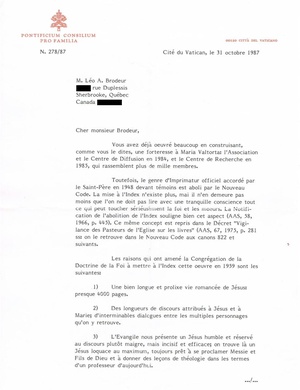
In 1987, Professor Léo A. Brodeur engaged in correspondence with his Canadian compatriot on several points relating to Maria Valtorta for which he was very committed; notably the canonical value of this verbal imprimatur. This issue had gained importance because after the death of Pius XII, the work of Maria Valtorta was placed on the Index. The canonical reason for this condemnation, now abolished, was precisely the lack of imprimatur. At the time of this correspondence, of which we only possess one letter, Cardinal Édouard Gagnon was president of the Pontifical Council for the family[6] and therefore sat in the Vatican.
This reply letter was provided to us by Paul-Claude Brodeur, his son with whom he collaborated. It follows a previous exchange, but the earlier letter received (February 5, 1987) from the Cardinal Édouard Gagnon, as well as those from Professor Léo Brodeur, have not been found.
Content[edit | edit source]
In this letter, Cardinal Édouard Gagnon, although "not personally acquainted with the work [of Maria Valtorta]," echoes what is said about it and merely reproduces the official Vatican documents, the only two authoritative documents at the time regarding the case of Maria Valtorta: her placement on the Index, commented on by an article in the Osservatore Romano, and the abolition of this procedure.
This was also the period when Cardinal Josef Ratzinger responded to Cardinal Siri by expressing, personally, his reluctance concerning the work of Maria Valtorta which he did not know. In this context, Cardinal Édouard Gagnon had every reason to warn Léo Brodeur. He does so, however, based on inaccurate assertions: the "kind of official Imprimatur granted by the Holy Father in 1948 before witnesses" is indeed valid according to the 1917 Code of Canon Law, but:
- It was not abolished by that of 1983, which reorganizes the procedure differently without abolishing the Pope’s primacy in the matter and especially without invalidating previous decisions.
- The abolition of the placement on the Index substitutes a "warning to the mature conscience of the faithful" but does not covertly maintain the condemnation, which would be a subterfuge.
This historical testimony reflects an expert individual opinion but not an exegesis of Maria Valtorta which he does not know.
Correspondence with Father Kevin Robinson of the FSSPX[edit | edit source]

In 1987, Cardinal Édouard Gagnon was commissioned by Pope John Paul II for a mission of evaluation and moderation of the Society of Saint Pius X (FSSPX) founded by Archbishop Marcel Lefebvre. The visit took place from November 8 to December 8, 1987. Perhaps he established ties or developed a particular reputation on this occasion because a few years later Father Kevin Robinson asked him about Maria Valtorta and the verbal imprimatur of Pius XII.
In his response dated January 3, 1992, written in Rome on the back of a postcard, he writes:
"I am not authorized to give an official judgment on the books of Maria Valtorta. You should write to Cardinal Ratzinger. One thing has been said several times by the Holy Office: that Pius XII never gave an Imprimatur.
I know many people with a good basic Christian formation who use M.V.'s interpretation as an aid for meditation on Scripture. But the danger is to give them the same value, or even a higher value, than Scripture, inspired by the Holy Spirit, where we find all we need to know the life and Passion of Christ.
If many requests are addressed to the Congregation for the Doctrine of the Faith (the Holy Office), they could clarify this position, which remains negative.
Fraternally in Jesus, Mary and Joseph,
Cardinal Gagnon (Via Porta Angelica, 31–00193 Rome, Italy)"
In this second correspondence, it can be observed that:
- He confirms the denial of encouragement by Pius XII by the Holy Office. Indeed, after the death of Pius XII, he proceeded to the reconstruction of the file: the Maria Valtorta file registered under number 355/45[7] under Pius XII, was renumbered 144/58[8] at his death.
- He acknowledges the spiritual fruits that Pope Francis will encourage in 2024.
- His position has slightly evolved compared to his 1987 correspondence with Léo A. Brodeur: while he still discourages the "risky" reading of Maria Valtorta, he has begun to inquire and advises more complete information to Cardinal Ratzinger.
What he does not know is that at that time Cardinal Ratzinger discovered the work of Maria Valtorta by reading articles published by Abbé Andrew the Apostle Richard in L'Homme nouveau, a French magazine he regularly read. He asked the editor-in-chief to suspend the dissemination of the work while verifying doctrinal conformity. This was done and resulted, a year later, in authorization to resume dissemination.
Notes and references[edit | edit source]
- ↑ ÉDOUARD GAGNON - Book censorship: historical and legal study of the canons relating to the prior censorship of books" - Québec, Université Laval, 223 f.
- ↑ Quoted by Father Oliva Melançon of the Congregation of Holy Cross, in his book Exorcism and powers of the laity, Benedictine edition, October 1996, page 17. "Consulted on this subject, Cardinal Gagnon, who already prepared a doctoral thesis in Canon Law on "Book censorship", considered entirely in conformity with the requirements of Canon Law "the kind of imprimatur granted by the Holy Father in 1948 before witnesses": which completely invalidated the subsequent condemnations made by a Roman Dicastery regarding the works of Maria Valtorta..."
- ↑ Fathers Andrea Cecchin, Corrado Berti, Romualdo Migliorini.
- ↑ GABRIEL M. ROSCHINI, The Virgin Mary in the work of Maria Valtorta, Kolbe ed. (Canada), 1983, p.7.
- ↑ The Maria Valtorta Research Center. Kolbe’s Publications: Sherbrooke, Canada, 1996. ISBN: 2920285009. Archived version online.
- ↑ Function he held for 16 years (1974 to 1990).
- ↑ 355th file of the year 1945 registered by the Holy Office. According to Alexis Maillard (work, p.6), it is about "fifteen centimeters thick" and is accessible since the opening of the archives of the pontificate of Pius XII (2020).
- ↑ 144th file registered by the Holy Office (which became the Congregation for the Doctrine of the Faith only in 1965) for the year 1958, the year of Pius XII's death. There is speculation about the reasons for this new numbering and its content. It is this new file that will serve for the placement on the Index (1959/1960) and will be the documentary basis for Cardinal Ratzinger (1985). According to the testimony of Fr. Berti, there seemed to be no actual trace of Pope Pius XII's intervention since Fr. Marco Giraudo, whom he met in December 1960, was unaware of it. It was upon learning of the existence of this verbal imprimatur that Fr. Giraudo prudently gave a "verbal" lifting of the Index."