


Holy Office, Brief Notices, (02/02/1949)
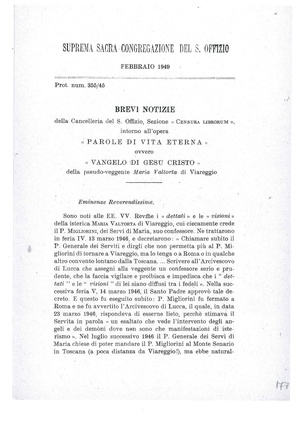
This internal report from the Holy Office, signed by Msgr. Giovanni Pepe, takes stock of the Maria Valtorta file as of February 2, 1949. It is extracted from the Vatican archives.
Context[edit | edit source]
As can be read, the Holy Office opened a file on Maria Valtorta as early as 1945, as indicated by the protocol number (355/45). At that time, the aim was not to evaluate the writings of Maria Valtorta, which were then just beginning to be written, but rather the personality of her confessor, Father Romualdo Migliorini. He was disseminating excerpts of her visions indiscriminately - and against Maria Valtorta’s wishes - and was misguided in his accompaniment of questionable mystics.
This attitude would cause a lasting hostile position by the Holy Office. According to Maria Valtorta, it was due to Cardinal Francesco Marchetti Saltvaggiani (1871-1951) who considered the priest "as dangerous, fanatical, agitator of souls, etc., etc."[1] and triggered his recall to Rome. This judgment reflected on Maria Valtorta’s visions, which would be labeled "hysterical."
Cardinal Marchetti Saltvaggiani was Secretary of the Sacred Congregation of the Holy Office. In this capacity, he directed its administrative and doctrinal work and was the interface between the Pope and the Congregation. He also supervised the examination of books, teachings, or practices suspected of heresy or doctrinal errors, in collaboration with the notaries (the body from which Msgr. Giovanni Pepe, who drafted the note, came) and the censors.
Text of the document[edit | edit source]
The French translation was made by Alexis Maillard in his book available online: Maria Valtorta The Vatican File.
SUPREME SACRED CONGREGATION OF THE HOLY OFFICE
FEBRUARY 1949 - Prot. No. 355/45[2]
BRIEF NOTE
from the Chancellery of the Holy Office, Section "Censorship of books," concerning the work "WORDS OF ETERNAL LIFE" or "GOSPEL OF Jesus CHRIST" by the alleged seer Maria Valtorta of Viareggio.
Page 1 of the original document
Most Reverend Eminences, The "dictations" and "visions" of the hysterical[3] Maria Valtorta of Viareggio, whom Father Migliorini, of the Servites of Mary, her confessor, believes sincerely, are known to Your Most Reverend Eminences. They deliberated on Thursday, March 13, 1946, and decreed: "Immediately call the Father General of the Servites and tell him not to allow Father Migliorini to return to Viareggio but to keep him either in Rome or in another convent far from Tuscany"... "Write to the Archbishop of Lucca[4] to appoint a serious and prudent confessor for the seer, who will supervise her and forbid and prevent her 'dictations and visions' from spreading amongst the faithful." The next day, Friday, March 14, 1946, the Holy Father approved this decision. And it was immediately carried out: Father Migliorini was held in Rome and the Archbishop of Lucca was informed, who on March 23, 1946, replied that he was happy about this, as he considered the Servite in question "an exalted person who sees the intervention of angels and demons where there are only manifestations of hysteria[5]." In the following July 1946, the Father General of the Servites of Mary requested permission to send Father Migliorini to Monte Senario in Tuscany (a few kilometers from Viareggio![6]), but naturally he received a negative response from the Holy Office. And Valtorta's exalted confessor remained in Rome.
Page 2 of the original document
But here, he made proselytes among his brothers: Fr. Andrea M. CECCHIN[7], Rector of the International College of St. Alexis Falconieri[8], and Fr. Corrado BERTI, he even dared to send to the Holy Father ten large volumes of Valtorta's "dictations" and "visions"[9], under the common title "Words of Eternal Life" or "Gospel of Jesus Christ[10]."
In his letter to His Holiness on June 19, 1948, Father Berti declares he spoke several times about these volumes with Father Bea, Rector of the Biblical Institute, who - always according to Berti - "is really favorable[11]". And this fact - he adds in the letter[12] - encourages me greatly." But is this fact true?
Father Gabriele ROSCHINI, Servite, Consultant to the Holy Office, in his written opinion for this Supreme Congregation [of the Holy Office] in 1946, judged the seer's dictations "of uncommon elevation, disproportionate to her culture and therefore attributed to supernatural causes: to God or to the angel of darkness disguised as an angel of light?" - he wondered[13][14].
Valtorta, for her part, in a letter addressed to the Holy Father on November 9, 1948, said: "I entrusted the writings to the Order of the Servites of Mary. They are responsible for the faithful transcription and present You with the volumes as they are transcribed[15]. Fathers Cecchin, Migliorini, and Berti thus carried out a mandate received from Valtorta, openly disobeying the Holy Office decree cited above of March 13, 1946, approved by His Holiness[16]. They even did more: they dared to request a special audience with the Holy Father! They obtained it on February 26, 1948, and asked the Grace to print the volumes of Valtorta's "dictations" and "visions." But His Holiness wisely ordered them to address an Ordinary[17] to obtain the Imprimatur for the publication of "Words of Eternal Life" or "Gospel of Jesus Christ," which was the object of their interest[18]. And they set out to find this Ordinary.
Page 3 of the original document
However, "having knocked in vain on the doors of many bishoprics" - these are the words of Fr. Berti in the letter he wrote to the Holy Father on June 29, 1948[19] including that of His Excellency Monsignor A. C. Camillo De Romanis[20], they thought of attaching the Imprimatur of their Servite brother Monsignor Barneschi, titular bishop of Tagaste and Apostolic Vicar of Swaziland (where Migliorini had been on a mission), thinking they could do so because the volumes would be printed at their Order's printing house in Rome.
In fact, this Imprimatur appears on page 32 of the promotional brochure, published by them as excerpts of the "dictations" and "visions" (Rome, Tip. Laboremus, 1948) and sent to many people to solicit subscriptions and advances amounting to 7,500 Italian Lire, the price of the whole work.
* * *
In the preface of the promotional brochure, the publishers say they must keep the name of the Author (the seer Maria Valtorta) secret and incognito and add: "We ask readers to do the same, without even trying to lift the veil of this delicate modesty" (page 5). Valtorta sacrilegiously puts a shameful way of speaking on the divine lips of Jesus in an essay of the "dictations" published in the Giornale d'Italia on October 14, 1948, regarding almsgiving to be done in secret: "Do not reveal - she makes the Divine Master say - your goodness, just as you would not reveal a maiden to the eyes of a crowd."
Also speaking of the Virgin Mary's relation with the Most Holy Trinity[21] - Maria Valtorta shows enthusiasm about the apparition at Tre Fontane[22]. In her journal of June 10, 1947[23] she writes: "The apparition of Tre Fontane is not unrelated to the Work" to be published[24]. Even the disciples of Dain Cohenel (Dolindo Ruotolo[25]) say in Naples that the book the statue of the Virgin of Tre Fontane holds in her hand is the Commentary on the Bible by Dain Cohenel, placed on the Index! Could the Bible that Valtorta reads be the voluminous work of the famous Neapolitan priest? Pares cum paribus facillime congregantur [26]!)
Page 4 of the original document
Valtorta states that "the Holy Trinity descended, dwelled with its Three Persons, enclosed its infinity in a small space (the womb of Mary); and it was not diminished for that, because the love of the Virgin and the will of God expanded this space until it became a Heaven! The Son taught Mary his truth and his wisdom 'while she was still just a seed growing in her womb'[27]."
Father Alberto VACCARI S.J. speaks with authoritative competence about the gross heretical absurdity of Valtorta who calls the Virgin "Second born of the Father..., because she comes second after the Son of the Father" [the "junior of the Father"][28], and of her endless errors in his opinion. We add here only that Valtorta sees the Most Holy Mary "in the Incandescent Triangle of the Most Holy Trinity" and warns: "Let the theologians understand what this vision means... Mary is embraced, I could say contained in the Most Holy Trinity, in which she was before time existed and whose tabernacle she was, containing within her womb the Father, the Son, and the Holy Spirit containing Jesus[29]. Revelation is her treasure... There can be no second Redemption to be accomplished by Jesus Christ; but there can still be one to save more spirits from the bonds of hell: that of glorious Mary"[30] [31].
"These news having been reported on Wednesday, November 24, 1948, their Most Reverend Eminences decreed: 'Make a recall (to the Father General or his representative) concerning Father Migliorini and C. [Cecchin?] in relation to Valtorta... Send the files to the Reverend Father Vaccari for his opinion... Meanwhile suspend the collection of memberships and subscriptions for the work.' The Holy Father, the following Thursday, November 25, 1948, approved the decree; and it was immediately executed. But meanwhile, questions, astonishment and scandal, protests rained from all sides in Italy to the Holy Office[32], concerning the oddities published and widely distributed in the famous promotional pamphlet "Words of Eternal Life" and in a new article of the Giornale d'Italia published, despite the warning given, on Christmas Eve 1948, with this brief warning: "The author is a Christian who wishes to remain anonymous, because the truths of faith have no other author than God[33]."
Page 5 of the original document
Father Migliorini, recalled to order, defends himself by writing in a memorandum[34] that "he is neither directly nor indirectly in epistolary contact with the writer. The parts of the work written after his departure (from Viareggio) were not added to the rest by his intermediary, at his request or on his advice."
Fr. Cecchin and Fr. Berti (the latter shuttling between Rome and Viareggio)[35] sent to the Holy Father a statement from Mr. Barilari and G. Milani, associates of the Servites in the publishing house of Valtorta’s work, in which they say: "We have made moral and material commitments, which puts us in considerable difficulties… Many people harass us every day, asking when publication of the Work will begin. And just as great is our embarrassment toward those who entrusted us money for a publication everyone desired and considered imminent, the reviewers (the Servites Fr. Roschini, Fr. Rocca, clergy examiner at the Vicariate), His Excellency the Bishop of Sora, etc., having declared themselves favorable to the publication of the first volume they examined[36], and many other priests and laity, pious and learned, having spoken favorably about publishing the entire Work whose various volumes they had read." They request to be allowed to publish the first three volumes, or at least the first, of the work in question. For her part, Valtorta - no longer as "spokesperson for Jesus," as she previously dared to call herself, but in the name of the Eternal Father - dares to say with reckless audacity to His Holiness:
"Invoke my Spirit and read. Read what can enlighten you[37]… The Church of my Christ, incorrectly interpreting the word of its Divine Founder, believes it is so strong and so invulnerable so as to no longer take care to practise those actions which would make them friends of God. This is true of the vast majority of its members, and even among its elite members. It presumes. It feels itself superior to everything and everyone. It says, “I am established. Nothing will prevail against me.”[38][39]
Page 6 of the original document
"No. Know how to understand the word of God. Don’t fall again into the errors willed by the ancient scribes who wanted to interpret God’s prophecies and promises according to what pleased their own foolish pride as the Chosen People."
"Sebna’s time dominates. Thrown like a ball into the uncontrolled crowds. I have said this for years to my spokesperson so it could 23.12.48 reach you. This is what I say to You today, Vicar of my Christ and my servant.
If You had rejected the means (that is Maria Valtorta), you would have sinned. You would not have hurt him; he is innocent. You would have hurt Me, We, who are one God in Our wonderful Trinity, and sinned against Love. That’s because Love, our Triune Love, wanted to give this Pontificate the Word of God. If you resist my Will to love, you will repeat the gesture of the Princes of the Priests, of the Sanhedrin, the Pharisees and Scribes…"[40]
* * *
And that is enough. However, may it at last be permitted for the humble Reporter of these Brief News to observe: since Valtorta's original manuscripts were not presented to His Holiness, but only their typewritten copies by the cited Servite Fathers, who can say if this copy "faithfully" reflects Valtorta’s "dictations" and "visions," or if, on the contrary, the whole original work is not rather a multiple and simultaneous drafting by the Seer and her admirers, the Servite typists? Could the Holy Office, with authority, not demand the intact and complete original manuscripts, with all marginal glosses, additions and corrections, in order to submit them to a thorough and thoughtful examination by patient and competent scholars?[41]
Your Most Reverend Eminences will say so by their wise and prudent judgment.
Rome, February 2, 1949.
Sac. (Sacerdos = priest) GIOVANNI PEPE.
Notes and references[edit | edit source]
- ↑ Letter from Maria Valtorta to Mr. Arturo Bottai, February 18, 1950 (still unpublished).
- ↑ Numero di protocollo in Italian, Numerus protocolli in Latin. This is the constant reference for tracking and archiving all parts of the "Maria Valtorta" file (no. 355) opened in 1945.
- ↑ In his report, however critical, Father Augustin Bea would reject this label originating from Alberto Vaccari: one cannot call Maria Valtorta hysterical.
- ↑ Msgr. Antonio Torrini, Archbishop of Lucca from 1928 to 1973.
- ↑ This remark concerns Father Romualdo Migliorini. The judgment on the seers he accompanied is here applied indistinctly to Maria Valtorta. However, at that time, Maria Valtorta warned her confessor not to be misguided in accompanying two questionable mystics.
- ↑ 100 km, however. Monte Senario, near Florence, is the spiritual high place of the Servites. The seven founding saints retired there. See the section in the Communities under the General Prior, Servites of Mary site.
- ↑ The cause for beatification of Father Andrea M. Cecchin (1914-1995) was opened by the Diocese of Vicenza and the Servite Order on March 23, 2002. For Don Giuseppe Busato who wrote his monograph on saints and blesseds, "His memory remains blessed as that of a saint."
- ↑ This college is named after one of the seven founding saints of the Servite Order. In 1950 this school became a Theological Faculty (Father Corrado M. Berti taught there); it was definitively approved in 1955 under the title "Marianum" and was promoted to a pontifical theological faculty in 1971.
- ↑ It was not the "exalted confessor" of Valtorta (Father Romualdo Migliorini) who sent the typed manuscripts of the work, but Father Corrado Berti.
- ↑ This confirms that the work of Maria Valtorta now known as The Gospel as Revealed to Me was initially named "Vangelo di Gesù Cristo come rivelato al piccolo Giovanni (The Gospel of Jesus Christ as revealed to little John)'." In 1948, Father Romualdo Migliorini, who typed the copies, thought it good to change the title according to a suggestion of Jesus. He adopted “Parole di vita eterna (Words of Eternal Life)” with the subtitle “La Buona Novella spiegata ai piccoli del gregge di Gesù (The Good News explained to the little ones of Jesus' flock)'." These two titles were known by the Holy Office. See Successive Titles of the Work, note no. 1.
- ↑ Indeed, at first (January 23, 1952), he publicly showed support for this work which displayed remarkable knowledge. However, he did not declare it a work of divine origin and found the long descriptions superfluous. But a few months later (October 17, 1952), further studying the work, he judged it ambiguous and ambivalent and recommended not to publish it.
- ↑ Original document note: document No. 38 from File 355/45.
- ↑ Original document note: January 1946 opinion, page 5.
- ↑ Msgr. Giovanni Pepe biased against. Father Roschini wrote in his conclusions (August 27, 1946): "I found nothing contrary to faith and morals. On the contrary, I found a breath of great spirituality and an unusual power of reconstructing Gospel scenes", which distance the work from the Satanic inspiration Msgr. Pepe attempts to inculcate.
- ↑ Original document note: document No. 31 from File 355/45.
- ↑ Presumed personal approval totally at odds with what followed: Pius XII could not have openly received publicly disobedient persons in audience and encouraged them to continue publication (seeking imprimatur), supposedly harmful. It is therefore an "approval" by the Secretariat of State, at best.
- ↑ An Ordinary refers to the diocesan bishop responsible for the action here, the imprimatur. According to the 1917 Code of Canon Law, it was the bishop of the place of residence of the author (Maria Valtorta), her publisher or printer.
- ↑ A typically subjective wording aimed at influencing the reader. A neutral wording would have said: "They requested an audience with the Holy Father, which they obtained on February 26, 1948, to seek permission to print volumes containing the 'dictations' and 'visions' of Maria Valtorta. The Pope invited them to approach a diocesan bishop to obtain the necessary Imprimatur for the publication of the work, titled 'Words of Eternal Life' or 'Gospel of Jesus Christ'."
- ↑ Original document note: document No. 39 of the same File.
- ↑ Between 1948 and 1950, Msgr. Alfonso Camillo de Romanis (1885-1950) held the post of Vicar General of His Holiness for the Vatican City (in Italian, vicario generale di Sua Santità per la Città del Vaticano). This position made Msgr. De Romanis the Pope's direct representative for ecclesiastical jurisdiction in the Vatican State. He also had the role of sacristan of the Apostolic Palace. In this capacity, he managed the preparation of major international liturgical events, with an exceptional influx of pilgrims and ceremonies in St. Peter's Basilica. If Msgr. de Romanis declined the imprimatur of Maria Valtorta's work, it was for a trivial reason that Maria Valtorta reveals in her Letters to Mother Teresa Maria, Vol. 2, June 4, 1950, p. 310: "They even go so far as to prevent many souls from finding God and growing in divine life by their sordid feelings of envy and... profit. 'If you give me 200,000 lire, I approve,' said Msgr. Traglia in 1946. 'I approve if you give me 250,000 lire,' said Msgr. De Romanis in 1948, now deceased." As a reference, 250,000 Italian lire of 1949 corresponded to 192 days of an industrial worker's wage. This was for obtaining the imprimatur.
- ↑ Original document note: "Words of Eternal Life," volume 1, 1 and nos. 32-33 and 40 of the cited File.
- ↑ These same apparitions (whose worship is authorized) were the cause of the falling-out between Pius XII and Luigia Sinapi, a seer who had free access to the Pope. Msgr. Giovanni Pepe lumps Maria Valtorta, Tre Fontane, and Dain Cohenel (Dolindo Ruotolo) together in his aversion.
- ↑ Original document note: document No. 32 already cited.
- ↑ "On 10 June my cousin, Giuseppe, my guest brought me a copy of “Oggi”. I flip through it . I find a longer version of the story of the apparition. I give a start when I read the phrase : «I am She who is in the Divine Trinity. I am the Queen of Revelation». Because these same words were dictated to me by the Most Holy Mary in one of my first meetings with Her, and remained fixed in my mind, like other special phrases such as: «I am the compendium of the love of the Three» said by Jesus Christ, and «God’s vendetta is forgiveness» said by Jesus Christ, just to give examples. I feel even more stongly that the Apparition at Tre Fontane is not unrelated to the Work which the Most Holy Jesus would like from the Servites of Mary R. P. S. of M. if... (then, in June the conditions existed. Now they don’t, thanks to God’s grace!)." The Little Notebooks, November 9, 1947.
- ↑ The Servant of God Dolindo Ruotolo (1882-1970) was indeed put on the Index in 1940 (G. Pepe was in office). But in 2021 his cause for beatification was introduced by Msgr. Domenico Battaglia, Metropolitan Archbishop of Naples. The Family Missionary of Our Lady, which supports his cause, reports this customary phrase of Padre Pio: "Why do you come here? You have a great saint in Naples, Dolindo, go to him!" Thus it is a cohort of saints (D. Ruotolo is not yet one), sanctioned by the Holy Office of that time. On the occasion of the centenary of the Pontifical Biblical Commission (PBC), Father Dolindo's contribution was highlighted and described as a prefiguration of Pius XII's biblical encyclical Divino Afflante Spiritu (1943).
- ↑ Like attracts like!
- ↑ GRM 1.2.
- ↑ Original document note: Page 1 of vol. 1 of the work "Words of Eternal Life," typed manuscript. This opinion of Fr. Alberto Vaccari, which Msgr. Giovanni Pepe emphasizes ("a heretical absurdity"), is completely contradicted by the authorized comments of the Blessed Dom Prosper Guéranger: "Mary was therefore present like Jesus in the divine decree before creation came out of nothing."
- ↑ See the comments on this passage. Notebooks 1945-1950, October 24, 1947.
- ↑ Original document note: Documents No. 32-33 of File 355/45 already cited.
- ↑ This announcement corresponds to that of the "Virgin of the Last Times" prophesied by Saint Louis-Marie Grignion de Montfort (+1716) and actualized in Maria Valtorta. This expression designates Mary as she will be manifested to the Church in times of crisis preceding the final triumph of Christ: a Virgin better known, more loved and more followed by her “apostles of the last times,” called to renew faith and prepare the reign of Jesus Christ. Cf. Saint Louis-Marie Grignion de Montfort, Treatise on True Devotion to the Holy Virgin, nos. 55-59, 217-218: he describes the prophetic mission of Mary in the last times and the call of the "apostles of the last times" raised to prepare and strengthen the kingdom of Christ. See also René Laurentin, François-Michel Debroise - The Virgin of the Last Times A stage of the end of the world, From Grignion de Montfort to Maria Valtorta, Salvator Ed., 2014.
- ↑ Militant emphasis.
- ↑ Maria Valtorta, by Jesus’ request, was to remain anonymous as long as she was alive.
- ↑ Original document note: Document No. 54 of the cited file.
- ↑ Original document note: Document No. 52 of the same File: "During my last visit - he writes on November 10, 1948 - I found her (Valtorta) perfectly informed of the configuration and various decorations of the cemeteries" etc. of Rome, "good that she went there 20 years ago." For him, it is a miraculous phenomenon!,
- ↑ confirmation of the words of Msgr. Michele Fontevecchia, Bishop of Sora: he was ready to grant the imprimatur and was prevented by the Holy Office. The work had been examined by Msgr. Ugo Emilio Lattanzi, dean of the Pontifical Lateran Faculty.
- ↑ The Little Notebooks, December 23, 1948, 11 p.m. The omitted, prophetic passage says: "Hell is coming closer. In the Church (for Church I mean the community of all catholic Christians) of my Christ there is no longer that holiness which would spur the God of Victories to send his angels to defeat the demons." By "Church" is meant the society of all Catholic Christians, notes Maria Valtorta. God the Father sets Maria Valtorta's work as an antidote to this situation confirmed by the contemporary era.
- ↑ In an omitted passage in this citation, God the Father explains: "Hell prevails more or less, depending on whether the Church [the society of all Catholic Christians, notes Maria Valtorta] loses its holiness, which diminishes God's help. 'It is always prevailing, even if not destroying.' Yet, in all its secular life, the Church never knew such a moment of weakness - when it is not corruption, triple corruption - and such an assault from Hell."
- ↑ Analysis by Magisterium AI: "The assertion of private revelation highlights a potential tension between the divine and indefectible nature of the Church and the human reality of its members, who are always called to conversion and humility. While the Church, as a divine institution, is assured of the final victory of Christ and its perseverance until the end of times, its individual members, including the most eminent, are always subject to human weakness and the temptation of presumption. The Church is indeed 'established' by Christ and 'nothing shall prevail against it' in its divine essence and salvific mission. However, this does not exclude the constant need for its members to practice humility, prayer, charity, and penance, to live fully their vocation to holiness and to manifest God’s friendship in the world. The critique contained in the assertion may serve as a reminder of vigilance and fidelity for all members of the Church, so they do not fall into complacency or pride, but always strive to live according to the Spirit of Christ."
- ↑ Original document note: documents Nos. 60 and 61 of the cited file
- ↑ Strange request: Msgr. Giovanni Pepe has not ceased to demolish the "alleged seer" since 1946. Why examine the manuscripts since the matter is decided with the agreement of the Holy Father, besides? Does he want to demonstrate that Pius XII was deceived by an original improved by the Servites, which would explain his approval? But that is what he just demonstrated "with the agreement of the Holy Father"! Yet the research he suggests implicitly shows that Pius XII found nothing wrong, while the Holy Office finds a mass of dangerous nonsense. Or else, having found no serious reason for condemnation despite all his efforts, he hopes to find some among the manuscripts. This fictitious scenario will remain until the placing on the Index: the article of the Osservatore Romano will maintain the thesis of a Servite conspiracy to explain the theological value it cannot stifle.