


Father Corrado Berti: sworn statement (1978)
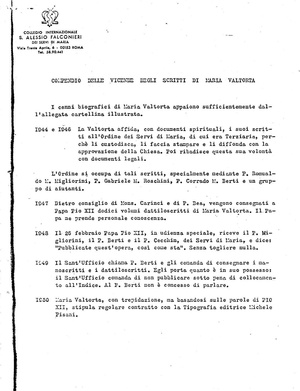
This sworn declaration of Father Corrado Berti attests to the events in which he was a central actor: audience with Pope Pius XII, dealings with the Holy Office, placement on the Index, dispute with the secretariat of Paul VI, ... He concludes with an inventory of Maria Valtorta's writings in 1978. It thus covers a period of thirty years. It is the second of the three testimonies he published. The first is the text of his conference in 1970 in Rome, and the last his article published in Rivista di ascetica e mistica (Vita Cristiana) in 1980, the year of his death.
The detailed exposition is preceded by a summary of the events. It is made on the letterhead of the pontifical faculty where Father Berti was professor.
COLLEGIO INTERNAZIONALE
S. ALESSIO FALCONIERI
DEI SERVI DI MARIA
Viale Trenta Aprile, 6 - 00153 ROME
Tel. 58.90.441[1]
English text of the initial summary[edit | edit source]
This summary occupies pages 1 and 2.
COMPILATION OF EVENTS (RELATED TO) THE WRITINGS OF Maria Valtorta The biographical notices of Maria Valtorta seem sufficiently illustrated by the attached file.[2]
In 1944 and 1946: Valtorta entrusted spiritual documents and her writings to the Order of the Servites of Mary, of which she was a tertiary[3] so that they could keep them and have them printed and distributed with the approval of the Church. Later, she officially reiterated this wish.
The Order took care of these writings, particularly Fr. M. Romualdo Migliorini, Fr. Gabriel M. Roschini, Fr. Corrado M. Berti and a group of collaborators.
1947 - On the advice of Monsignor Carinci and Father Bea[4], twelve volumes of Maria Valtorta’s typed manuscripts were transmitted to Pope Pius XII. The Pope personally read them.
1948: On February 26, Pope Pius XII received Fr. Migliorini, Fr. Berti and Fr. Cecchin, Servites of Mary, in a special audience and said: "Publish this work as it is" without removing anything.
1949: The Holy Office summoned Fr. Berti and ordered him to hand over the manuscripts and typescripts. It retained everything: the Holy Office ordered them not to be published under penalty of placement on the Index. Fr. Berti was not authorized to speak.
1950: Maria Valtorta, apprehensive but confident in the words of Pius XII, concluded a formal contract with the Michele Pisani editions.
1956 - 1959: Release of the first edition, without notes and very imperfect, of the Life of Jesus provisionally entitled: "The Poem of the Man-God."
January 6, 1960: The Holy Office places this work on the Index of prohibited books, not for doctrinal errors, but because of disobedience to the order given in 1949.
1963: Msgr. Macchi, secretary of Pope Paul VI, told Fr. Berti, during a meeting, that the above-mentioned Poem is not on the Index.
1960 - 1967: Release, in ten annotated volumes and faithful to the originals, of the second edition of "The Poem of the Man-God."
1961: The Holy Office authorized this second edition.
1966: Paul VI abolished the Index.
1969 - 1977: Publication of three spiritual writings and the Autobiography of Maria Valtorta.
1978: Still unpublished remain: certainly 282 spiritual chapters. Possibly a copious correspondence. Possibly a collection of testimonies both from personalities of the Holy Office and from laypeople.
Meanwhile, the published writings of Maria Valtorta have been widely disseminated in Italy and everywhere there are priests who studied in Rome and Italian emigrants. Many translations are made or planned. Some volumes already published.
Rome – December 8, 1978
Solemnity of the Immaculate Conception.
English text of the sworn declaration[edit | edit source]
This exposition covers pages 3 to 17.
Maria Valtorta (1897-1961) THE LIFE OF Jesus ENTITLED "IL POEMA DEL UOMO-DIO"
AND OTHER MYSTICAL WRITINGS
EXPOSITION
1. Biographical notes[edit | edit source]
"For all those who want to know more about Maria Valtorta, biographical notes about her are sufficiently available in her Autobiography (briefly treated in no. 12 below). Also, one can read the article by Renzo Allegri, which appeared in the August 26, 1978 issue of the Italian magazine Gente, pp.52-57[5]. It is remarkably well done. Its imperfections are only marginal. Finally, one can read the more detailed volume on the person and writings of Maria Valtorta, written and published by Dr. Emilio Pisani, in 1976, pp.46[6].
2. The Order of the Servites of Mary (OSM).[edit | edit source]
"In 1944 and 1946[7], Maria Valtorta, infirm, entrusted her spiritual writings, and later legal documents, to the Order of the Servites of Mary[8], of which she was a tertiary, so that they could preserve them, print and disseminate them, with the approval and blessing of the Church, to which she was very attached.
"The Order of the Servites of Mary itself took care of her writings, particularly through three of its priests:
Fr. Romualdo M. Migliorini, spiritual director for four years of Maria Valtorta, then infirm, who typed her writings;
Fr. Corrado Berti, who wrote the theological notes,
and Fr. Gabriele M. Roschini, who authored a work entitled: The Virgin Mary in the writings of Maria Valtorta, preceded by an interesting introduction on the phenomenon.
"These last two priests were professors in Rome, at "Marianum", Pontifical Faculty of Theology.
"Some priests of the Order administered the holy sacraments to Maria Valtorta. Others helped Father Berti, who had in the meantime become old and suffering[9].
3. His Holiness, Pope Pius XII[edit | edit source]
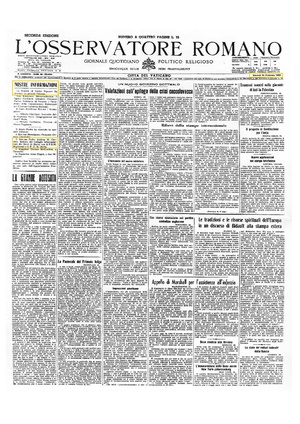
"Since Maria Valtorta’s writings appeared as emanating from supernatural visions and dictations, Father Corrado M. Berti, already mentioned, sought advice from two very experienced persons: His Excellency Msgr. Alphonse Carinci, secretary of the Sacred Congregation of Rites and vicar for Causes of Saints, and Msgr. Augustin Bea[10], SJ, confessor of Pope Pius XII and Rector and professor of the Pontifical Biblical Institute of Rome. They advised him to type copies of these writings and send them to His Holiness Pope Pius XII through a prelate of the Secretariat of State[11].
"Pius XII personally read these writings, as I was assured by the bearer himself of the typescript[12]. And on February 26, 1948, the Sovereign Pontiff received in a special audience - attested by L'Osservatore Romano of that day – Father Corrado Berti accompanied by two confreres: Father Romualdo M. Migliorini, former apostolic prefect in Africa, and Father Andrea M. Cecchin, prior of the International Order of Servites of Mary in Rome, and [the Pontiff] spoke the following words verbatim: "Publish this work as it is, the one who reads will understand." And he added: "There are so many visions and revelations talked about, I do not say all are true, but some of them could be true".
"Father Berti asked the Pope if the mentions: "visions" and "Dictations" [of the poem before publishing] should be removed. And he replied that nothing should be taken out[13]. As soon as the three priests left the papal audience, they stopped on the stairs and wrote on a paper the Pope’s words verbatim so as never to forget them.
4. The Holy Office[edit | edit source]
"But in 1949, the Holy Office, of which Cardinal Alfredo Ottaviani later became secretary[14], and Msgr. Pietro Parente assessor[15], summoned the general procurator of the Order of the Servites of Mary and Father Corrado M. Berti, considered the main instigator[16].
"Msgr. Pepe and Father Berruti, OP, responsible for the Holy Office, read the judgment [of the Holy Office] and wanted Father Berti to sign it.
"By this decision, they ordered Father Berti to deliver to the Holy Office all manuscripts and typed copies of Maria Valtorta to obviously destroy them or keep them locked away forever: "Here, they will remain as in a tomb," declared Msgr. Pepe.
"Father Berti handed over all typed documents in his possession, but he could not give manuscripts, kept by the writer [Valtorta], nor deliver all the typed copies [some were] possessed by others who refused to part with them[17].
"Moreover, and finally, the Holy Office forbade the publication of the work, threatening to place it on the Index in case of any publication.
"Father Berti could not reveal to the Holy Office the words said by Pope Pius XII at the audience, because he was not allowed to speak. He was only allowed to listen and sign the judgment, without comments. Such were the methods of the time before the Council [Vatican II].
"The Holy Office, however, was lenient towards the infirm Maria Valtorta and did not notify her of the judgment.
"She necessarily learned it from Father Berti and was upset. Her condition worsened.
5. Attempts at appeal[edit | edit source]
"To console Maria Valtorta - whose condition was worsening - Father Berti pointed out to her that the Pope was above the Holy Office, and that the Pope’s word ("Publish it") was of greater value than that of the Holy Office: "It is forbidden to publish it"). But the writer [Valtorta] remained perplexed and feared the placement on the Index and excommunication[18].
"Therefore, she wished and requested an appeal so that the sentence of the Holy Office would be revoked.
"Some made appeals to this Congregation, but in vain. The response was: "Id quod prius melius[19]". In other words: "Let what has been decided before rest."
"Maria Valtorta then expressed the desire that the appeal be attempted to the Holy Father himself, Pius XII, who in 1948 had said "Publish it".
"Msgr. Alphonse Carinci, archbishop, secretary of the Sacred Congregation of Rites, friend, protector, admirer of the person and writings of Maria Valtorta, went more than once to visit her and promised an appeal to the Pope and certified in writing what the Pope had decided in the audience.
"When Father Bea, SJ (mentioned above), saw and read the attestation of Msgr. Carinci, he wanted to write his own, very favorable, in which he compared Valtorta to the mystic Anne-Catherine Emmerich.
"After Father Bea, Msgr. Lattanzi, dean of the Faculty of Theology at the Lateran[20] and consultant to the Holy Office, also wrote a favorable attestation, as did Camillo Corsanego, legal advisor, dean of consistory counselors for the Holy See and professor at the Lateran.
"All these attestations were attached to that of Father Gabriel M. Roschini, OSM, renowned mariologist of "Marianum", the Pontifical Faculty of Theology of the Lateran.
"Msgr. Carinci wanted to present to His Holiness Pius XII photocopies of these attestations during an audience. But such an audience did not take place in 1950, given the workload caused by the Holy Year.
6. Publication of the first edition of the Life of Jesus, entitled "The Poem of the Man-God"[edit | edit source]
"Meanwhile, months went by and Father Gabriel M. Roschini, OSM, consultant to the Holy Office, who knew Maria Valtorta and was an admirer of her mystical writings, insisted to Father Berti: "Go to the Pisani publishing house!"
"Meanwhile, since Fr. Roschini had been appointed to the Holy Office, Father Berti thought the Dicastery had become favorable to the publication [of the Poem].
"So, one day he went to Isola del Liri, in the province of Frosinone, where he met Mr. Michele Pisani, owner of the publishing house, who, after quickly becoming familiar with Maria Valtorta, whom he visited, and with her writings, decided to print them.
"Fr. Berti feared the Holy Office. Maria Valtorta was terrified and did not want to lend the typed documents and authorize printing. But she later decided to conclude a standard contract with Michael Pisani, who declared again that he had no doubt about the outcome of the work, encouraged by his friends.
"The first edition of The Life of Jesus thus came out, provisionally titled The Poem of the Man-God, but without any notes [theological], without any introduction, with modest typography, and in four volumes that were too bulky. But all this was published in 1959[21].
7. Placement on the Index of prohibited books[edit | edit source]
"But the Holy Office had not forgotten its command: the prohibition and threat pronounced in 1949. And on January 6, 1960, the Holy Office placed the first edition of the Poem ... on the Index of prohibited books.
"L'Osservatore Romano, in an article on that day, justified the said condemnation, not for doctrinal errors, but for the offense of disobedience[22]. But in truth, there was no disobedience, since Pope Pius XII in 1948 said: "Publish [the work] ", and only the Bureau of the Holy Office, to whom it had been submitted, strangely forbade its publication[23].
"That being said, the first edition spread, was appreciated, and many readers sensed the hand of God in it.
8. Second edition of "The Poem of the Man-God"[edit | edit source]
"Mr. Michele Pisani was not impressed by the placement of the above-mentioned Life of Jesus on the Index. But feeling somewhat aged and ill, he entrusted the task of publishing the writings of Maria Valtorta to his son, Dr. Emilio Pisani, a lawyer, then in the prime of life.
"It was then that Pisani editions, with total confidence in God's help and in the future, conceived and decided to publish a second edition of the poem, with better binding, better paper, clearer and more modern typography, and in less thick volumes. In addition, Dr. Emilio asked Father Berti to provide explanatory notes for the more difficult passages for the new edition and to highlight the biblical foundations of the Work. The edition was also illustrated by Lorenzo Ferri, under the personal direction of Maria Valtorta.
"Thus, this work on the Gospel, in ten volumes, with an introduction and notes, came out attractively for everyone.
"The Father Gabriel M. Roschini, mentioned above, consultant to the Holy Office, repeatedly stated that such a new edition could no longer be considered placed on the Index, since totally renewed, entirely conforming to the original, and providing notes that removed any ambiguity and demonstrated the orthodoxy of the work.
9. Attempted audience with Pope Paul VI[edit | edit source]
"Father Berti was nevertheless still worried and very anxious about the placing on the Index of the Poem, even if it was only for the first edition.
"Conscious that he had overcome the first decision and confident in the safety of the second edition, he requested an audience with Msgr Pasquale Macchi, private, faithful, and dynamic secretary of Pope Paul VI. (1963).
"Msgr. Macchi held a cordial conversation with Father Berti for about an hour during which it was said and repeated with lively astonishment that the work (of Maria Valtorta) was not on the Index and that the pope [Paul VI], when archbishop of Milan, had read one of the volumes, enjoyed it and sent the entire work to the Seminary [of Milan].
"The secretary accepted the various volumes of the second edition, which had come out in the meantime, but after a few days, he diplomatically returned them to Father Berti with a note suggesting that [Fr. Berti] send them himself to the Secretariat of State, if he wanted to appeal to His Holiness in person. Thus, the desire and project for an audience with Paul VI evaporated.
10. The Holy Office authorizes the second edition[edit | edit source]
"In December 1960[24], Father Berti was called to the Holy Office where he was very kindly received by Father Marc Giraudo, OP, commissioner of this Congregation.
"Father Berti, seeing that this time he could calmly dialogue, related to the commissioner the words ("Publish [the work]") pronounced in audience by Pope Pius XII in 1948, and brought photocopies of attestations on the life of Jesus [i.e. The Poem...] by Maria Valtorta. Three of these attestations proved to be established by consultants of the Holy Office: that of Father [later cardinal] Bea, SJ, that of Msgr. Lattanzi and that of Father Roschini, OSM.
"Father Giraudo, who knew nothing of the words of Pius XII[25] and of these attestations from these three persons from the Holy Office itself, received Father Berti several times afterwards. After consulting his superiors and reflecting on the attestations, he pronounced the words: "Continue publishing this second edition. We will see how the world receives it."
"And that is how The Poem was published, and continues to be published, not only by order of Pius XII, but also with the approval of the Holy Office (1961)[26].
11. Abolition of the Index of prohibited books[edit | edit source]
"But in 1966, Pope Paul VI, who continued the ecumenical Vatican II Council to its completion, reformed the Roman liturgy, deeply renewed the Curia including the Holy Office, also made the courageous act of abolishing the Index of prohibited books on which The Poem written by Maria Valtorta had strangely been placed. Thus, from 1966, The Poem ... was free from any ecclesiastical sanction.
"Perhaps it was to this [papal] act, known only to him at the time, that Msgr. Macchi was referring, when, during his meeting, he affirmed to Father Berti that the poem was not on the Index.
"Some readers have hypothesized that Paul VI abolished the Index to free The Poem in a dignified manner. But it is not known if this hypothesis, which is not impossible[27], is founded. It is therefore wise not to consider it certain.
12. Maria Valtorta’s writings in 1978[edit | edit source]
"The first published work was the Life of Jesus. It was initially entitled: "The Gospel of Our Lord Jesus Christ, as revealed to little John". This name “little John”[28] established a comparison between Maria Valtorta and John, the great apostle and evangelist, and at the same time distinguished her from him, simultaneously indicating her humility and inferiority. But this title seemed somewhat imprudent to Maria Valtorta who imagined several others without being satisfied with any of them.
"Subsequently, the great doctor, Professor Nicholas Pende, admirer of Valtorta and her writings, suggested the title "Poem of Jesus". But since this title already existed for a small poetic composition, and its author protested, [the title] was modified by Fr. Berti to: "The Poem of the Man-God". Thus formulated and modified, it suited Maria Valtorta herself who approved it and made it her own.
"Two very different editions of this Life of Jesus [The Poem...] were published. The first, printed in 1956-59 [as indicated above], was very modest: four volumes too thick, without introduction, lacking the most cautious notes. It was imperfect even regarding the text, because it did not directly reproduce the Valtorta manuscript, but a very unfaithful and incomplete typed copy. This was the edition that faced the difficulties described above.
"The second edition was printed, under the direction of Dr. Emilio Pisani, in the 1960-67 years in ten handy volumes, composed based on a strict comparison with Maria Valtorta’s original manuscript and provided with thousands of theological notes, especially biblical, prepared by years of intense work of Father Corrado M. Berti of the Order of the Servites of Mary, professor at "Marianum", the Pontifical Faculty of Theology in Rome.
"This second edition is the one that faced no difficulties but had been authorized in 1961 by the Holy Office itself (now called the Sacred Congregation for the Doctrine of the Faith), as reported above in these pages in § 10.
"This edition has been reprinted several times. Considering these reissues, those who do not take into account that a rewriting is needed to speak of a new edition most often speak of a third and fourth edition.
"The second doctrinal printed work (1972), and so far in a single edition but widely disseminated and appreciated, is the Book of Azariah. This volume was originally entitled "angel Masses", that is, Sundays and festive Masses, enlightened under the dictation of Azariah, Maria Valtorta’s guardian angel according to what she says. But to exclude the possibility of misinterpretation, namely that angels celebrate the Holy Mass as priests do on earth, among the different potential titles, and after reflection and prayer, the title "The Book of Azariah" was chosen, out of deference for the angel to whom Maria Valtorta attributed the Dictation.
"The third doctrinal work published, contained in a thick volume of 800 pages, was published in 1976 and titled by the publisher, Dr. Emilio Pisani: "The Notebooks of the Year 1943", precisely because it contains all the Dictations written by Valtorta in 1943. The Poem, on the contrary, contains "visions" and "dictations" written mainly between 1944 and 1947[29].
"The fourth doctrinal work, of 300 pages, published in 1977, bears the title given by Valtorta herself: "Lessons on Paul's Epistle to the Romans". Maria Valtorta wrote these lessons between 1948 and 1950, under the dictation, she says, of her gentle host or her Most Holy Author, who is the Holy Spirit. The volume has a very useful index of topics, as is the case with the Notebooks of the Year 1943.
"To these four works, already published and attributed by Maria Valtorta to supernatural visions and dictations, one must add her Autobiography, composed by Maria Valtorta in 1943, with her sole authorial talent to obey a request by her spiritual director[30]. The volume, about 450 pages, was published in 1969.
13. Translations[edit | edit source]
"Only, to date[31], the major work, The Poem, has been translated into Spanish, French, and German. A Spanish one-volume translation has come out, which gathers two volumes of the original Italian.
"A florilegium has also been published in Japanese, which sold more than 8,000 copies in a few weeks.
"Finally, currently, there has been a volume published in Portuguese, with Imprimatur, gathering the Passion, Death, and Resurrection of Jesus.
"Other translations are planned or in preparation, with some volumes in French ready to be released soon.
"The original [Italian] of Maria Valtorta’s work is already widely circulated in the world, through some good priests who came to study in Rome and [also] by Italians who emigrated by millions and settled all over the world.
14. The unpublished writings of Maria Valtorta (1978)[edit | edit source]
"There still remain to be published[32] Visions and dictations from the years 1944, 1945, 1946, 1947 and 1953. Among these visions are those of the martyrs of various saints, some known, others unknown or disputed.
"Then, as was done for Saint Catherine of Siena[33] to better know the person, there remain perhaps nearly 2,000 pages of letters written by Maria Valtorta to various people, and by them to her.
"Finally, many attestations could be published (about one hundred pages) about the person and writings of Maria Valtorta. Some of them are of great value, such as those of Father [Cardinal] Augustin Bea, SJ, Msgr. Hugo Lattanzi, Msgr. Alphonse Carinci, Fr. Gabriel M. Roschini, and some other lay scientists.
Conclusion[edit | edit source]
"I knew Maria Valtorta since 1946, and, considering that she lived quite close to my mother, I often met her, at least once a month until the year of her death in 1961.
"I have read and annotated (by myself from 1960 to 1974, with the help of some confreres from 1974) all Valtorta’s writings, published and unpublished.
"I can certify that Valtorta could not have, by her own efforts, possessed the vast, deep, clear, and varied erudition that is manifested in her writings. In fact, she only had, and sometimes consulted, the Catechism of Pius X and an ordinary popular [Italian] Bible.
"Maria was a humble and sincere woman, so we can accept the explanation she herself provided regarding her knowledge - she attributes them to her visions and supernatural dictations, besides her natural talent as a writer. This is also the opinion of Miss Martha Dicotti who helped Valtorta for 30 years and who today receives many visitors in Maria Valtorta’s small room.
"It is also the opinion of the publisher, Dr. Emilio Pisani, who hears the written and oral echoes of very many readers."
Nota Bene[edit | edit source]
"Of all that I, Father Corrado M. Berti, OSM, have written in these pages, I was an eyewitness.
"Moreover, I noted these events on paper as they occurred, and I later sent them after her death, in the form of a letter to Valtorta’s representative.
"Rome, December 8, 1978
SOLEMNITY OF THE IMMACULATE CONCEPTION

See also[edit | edit source]
- Father Berti : quotes in the work
- Father Berti : conference in Rome (1970)
- Father Berti : memories of Emilio Pisani
- Father Berti : final testimony
Notes and references[edit | edit source]
- ↑ This college is in fact the seat of the Marian Pontifical Faculty "Marianum" founded by Fr. G.M. Roschini.
- ↑ This refers to the exposition that follows.
- ↑ Member of the lay fraternity affiliated with a religious order.
- ↑ At that time, the future Cardinal Augustin Bea was only a priest, rector of the Pontifical Biblical Institute and confessor of Pius XII. Founded by Pius X on May 7, 1909, the "Pontificio Istituto Biblico" is an academic institution specialized in research and teaching of the critical study of biblical texts.
- ↑ Gente no. 34 of August 26, 1978. Emilio Pisani discusses it in his book "Padre Pio and Maria Valtorta", page 57. Renzo Allegri had made a report on Padre Pio. He also took interest in Maria Valtorta. During the summer of 1978, he met Maria Dicotti, Maria Valtorta’s housekeeper, and the Pisani couple. The article that resulted was published in the widely circulated magazine Gente. The report, faithful to the case studied, had such an impact that the mail addressed to the publisher arrived at Maria Valtorta’s address in Viareggio. We reproduce the magazine cover, but do not have the article in question.
- ↑ Undoubtedly the text appearing as an introduction to the first volume of The Gospel as Revealed to Me. Emilio Pisani and his wife knew Maria Valtorta very well as they had followed her since 1948.
- ↑ Exactly from April 1943 to April 1947. Father Berti came onto the scene later than Father Migliorini. The specific visions of "The Gospel as Revealed to Me", on which Fr. Berti worked theologically, only began in early 1944.
- ↑ The Order of the Servites of Mary was born in 1233 in Florence on the initiative of seven merchants among whom the best known, Alexis Falconieri (1200-1310), lived more than a century. They founded the Santissima Annunziata of Florence in 1250 where Maria Valtorta is now buried. The Rue des Blancs-mantWaterx in Paris commemorates one of their monasteries founded at the initiative of St. Louis.
- ↑ He was only 67 years old at the time he wrote these lines. He died two years later. In his final testimony, he alludes to priests who helped him with his work.
- ↑ He was not yet cardinal. He was appointed at the beginning of the pontificate of Saint John XXIII.
- ↑ Msgr. Francesco Norese, archivist of the Secretariat of State (the highest Vatican authority) with whom Fr. Berti had become friends.
- ↑ Msgr. F. Norese had placed the typed manuscripts on the table of Pius XII, according to his function. He regularly checked the progress of the bookmark indicating the reading progress. When the time came, an audience was requested.
- ↑ Pius XII advised to publish the work without removing anything, not even explicit declarations of reporting "visions" and "dictations"; but at the same time he did not approve a preface text that spoke of a supernatural phenomenon. According to the Pope's advice, all interpretation should be left to the reader: there is no need to give an opinion about its origin, whether extraordinary or not. Those who read will understand". The Holy Father also instructed them to seek a printer and a bishop for the usual imprimatur.
- ↑ He was appointed in November 1959, shortly before the placement of Maria Valtorta on the Index (December 16, 1959). At the council, he was considered the spokesperson for the conservatives.
- ↑ If Father Berti specifies these points, which do not concern the fact itself but the future chronology, it is, from our point of view, because he wants to designate the cause of this hostility. It can be understood because of the currents confronting in the Curia. The event recounted in this paragraph happened outside the usual procedures. Besides, there has never been found an official or even unofficial trace of this summons. It is likely that Msgr. Pepe, dismissed in 1952 by Pope Pius XII for having placed works of Padre Pio on the Index without his approval, must have taken the traces of all “his low deeds” (this judgment is ours), so much so that in 1960 when Fr. Girolamo Berruti commented on the Indexing, he could only evoke a distant memory, in the absence of an official dated and referenced document.
- ↑ Fathers Migliorini and Berti, relying on the papal imprimatur, contacted the Vatican polyglot printing press, which initially treated them well. But a few months later, the Holy Office suddenly summoned Fr. Berti, ordered him to abandon his project and deliver the originals.
- ↑ Father Berti, who kept only some originals in Rome, hurriedly made a night trip to Viareggio to return them to their legitimate owner; he brought to the Holy Office only the incomplete and duplicate typed copies then in his possession.
- ↑ See regarding this the legal note on the Index of prohibited books.
- ↑ Which is the best. Probably a sentence from a Father of the Church.
- ↑ The most Roman of the faculties of theology.
- ↑ The first volume came out in 1956. The others at an annual pace. The Holy Office intervened only after the death of Pius XII (1958).
- ↑ The official reason is indeed the lack of imprimatur. A case abolished since. But the article makes an implicit reference to the meeting between Msgr Pepe and Fr. Berti ten years before, as well as to the wave of support obtained by the work of Maria Valtorta: "These words evoke memories of about ten years ago, when some voluminous typed texts circulated, which contained alleged visions and revelations. It is known that at that time the competent ecclesiastical authority had defended the printing of these typed texts and had ordered their removal from circulation" and further on: despite illustrious personalities (whose unquestionable good faith was surprising) who supported the publication, the Holy Office found it necessary to place it on the Index of Prohibited Books". The Holy Office was therefore perfectly aware of the support of Pius XII reported by these attestations and deliberately ignored it.
- ↑ For Msgr Gagnon, specialist in these matters, the papal opinion indeed amounted to an imprimatur.
- ↑ The placement on the Index dated from the beginning of the year. Father Berti goes back here.
- ↑ And yet the article of L’Osservatore Romano referred to "those illustrious persons" who had supported Maria Valtorta. This indication shows the compartmentalization of the Institution that allowed the rather shocking conspiracy reported here by Father Berti.
- ↑ Unfortunately verbal approval: Vatican diplomacy obliges. But at least it relieved the very strained conscience of Father Berti.
- ↑ Msgr Giovanni Battista Montini (Paul VI) had been Pius XII’s right-hand man at the Secretariat of State until 1954. As such, he was aware of the Maria Valtorta affair and of Pius XII’s attitude toward it. Maria Valtorta mentions it in her correspondence with Msgr Carinci.
- ↑ Affectionate nickname given by Jesus to Maria Valtorta.
- ↑ This is correct. Father Bert corrects here the inaccuracy he made at the beginning of the text (see note no. 5 above).
- ↑ Father Migliorini.
- ↑ The situation has evolved a lot since. See on this point the publisher’s site and the Foundation’s site.
- ↑ Idem.
- ↑ Saint Catherine of Siena (1347-1380) maintained correspondence with the Pope.
