


Geographical Dictionary of the Gospel
 Cover page of the French edition (2017) Cover page of the French edition (2017)
| |
| Work Details | |
|---|---|
| Author | Jean-François Lavère |
| Pages | 430 |
| Full Title | Geographical Dictionary of the Gospel, according to Maria Valtorta, Places, Monuments, Peoples |
| Publication | 2017 |
| Publisher | Éditions Maria Valtorta |
| ISBN | 978-2364635111 |
The Geographical Dictionary of the Gospel, according to Maria Valtorta is the fourth volume of the research conducted by Jean-François Lavère on The Gospel as Revealed to Me by Maria Valtorta.
After studying various scientific aspects of her descriptions (The Valtorta Enigma volume 1), then the exegetical or biblical aspects (The Valtorta Enigma volume 2), then collaborating on the historical basis of the characters in the work (Dictionary of Gospel Characters), Jean-François Lavère here addresses the study of 500 "places, monuments, and peoples."
Author's Preface (excerpts)[edit | edit source]
Geography in the Work of Maria Valtorta[edit | edit source]
Generalities
"Maria Valtorta cites or precisely describes more than five hundred geographical and ethnographical data related to first-century Palestine. Throughout her narrative, she locates all the acts and teachings of Jesus reported by the Gospels, but she also adds other data relating to previously unpublished events, of which she was a privileged witness. These places, which she never visited nor knew, are nonetheless described with remarkable precision. Jesus Himself confirms this in a dictation to Maria: 'A few days ago, you said you would die without seeing your desire to visit the Holy Places fulfilled. You see them as they were when I sanctified them by my presence. Now, after twenty centuries of profanations by hatred or love, they are no longer as they were. So now, you see them, while those who go to Palestine do not' (L1, chap. 57)[1] Some mentioned places are little known, which surprises specialists. The Father François-Paul Dreyfus, O.P. (1918-1999), of the French Biblical and Archaeological School of Jerusalem testified: 'I am very impressed to find in Maria Valtorta’s work the name of at least six or seven cities that appear neither in the Old nor in the New Testament. These names are known only by a few rare specialists and thanks to non-biblical sources.'[2] These ‘remarkable knowledge’ transmitted by Maria Valtorta are much more numerous than it appears at first glance. (I have highlighted several dozen in this dictionary with a specific symbol: )."
Location of Historical Sites
"Many sites disappear over time. To the fury of men who exterminate inhabitants and destroy dwellings through acts of war, are added numerous natural causes that can provoke site abandonment: cataclysms, floods, fires, earthquakes, epidemics, famines... Calamities of all kinds certainly have not spared the Middle East over the centuries! Thus, the exact location of some villages gradually disappears from human memory. Some cities are sometimes rebuilt, at some distance from their original site... But it also happens that cities are rebuilt directly on their ruins by new inhabitants who more or less voluntarily erase all traces of the past. History also teaches us that geographical sites often change their designation over time, due to invasions and according to the dominant powers. The toponymy of the Holy Land confirms this!
Anyone attempting to describe meticulously the places of first-century Palestine, without having at least some documentation, would necessarily be exposed to numerous inaccuracies or errors that modern archaeology would highlight. It suffices to be convinced of this by reviewing the countless scholarly studies written over the past two or three centuries. Even though these authors went on site, some of their assertions are invalidated by modern discoveries. However, the exact opposite happens with Maria Valtorta’s account. None of the numerous archaeological finds of the last fifty years have contradicted the mystic’s visions. On the contrary, recent discoveries have confirmed some of her descriptions, as we will see later.
When she experiences some difficulty in describing certain places, Maria Valtorta, who had no detailed map of Palestine at her disposal, then illustrates her manuscript with rather rudimentary but nonetheless relevant sketches. It is easy today to realize this by comparing these drawings with numerous maps or satellite images widely available on the Internet."
Specificity of Geographical Data
"Watercourses, reliefs, inhabited areas generally leave lasting traces. Research to locate them is therefore facilitated... In this field, practically everything in Maria Valtorta’s work is verifiable, because she does not limit herself to indicating place names more or less known. She also very often provides a detailed description, as only a talented eyewitness could do. However, some difficulties may arise during identifications..."
Place Names
"Despite the relative smallness of Palestine, it often turns out that different places bear the same name. Well-known examples are Bethlehem (in Judea and in Galilee) or Bethany (near Jerusalem and near Jericho), but one could cite many others somewhat less notable (Emmaus, Gamala, Arbel, etc.)
It is also common for a site to be known today under various designations. City names often changed over the centuries, due to events (for example: Joppa, Jaffa, Tel Aviv; or Acco, Ptolemais, Saint Jean d'Acre…). These various names could even coexist during more or less long periods. Thus, at the time of Jesus, several cities were known both by their indigenous designation and by names inherited from Greek or Roman invaders (Beth Shean-Scythopolis; Aphek-Antipatris; Rabbath Ammon-Philadelphia; Shechem-Neapolis; etc.) Such examples are numerous in the work, and it is observed that the romans more willingly used Greek or Roman designations rather than Jewish ones, unlike the inhabitants of Palestine.
Maria Valtorta also avoids the frequent anachronism trap. Thus in her personal descriptions, she does not hesitate to mention the word Mediterranean, (from the Latin media terrae, middle of the lands, which apparently does not appear before the 3rd century), while the characters in their dialogues simply use 'the sea,' or 'the great sea,' designations attested by the Bible. Similarly, Maria Valtorta frequently uses the expression 'the Dead Sea' in her descriptions. However, this expression was unknown at the time of Jesus (it is generally attributed to Galen). Here again, it must be noted that Jesus and his followers, in their dialogues, designate it otherwise: 'the eastern sea'; 'the salty sea' or 'the Asphalite lake.' These are designations found indeed in the Bible or among secular authors of the time. It should not be surprising either to 'hear' in the work the apostles mentioning 'the Sea of Galilee,' when Maria Valtorta naturally writes 'the Lake of Tiberias' or 'the Lake Gennesaret Plain' in her descriptions. Indeed, in Hebrew, the word 'yam' (sea, as does the Greek word 'thalassa') designated any body of water. Also surprising, (but biblically accurate) may be the mention of Lake Merom. This lake, sometimes dried up and recently refilled with water, was better known in Maria Valtorta’s time under its modern designation of Lake Huleh.
Finally, it should be noted that the transcription into Latin orthography of Hebrew or Arabic place names in the Middle East often generates variants, making some research quite delicate. Especially since Maria Valtorta’s spelling is sometimes purely phonetic! And the modern Italian designation used by Maria Valtorta may also be quite different from the spellings used by English or French explorers in their travel accounts in the Middle East, which often serve as references for this type of study. For example, when in 1945 Maria Valtorta mentions 'Alessandroscene' in her manuscript, how many scholars worldwide could have made the connection with the ancient 'Scandelion' and the modern locality 'Aïn Scanderûna'?
It also appears that Maria Valtorta described many places without naming them. A careful study of these descriptions often allows identification of these places without any ambiguity. Examples of this are provided in this work, but it should be emphasized that regarding this point, the study presented here is still far from exhaustive..."
Architectural Elements
"Many monuments have been transformed or disappeared over the centuries. Only ancient testimonies can mention or describe them as they were at the time of Jesus. Maria Valtorta mentions about fifty ancient monuments in her work, whose historicity is now established. It should be noted that several of them were completely forgotten at the time when the mystic wrote her account, and were brought to light by the countless archaeological finds carried out over recent decades. Sometimes certain remains were rediscovered after the mystic’s death. For example, the existence of the enclosure wall and the four towers of the Esdraelon Plain (Jezreel), mentioned by Maria Valtorta, was unknown in 1945. Their remains were only discovered during excavations in 2010/2012. Likewise, the house of the Peter’s mother-in-law (the Domus Petri) in Capernaum, precisely located by Maria Valtorta in 1944, was only discovered by Fathers Virgilio Corbo and Stanislao Loffreda during excavations in 1968. Also mention the discovery by J.-B. Pritchard, between 1957 and 1962, of a large water cistern in Gibeon, which Maria Valtorta had described ten years earlier. Many other examples of this kind are found in this work..."
Peoples of Antiquity
"Regarding peoples prior to the first century, the memory of some has today almost disappeared, and traces of their existence can only be found by consulting works from that time. Their mention by Maria Valtorta is all the more remarkable. Analysis reveals the mention in the work of fifty ethnic groups contemporary to the time of Christ."
Provinces and Kingdoms at the Beginning of the First Century
"Under the Roman Republic, conquered territories were divided into provinces administered by a magistrate (consul or praetor) holding power (imperium). Then, the territorial expansion of Roman domination led Augustus to divide provinces between the emperor and the Senate, and to create posts of proconsuls and propraetors, assisted by quaestors and legates. At the time of Tiberius, the Empire included about twenty provinces. And this Empire was bordered by kingdoms more or less hostile. Maria Valtorta’s account mentions sixty territories, reconstructing an almost exhaustive collection of the world known to Jesus’ contemporaries."
The Movements of Jesus
"Maria Valtorta describes almost day by day the deeds and gestures of Jesus during the three years of his public life. It is thus possible to reconstruct the movements of the Master and his disciples with great precision. I have already pointed out[3] how all these descriptions are plausible both in terms of their duration and distance traveled. A Spanish reader, Carlos Martinez, has listed all these movements and mapped them onto a map of Palestine. It is then easy to see that Jesus evangelized the land of Israel from north to south and from east to west with his apostles. Carlos Martinez has calculated that Jesus, tireless pilgrim, traveled, during the ten quarters of his public life, a little more than 6000 kilometers, an average monthly distance of 200 kilometers. These numerous journeys were for the apostles occasions for very varied encounters and had the effect of awakening them to the universal dimension of the Gospel. The very meticulous surveys conducted in Palestine by the British army under the command of H. H. Kitchener in 1874 are now easily available. The layout of many Roman roads and ancient paths appears on these maps. It is now possible, by carefully examining these maps, to locate many passing points of the apostolic group and to reconstruct precisely the exact routes followed by Jesus and his followers. It would even be relatively easy to map them onto Google Earth satellite views and thus make them available to the internet community."
Some Specific Features of this Dictionary[edit | edit source]
"We have given this study the form of a dictionary, in order to make it a detailed guide of places, peoples, and monuments mentioned by Maria Valtorta. In each entry, only the citations considered most relevant have been retained, to lighten the text. This dictionary therefore does not claim to provide an exhaustive list, far from it, of 'Valtortian' references for each mentioned subject. This dictionary includes more than five hundred articles. This list alone obviously shows that all this goes beyond the knowledge Maria Valtorta could have accumulated by herself. Who could, even nowadays, assemble such a vast and reliable corpus by relying only on a Bible and an elementary dictionary as documentation?"
Contents of the Work[edit | edit source]
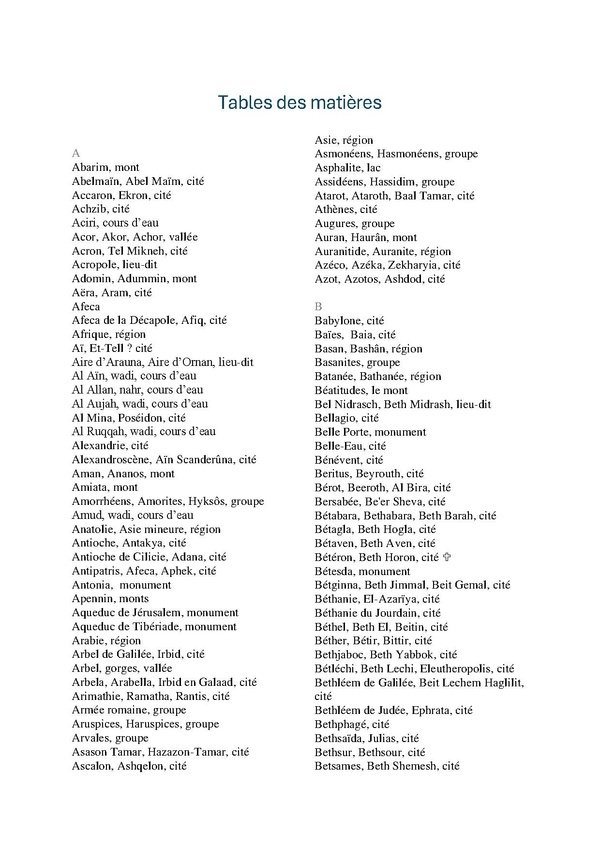
(To open the Table of Contents, click on the image)
Notes and references[edit | edit source]
- ↑ In the 1985 French edition, the first, this dictation from Jesus appeared at the end of chapter 57 (p. 216) on the faith of the Magi. In the new edition, this passage no longer appears there but has been reintegrated in its original place in Notebooks 1944, dated March 3.
- ↑ Letter to the Centro Editoriale Valtortiano, 1986.
- ↑ See Jean-François Lavère, The Valtorta Enigma, volume 1, RSI 2009, pp. 122-139.