


Holy Office, Second Opinion of Father Augustin Bea, (17/10/1952)
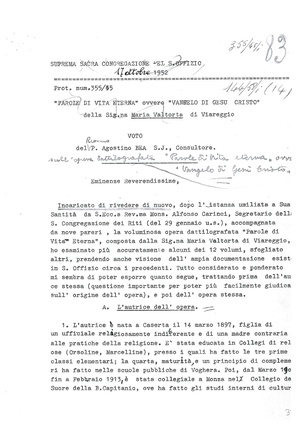
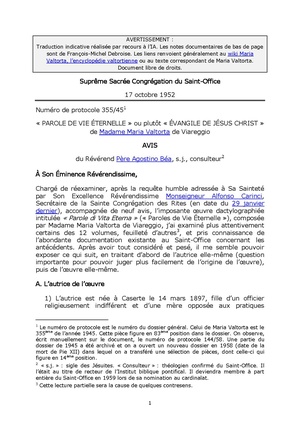
This opinion of Father Augustin Bea sj was given at the express request of the Holy Office following the petition to the Holy Father submitted a few months earlier by Msgr. Alfonso Carinci and eight other "illustrious personalities," including Father Bea himself. This opinion is presented as a "voto (vote)" whereas that of Father Alberto Vaccari sj was presented as a "parere (opinion)." While the latter expresses the opinion of an expert, Father Augustin Bea's has a more formal aspect intended for an official decision (in decisis), which he expresses in conclusion (p. 77):
- "The work cannot be published as is because of the theological and exegetical difficulties that have been exposed"[1].
- Correcting these difficulties would amount to writing a new work.
- One could publish the best parts "but this concession would be inappropriate given the impetuous and imprudent zeal of those who support this work."
- "To the Reverend Servite Fathers who have so far been interested in the work[2], a stern warning should be given with prohibition to be involved with the work, both publicly and privately."
Father Bea had been struck by the exegetical knowledge demonstrated by Maria Valtorta. He did not regard it as an inspired work, but as a good popularizing book whose publication he recommended without all the descriptive details it contained[3]. In this new study, however, overwhelmed by too many doubts, he opts for the complete abandonment of the work.
Contextual Elements[edit | edit source]
This document, by its nature, content, recipient, and conclusions, proves that the decision had not been made before. This invalidates accordingly:
- The Salton thesis that the decision to prohibit had already been taken earlier, on February 17, 1949 with the support of the Holy Father.
- The legitimacy of the meeting of Msgr. Giovanni Pepe on February 22, 1949 asking Father Berti not to publish the work and to hand over the manuscripts.
This also explains why the Osservatore Romano of 1960 article commenting on the placing on the Index refers vaguely and unusually to "memories from about ten years ago"[4]. It is therefore mistaken to translate this vagueness as "1949" since in 1952 the work was still under examination. This confirms that the 1959 decision of the Holy Office referred only to its own opinion not validated by the Holy Father at that time, as required by law[5].
French Translation[edit | edit source]
The French translation was made by Alexis Maillard in his book available online: Maria Valtorta The Vatican File. We reproduce here the excerpts which we comment on in various articles on the Maria Valtorta wiki. Page references relate to it.
On the general structure of Maria Valtorta's work[edit | edit source]
If Father Bea's opinion ultimately proves negative, it diverges from prevailing opinions at the Holy Office: in the judgment below, he prophesies what Maria Valtorta’s work would become[6] within the criteria of authenticity of a private revelation which, more than half a century later, Benedict XVI would codify[7]. Significant passages are in italics.
(p. 67) "Valtorta’s work manifests a profound religiosity and a genuine love of Christ, of the Virgin Mary and of the Church. There are very edifying and very moving pages that are rarely found in modern writings about the life of Jesus and other books of meditation. This religious quality combined with a great ability to present arguments in a lively, interesting, and even sometimes fascinating literary manner explains the strong impression the work has made especially on the laypeople of great religiosity and the desire to see it published, a desire expressed by many and continually renewed."
But if he ultimately opposes the publication of the work, it is due to "some rather serious difficulties" that he believes he has identified. The "greatest objection", according to Salton, is that "Our Lord is lowered and immersed in the events of ordinary human life in an unacceptable manner" (p. 68). He thus denounces two things: a Christ living a daily human life and how it is described.
A Christ he judges too human[edit | edit source]
Father Augustin Bea acknowledges that "Our Lord has experienced all our infirmities except sin"[8], but he questions the pertinence of emphasizing this humanity, fearing it diminishes the reverence due to the God-man. His main objection is therefore not doctrinal but concerns the appropriateness of this approach.
The humanity of Jesus does not prevent his divinity; it is its revelation. It is in this humanity that Redemption was accomplished. Without Redemption, there is no Redeemer. Jesus possesses a holy humanity, a model for believers, and complete except for sin: "Have this mind among yourselves, which is yours in Christ Jesus, who, though he was in the form of God, did not count equality with God a thing to be grasped, but emptied himself, taking the form of a servant, being born in the likeness of men, and being found in human form[9]." Jesus' humanity is not a mere appearance but a full and entire reality, with all its properties except sin.
By mentioning the reverence due to the God-man, Father Augustin Bea refers to a cultural context but not a theological one. In a work like Maria Valtorta’s, the true reverence due to the God-man is on the contrary magnified in love for the incarnate Word. He implicitly recognizes this when he says: "Valtorta’s work manifests a profound religiosity and a genuine love of Christ, of the Virgin Mary, and of the Church."
Cultural contexts
By framing as cultural what is a teaching of the Church (completeness of Jesus’ humanity, except for sin), he biases the view on a private revelation reporting the life of Christ some 2,000 years ago. He is not alone in doing this for what he judges a good reason. For example, Msgr. Marcel Lefebvre similarly expressed reservations about Maria Valtorta’s depiction of Jesus during a retreat in September 1986[10].
Both come from the cultural context of the 19th century when the Church developed its cultural magnificence, which modernism fought against. This deviation was also opposed by Maria Valtorta but through an exposition of historical authenticity.[11] In 2024, Pope Francis has emphasized the importance of recovering a living Christ: a "Jesus Christ made flesh, made man, made history." He recommends never losing sight of "the 'flesh' of Jesus Christ, this flesh made of passions, emotions, feelings, concrete stories, hands that touch and heal, looks that free and encourage, hospitality, forgiveness, indignation, courage, fearlessness: in a word, love[12]." It is this historical reality that Maria Valtorta’s work presents, which Pope Francis encourages[13]. It does not lead to irreverence, but to love of the God-Man, Salton the title under which it was published.
On the material data of the work[edit | edit source]
Already in his attestation of January 23, 1952, Father Augustin Bea did not attribute Maria Valtorta’s work to a divine origin but was "very impressed by the remarkable accuracy" of Maria Valtorta’s descriptions. This wonder remains in his second opinion:
(p. 72) "Here we have a phenomenon that leaves one very puzzled. Examining the various volumes, one must note that the geographical and topographical indications, generally speaking, are accurate. And it is not just a few names but hundreds of cities, villages, rivers, valleys, mountains. There will probably be few specialists, among priests and theologians, who on this point could confirm the writer."
He offers his critical viewpoint but without being able to understand the origin of this abundance of remarkable knowledge:
(p. 74) "However, the problem remains for me, unsolvable, of the source from which the writer has this abundance of geographical, topographical, historical, archaeological knowledge with which this strange work is so rich. Where does she get all this?"
The answer was in front of him: did she have it from personal culture? No, he honestly studied the life of Maria Valtorta and knows this is excluded. Was it a Satanic prodigy? Satan cannot inspire a work which "manifests a profound religiosity and a genuine love of Christ, of the Virgin Mary and of the Church" as he himself noted.
Value of the material data[edit | edit source]
These material data ("geographical, topographical, historical, archaeological"), as well as those on the characters (pp. 71–72), are constitutive of the historical visions: they authenticate them. Father Alberto Vaccari, whom he quotes, denied this. Father Augustin Bea acknowledges it. In this area, since his report, new technologies such as aerial surveys after the war have revolutionized the landscape, confirming many of Maria Valtorta's descriptions[14]. In 1970, eighteen years after Father Augustin Bea's report, the Blessed Gabriel Allegra already noted the amount of work it took for scholars to establish a tentative map while "at least four times out of five, recent studies confirm the identifications supposed in Maria Valtorta’s work, and I think the number would grow if specialists wanted to study the matter in depth[15]."
In 1986, Father François Dreyfus (1918-1999) of the Biblical Institute of Jerusalem confessed to the publisher to have been impressed "to find in the work of Maria Valtorta the name of at least six or seven cities that do not appear in either the Old or New Testaments. These names are known only by a few rare specialists and thanks to non-biblical sources."
On the doctrinal aspects of the work[edit | edit source]
In this area, which had not struck him in his first attestation, he shows himself influenced by the report of his confrere Alberto Vaccari. He finds formal objections (p. 70) and substantive objections (p. 75). In the first category, he retains the proclamation of Jesus’ messianity by Maria Valtorta’s Jesus contrary to what he understands from the Gospel: Jesus forbade public proclamation.
It was answered that it is God the Father Himself who proclaims him publicly from Jesus’ baptism, and that Jesus was killed because he proclaimed himself "Son of God." He reserves for himself the exclusivity of this announcement until Redemption is accomplished.
Father Augustin Bea also points out the use by Maria Valtorta's Jesus of contemporary theological vocabulary. This has been otherwise justified. This pedagogy proves especially relevant for a specialist "skeptical" audience. Thus, Father Augustin Bea classifies among "doctrinal errors and inaccuracies" the expression "God begets only another Himself[16]." He wonders: "(so another God?)." He does not identify that this is already an affirmation present in the Psalms[17] and which will be taken up in the Nicene Creed: "...he is God, begotten of God, [...] true God, begotten of true God. Begotten, not created, consubstantial with the Father*." The call to contemporary theological vocabulary proves thus appropriate both for specialist and non-specialist audiences.
With honesty, Father Augustin Bea notes that ultimately the doctrinal errors and inaccuracies are less frequent "than is generally supposed." However, following Alberto Vaccari (p. 75), he notes the parallel Jesus makes between his Incarnation and the Incarnation of Satan in Judas[18]. This objection, taken up in a recent study by Don Chevallier, has been answered by Mary of Nazareth[19]. The Incarnation of Satan in a man remains that of a creature (angelic, pure spirit) in a creature (human). This is profoundly different from the Incarnation of the Word.
Notes and references[edit | edit source]
- ↑ The difficulties and not the errors.
- ↑ The Fathers Migliorini, Berti, Cecchin, Roschini.
- ↑ Attestation of January 23, 1952.
- ↑ Memories and not decrees. No precise date: a very unusual behavior.
- ↑ In the Sacred Congregation of the Holy Office, the Pope held final authority over all doctrinal and disciplinary decisions. Although the Holy Office dealt with matters of faith and morals, all its actions and decrees were subject to papal approval. The proposal to censor the works of Maria Valtorta from February 17, 1949 was not upheld by Pius XII. Father Bea’s report of October 17, 1952, which attempted to regain control, was in no way validated by the Pope during his lifetime despite editions in 1956, 1957, 1958. In its 1960 article, the Holy Office could therefore refer neither to a 1949 decision, invalidated, nor to any subsequent decision taken after 1952, at least during the Pope's life.
- ↑ See for this the testimonies of readers of Maria Valtorta's work.
- ↑ BENEDICT XVI, Verbum Domini, § 14 second part.
- ↑ Hebrews 4:15.
- ↑ Philippians 2:5-7.
- ↑ "We are better off (…) not dwelling too much on the little facts of Our Lord’s life. It is perhaps for this reason that these lives written about Our Lord, (…) these books which present themselves as revelations of the life of Our Lord, in my view, can be a danger, because precisely they represent Our Lord in a too concrete way, too much in the details of his life. I am of course thinking of Maria Valtorta. And perhaps for some, this reading does good, it can bring them closer to Our Lord, it tries to imagine what the lives of the apostles with Our Lord were like, the life in Nazareth, the visits Our Lord made in the towns of Israel. But there is a danger, a great danger: to over-humanize, too concretize, and not sufficiently show the face of God in the life of Our Lord. That is a danger. I do not know if it is advisable to recommend such books to unprepared persons. I am not sure that it uplifts them much or makes them truly know Our Lord as he was, as he is, as we must know and believe Him."
- ↑ GRM 652: Farewell to the Work.
- ↑ POPE FRANCIS, Letter on the role of literature in formation, July 17, 2024, Never Christ without flesh, §§ 14 and 15.
- ↑ Letter of February 24, 2024 to Don Ernesto Zucchini, president of the Maria Valtorta Foundation of Viareggio.
- ↑ See in this regard: the description of places and the description of characters, etc.
- ↑ Analysis of Maria Valtorta's Work by Gabriele M. Allegra - Striking Details
- ↑ GRM 487.6. It is difficult, when reading all the development that Jesus makes in this entire passage, on the nature of the Messiah, to find "errors or doctrinal inaccuracies."
- ↑ Psalm 2:7-8.
- ↑ GRM 587.3.
- ↑ Mary of Nazareth - Response to Don Guillaume Chevallier: there is no doctrinal error in the writings of Maria Valtorta - January 24, 2023 - II. "The Incarnation of Satan in Judas" (doc. 3, p. 3 & p. 24)