


Holy Office, Opinion of Alberto Vaccari, (26/01/1949)
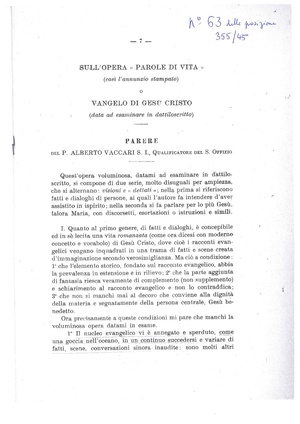
This opinion (Parere) by Alberto Vaccari sj, was made starting from November 24, 1948, at the request of the Holy Office while the work of Maria Valtorta was about to be published by the Servites of Mary. Completed in two months from an incomplete study[1], this opinion, very critical, sums up the value of Maria Valtorta's work in the last word of the report: "zero".
It follows the Brevi notizie of the report by Msgr. Giovanni Pepe, of which it constitutes pages 7 and following.
Context and Posterity[edit | edit source]
This opinion does not establish the Holy Office's stance; it justifies it a posteriori. Indeed, in his brief note of February 2, 1949, Giovanni Pepe recalls that as early as March 13, 1946 (p. 35), the confessor of the "hysterical" Maria Valtorta was to be replaced by "a serious and prudent confessor, who will watch over her and forbid and prevent her 'dictations and visions' from spreading among the faithful." A position not based on a study but on hearsay. This did not prevent Pius XII from receiving in audience "an excited person who sees the intervention of angels and demons where there are only manifestations of hysteria" (p. 36) and from encouraging the publication of Maria Valtorta's work. A position contrary to the Holy Office's opinion.
The Vaccari report perfectly meets this objective of "demolishing" the work of the "hysterical" to the point "zero." However, it gains importance insofar as it inspired, in 1960, the article commenting on the placement on the Index. An article that largely reprises Alberto Vaccari's argumentation in a more measured way: it denounces a "poorly romanticized life of Jesus" and not at all heretical, unlike the original analysis presented here which finds all the faults.
This 75-year-old analysis has apparently circulated widely among critics of Maria Valtorta's work. Its components can be found as early as 1994 with Fr. Mitch Pacwa sj[2]. They reappear in recent critical studies. All present themselves as original studies, without citing Vaccari as the source.
Text of the Document[edit | edit source]
The French translation was made by Alexis Maillard in his book available online: Maria Valtorta The Vatican File.
Handwritten note: Piece No. 63 of File 355/45[3] ABOUT THE WORK "WORDS OF LIFE"
(as the printed text announces)
or
THE GOSPEL OF Jesus CHRIST
(given to examine on a typewritten copy)
OPINION
of Father Alberto Vaccari s.j., Qualifier of the Holy Office[4]<c/enter>
Page 7 of the original document[edit | edit source]
This voluminous work, which I was given to examine on a typewritten medium, contains two types of writings, very unequal in length, an alternation of visions and dictations. For the first type [the visions], reference is made to facts and dialogues between persons which the author suggests she witnessed in spirit; for the second type [the dictations], Jesus speaks mostly, sometimes Mary, through short discourses, exhortations or instructions, or similar things.
I. As for the first type, the visions of facts and dialogues, it is conceivable and even legitimate to novelize[5] a life of Jesus Christ (actualizing it with modern words and concepts), that is to say, the evangelical events recounted are framed by a plot of facts and scenes created, against all likelihood, by the imagination. But this could be done only under certain conditions: 1°) that the historical element, based on the evangelical account, has priority both in length and content; 2°) that the part added by the imagination is only a complement (but not a supplement), and that it serves to clarify the evangelical account and is not contradictory; 3°) that what is added does not harm the dignity of the narrative and especially of the central person, Jesus.
Now, having specified these conditions, it seems to me that this voluminous work, entrusted to me for examination, shows failures.
1°) The heart of the Gospel is drowned and somewhat lost, like a drop of water in the ocean, in a continuous succession of varied facts, scenes, unpublished conversations:
Specific Points Noted[edit | edit source]
Confusion in the chosen reference frame
- Alberto Vaccari defines what, according to him, should be a novelized life of Jesus. He outright excludes the hypothesis of a vision. This is the origin of the confusion observed in the article commenting on the placement on the Index: wishing to condemn the inspired character of the private revelation, he only argues about a poorly novelized life of Jesus. But the Holy Office is not a literary critic. It is, on the contrary, within its competence to judge doctrinal conformity or respect for good morals, which the chosen title does not address because ultimately nothing convincing is found. Moreover, the censor mentions three times the conformity and excellence of theology, which he considers suspicious.
- His will to confine private revelations within the domain of imagination bumps into their very principle, which is that of The Holy Spirit who blows where He wills[6]: a divine freedom as the Church recalls:
"The Holy Spirit, who springs from the heart of the risen Christ, acts in the Church with divine freedom and offers us many precious gifts that help us on the path of life and stimulate our spiritual maturation in fidelity to the Gospel. This action of the Holy Spirit also includes the possibility of reaching our hearts through certain supernatural events, such as apparitions or visions of Christ or the Holy Virgin and other phenomena. These manifestations have often produced a great richness of spiritual fruits, a growth of faith, devotion, fraternity, and service[7]".
Page 8 of the original document[edit | edit source]
"there are also many other journeys of Jesus, other miracles, other parables, etc., than those reported by the holy evangelists[8]; in sum, it is another Gospel, similar in substance (but neither in size nor quite modern style) to the apocryphal gospels of early Christianity and must be treated as the early Church treated apocryphal gospels: exclude, ignore[9].
- 2°) The author never tells us, not even indirectly, how this account can be reconciled with the public life of Jesus in the Gospels[10], these multiple comings and goings she makes the Savior undertake, up to the extreme points of Syria and Palestine (from Antioch to Mount Nebo and Masada on the Dead Sea, from Ashkelon on the Mediterranean to Aéra, not far from Damascus).
- The Jesus she presents in facts and words on some points is not the one we know well from the Holy Gospels. In the way of speaking about himself and his mission and dealing with his adversaries, for example on page 3258 (obviously I cite the pages according to the continuous numbering indicated at the top left), there is not this "gentle and humble heart" he proposes to us as a model[5].
- In particular, he goes against the entire evangelical tradition with the kind of temptation with which Jesus from the beginning of his preaching (page 244) and then very often with all types of people, proclaims himself Messiah, and "Son of God," and even, the "Word of the Father," and this is why he is even considered as such by a part of the population, well before the famous confession of Saint Peter at Caesarea Philippi (and this one is not in the typewritten manuscripts given to me, but I read it in the small pamphlet of essays titled "Words of Eternal Life," p. 21-25).
- So Saint Peter no longer has the primacy of his confession: "You are the Christ, the Son of the living God," and this no longer makes sense, or at least loses much of its great force, the response of Jesus who congratulates him for the revelation from the heavenly Father and which confers on him accordingly the primacy over the Church; then one would have to erase the very good and very justified praise of Saint Peter drawn from it by the doctor of the Church Saint Hilary [of Poitiers, in his commentary on the Gospel according to Saint Matthew 16:13-20]: "You are deemed worthy because you are the first to know the Christ of God. Blessed is the Church which has such a foundation" (Breviary, feast of the Chair of Saint Peter, Lesson 8, January 18)[5].
Specific Points Noted[edit | edit source]
"There is not this 'gentle and humble heart' that he proposes to us"
- Contrary to Alberto Vaccari's overly interpretative assertion, Jesus also uses extremely harsh words against his interlocutors, even with Peter:
- "Hypocrites!" (Matthew 22:18) | "Blind guides," "worser than you," "fools and blind," "whitewashed tombs," "serpents, brood of vipers" (Matthew 23:13-36) | "Get behind me, Satan!" (Matthew 16:23) | "You make it a den of robbers" (Matthew 21:12-13) | "Depart from me, you cursed, into the eternal fire" (Matthew 25:41) | "They devour the houses of widows" (Mark 12:40) | "You have as father the devil" (John 8:44) | "You are liars" (John 8:55), etc.
Jesus does not cease to proclaim himself Messiah
 See also:
- This is one of the four criticisms that the 'Osservatore Romano would later retain against the work[11] as well as "indecencies"[12]
- Alberto Vaccari is shocked that "Jesus, from the beginning of his preaching and then very often with all types of people, proclaims himself Messiah, and 'Son of God,' and even, the 'Word of the Father,' and this is why he is even considered as such by a part of the population, well before the famous profession of Saint Peter at Caesarea Philippi."
- He forgets that the first to publicly proclaim that Jesus is "Son of God" is the Eternal Father himself in the first of the three theophanies of the Gospel[13].
- He also forgets that the first apostle to confess Jesus as Son of God is Bartholomew (Nathaniel) the Apostle[14], not to mention the apostles who from the beginning use pertinent periphrases against Jesus: Lamb of God, the one who was announced.
- Finally, he misunderstands the discretion requested for the announcement of the Messiah. Jesus proclaims himself Son of God publicly[15], which will even be the reason for his condemnation[16]. But he reserves the exclusivity[17] until Redemption is accomplished.
Page 9 of the original document[edit | edit source]
"3°) Very often in this very prolix work, the suitable character befitting a serious subject is lacking, more so when it concerns the sacred. For example:
- the extremely precise description of the physical appearance of the Virgin Mary as a child[18];
- Jesus "kisses on the cheeks" the mother of Judas[19],
- a spontaneity quite incongruous regarding fishing methods and there is an admiring "Oh" from St. Peter replying to: "I have never fished and I wait for you to teach me." [from Jesus], and Peter gives a very precise instruction about fishing[20],
- There are many childish, clumsy, grotesque, and even indecent scenes such as the healing of the Beauty of Chorazin (always mentioned with a capital B)[21].
On this subject, frequent "opportune and inopportune" shifts on sexual subjects can be noted, to flog vice and combat a corrupt society like today's, but is that a good way to combat such violent vice, to recall it so often and crudely?
Presenting all these scenes as "visions" increases the blame deserved by the author, thus trying to authenticate the imaginations of his fantasy through the seal of the supernatural. However, she herself sometimes shows she is not sure of the truth of her visions because she says she describes places as she saw them without being sure that these places exist in reality[22].
They cannot be genuine visions because they contain false things"[5].
- On page 67 the author writes: "Mary begins to sing in a low voice (...) But as now and again She repeats «Jehovah», I realize that it is a sacred song[23]." This is pure fantasy! No Jew, especially in Antiquity, ever pronounced "Jehovah" for his God; this pronunciation of the divine name, as has now been demonstrated, has recent origins and is now abolished in schools as false.
- The author's knowledge is rather outdated. She seems to recognize this when she writes: "But this is a gospel for the simple and the little ones, not for the doctors for whom the great majority (if not all) [chap. 312.14] find it unacceptable and useless" (page 1680a, at the end of year II, vol. 3); in short: only the ignorant may believe it.
II. In the "dictations," the audacious claim appears to attribute one's fantasies and errors to the supreme authority of the divine Savior and his most holy Mother.
Specific Points Noted[edit | edit source]
Diverse Indecencies
- In what way is the description of young Mary[24], as seen by Maria Valtorta, indecent? The visionaries of Fatima, Lourdes, La Salette, ... did the same.
- Why is kissing "on the cheeks" the "troubled" mother of Judas[25] shocking? Is Alberto Vaccari shocked by the kiss of peace[26], a long-standing tradition?
- He finds it "incongruous" that Jesus teaches Simon Peter fishing net casting[27]. Alberto Vaccari seems to classify this under "childish, clumsy, grotesque scenes." Can these adjectives apply to Jesus practicing the carpentry trade? King David was a shepherd, Peter a fisherman, Paul made tents.
- The simple word "naked" provokes discomfort in Alberto Vaccari as was often noted in Giovanni Pepe. But God created us naked and innocent. The Gospel mentions naked persons[28]. Nudity is not perversion for the doctor, nurse, artist, ... Only the thoughts it provokes are shocking and disturbing. "Everything is pure for the pure" says Saint Paul[29].
Condescensions
- Alberto Vaccari treats the material data contained in the work and its author condescendingly: "The knowledge of the imaginative author is rather outdated. She seems to recognize this when she writes: 'But this is a gospel for the simple and the little ones, not for the doctors for whom the great majority find it unacceptable and useless,' in short: only the ignorant may believe it." The explanations Jesus gives, - because it is Jesus who speaks and not Maria Valtorta - are nonetheless common sense[30]. Are Jesus’ discourses in the Gospel accessible to all, or only to scholars?[31]?
- To illustrate this point, he denounces the "pure fantasy" of young Mary invoking "Jehovah"[32]. This name, he says, is of recent origin and was unpronounceable. If this name appeared in the Middle ages it is because the Masoretes (Jewish scholars) added vowel points to the Hebrew text to facilitate reading. There would have been no need if this name were truly unpronounceable. If the liturgical respect and usage are established, the theophoric names (proper names composed with the Divine Name) prove their use spread into daily life[33]. The prohibition of swearing or blasphemy does not forbid saying God, thank you!
A private revelation that contains false things is false
- The assertion: "These cannot be genuine visions because they contain false things" contradicts the teaching of the Catholic Church today[7], as yesterday[34]. On the contrary, the Catholic Church holds that the presence of inaccuracies or false elements in the minor details of a private revelation does not necessarily invalidate its fundamental authenticity or divine origin. When the Church approves private revelations, it declares only that they contain nothing contrary to faith or good morals, and they can be read without danger or even with benefit. The criterion for judging the truth of a private revelation is its orientation towards Christ himself[35]. The conformity of Maria Valtorta's work with the four Gospels and the Bible has been demonstrated[36], a unique characteristic not found in the novelized or historical “lives” of Jesus to which Alberto Vaccari would have liked to associate this private revelation.
Page 10 of the original document[edit | edit source]
- Asserted on page 3249 and following (among the "visions") a topographical fact really contrary to the explicit statement of the Gospel (John 11:30) has a petty and insipid explanation or defense made by Jesus himself (page 3263[37]). In Valtorta, Jesus enters Lazarus’s garden and the Pharisees witness the dialogues between Jesus and Martha, whereas in the Gospel, Jesus does not enter the village where Lazarus’s property is located.
- On page 19[38], citing the words of Proverbs 8:22-30, “Jesus says... (to men). You applied these words to Wisdom, but they speak of Her: the beautiful Mother, the holy Mother”; in good exegesis (and especially in the Church’s sense) one should have said exactly the opposite: these verses are about Wisdom and apply to Mary[5].
- Above all, it is reprehensible that in two “dictations” one after the other, the first of Mary, the second of Jesus (pp. 69-73 and 73-74), one tries to explain in depth and defend the opinion (which also appears elsewhere, for example page 346) on which the original sin, the first fault of Adam and Eve, was the conjugal act accomplished at the devil’s instigation against God’s prohibition; an opinion which is not new, but already known to Saint Augustine who qualified it as “ridiculous” (Commentary on Genesis, Book 11, chapter 41 at the end), currently back in fashion in some circles because of this itching that excites, especially among youths, everything related to the sixth commandment of the Decalogue [“You shall not commit adultery”]. But it is possible to affirm without the shadow of a doubt that: 1° this has no solid foundation in the biblical account Genesis chapters 2-3; 2° Indeed, [this idea that original sin was the conjugal act] is directly contrary both to the order given by God to the first humans in the first creation account (Genesis 1:28: be fruitful, multiply) and as proclaimed by the presentation of the first woman to the first man (Genesis 2:32-34), in which Jesus himself notes the divine institution of marriage in its purest and most sacred form (Matthew 19:4-6); 3° to suppose a temporary order of continence, that is, the suspension or postponement of divine order "be fruitful and multiply," as proponents of this opinion are forced to do, is pure arbitrariness, pure fantasy, it is wanting to introduce into divine Scripture something that is not there; and it is not licit to do such a thing[5].
This suffices to conclude that this work, both in the one and the other element of which it is composed (visions and dictations), is condemnable. Moreover, here and there erroneous doctrines in theology are taught or suggested, worthy of a more or less grave censure.
- Thus the preexistence of souls. Of the Blessed Virgin Mary it is said with great clarity that she was created "only spirit" before the beginning of time[39] (page 22) and then, conceived and born on earth, in her spirit "she relives what her spirit had seen in God before being conceived" (page 47).
Specific Points Noted[edit | edit source]
The resurrection of Lazarus

- Alberto Vaccari denounces an "audacious claim to attribute one’s own fantasies and errors to the supreme authority of the divine Savior and his most holy Mother" (p. 52). To support this, he points out that contrary to John 11:30, the Jesus of Maria Valtorta sends Martha away at the threshold of the property and not at the boundary of Bethany. He does not accept the explanation Jesus gives on this particular point[40].
- This charge ("audacious claim... fantasies") clashes with two facts noted by Jesus: Martha could not leave Lazarus’s property: according to Jewish laws (halakha), Martha and Mary had to remain cloistered for seven days without leaving the house (Lazarus had been buried only 4 days). This strict mourning obligation is called "shiv'a" (the seven days of mourning). On the other hand, Jesus bypasses the village of Bethany to go to Lazarus’s property, which is in the opposite direction. This is perfectly illustrated in this diagram[41]. If Maria Valtorta could not have known this ancient custom of the Shiv'ah, which she nevertheless mentions, an exegete such as Alberto Vaccari should have noted this point which gives full coherence to the canonical Gospel account.
Contested exegesis of Proverbs 8:22-30 and "preexistence" of souls


- Alberto Vaccari contests the exegesis that applies this text to the Virgin Mary and infers a series of absurdities such as the preexistence of souls, the spiritual nature of Mary, or the fact that she is called the "second-born" of the Father. These complaints have been taken up, without citing the source, by Don Guillaume Chevallier. They have been the subject of a reasoned response by Marie of Nazareth[42], referring notably to the Liturgy and to the comments of the Blessed Dom Prosper Guéranger who cannot be accused of lack of exegesis. We reproduce them[43] as they respond to Alberto Vaccari’s objections:
One understands reading these comments of the Blessed Dom Prosper Guéranger, how Wisdom, essence of God the Father, could conceive from all eternity the Immaculate Mother of Wisdom incarnate, Jesus, "firstborn of all creation." Maria Valtorta may not have known these comments. But Alberto Vaccari could not have ignored them: In 1947 Pius XII, in his encyclical Mediator Dei (1947), noted that a remarkable renewal of learned interest in the sacred liturgy had taken place at the end of the 19th century and beginning of the 20th, mainly thanks to the private initiative and zealous work of Benedictine monasteries. The Blessed Dom Prosper Guéranger, who played a fundamental role in the liturgical movement, whose importance Pius XII recognized as providential[45], was also the restorer of the Benedictine order in France, notably at Solesmes."The Apostle teaches us that Jesus, our Emmanuel, is the firstborn of all creation (Colossians 1:15). This profound word means not only that he is, as God, eternally begotten of the Father; but it also expresses that the Divine Word, as man, is prior to all created beings. However, this world had come out of nothingness, humanity inhabited this earth for already four thousand years[44], when the Son of God united with a created nature. Therefore it is in God's eternal intention, and not in the order of time, that one must seek this priority of the God-Man over all creatures. The Almighty first resolved to give his eternal Son a created nature, the human nature, and, by virtue of this resolution, to create to be the domain of this God-Man all spiritual and corporeal beings. This is why divine Wisdom, the Son of God, in the Scripture passage that the Church proposes today and which we have just read, insists on his preexistence to all creatures forming this universe. As God, he is begotten eternally within his Father; as man, he was in God’s mind the pattern of all creatures before they were brought from nothingness. But the Son of God, to be a man of our lineage, as divine decree required, had to be born in time, and born of a Mother. This Mother was therefore eternally present in God’s mind as the means by which the Word would take human nature; the Son and the Mother are thus united in the same plan of the Incarnation; Mary was therefore present like Jesus in the divine decree, before creation came out of nothingness. This is why, from the first centuries of Christianity, the holy Church recognized the voice of the Mother united to that of the Son in this sublime passage of the sacred book, and wanted it to be read in the assembly of the faithful, as well as other analogous passages of Scripture, at the solemnities of the Mother of God [...]
The original sin would have been a sexual act
- The superficial reading, which Alberto Vaccari acknowledges, led him to confuse cause and consequence of original sin. He thinks that "The original sin, the first fault of Adam and Eve, was the conjugal act performed at the instigation of the devil against God's prohibition." It would be, according to him, "wanting to introduce into divine Scripture something which is not there" and would suffice "to conclude that this work, in both of its constitutive elements (visions and dictations), is condemnable." The Osservatore Romano, ten years later, retains this objection but in more moderate terms: it is qualified as "rather extravagant and inaccurate."
- Maria Valtorta, in a note of GRM 174.8/9, details the sequence of cause and consequences of Original Sin: under the serpent’s action "Eve also saw herself as powerful as God, as if she had cast off the mark of every creature: having to obey everything God commands and limiting herself to doing what God allows. After she cast off this mark to be ‘like God,’ the spiritual lust of ‘being able to do anything’ entered her."[46] This spiritual lust "engendered the intellectual lust of ‘knowing everything’: the good and especially the evil God forbade her to know." This "engendered the carnal lust" that drives them to a coupling that "brought an immediate new jYesssance and a future power to be like God by creating themselves new men on earth, by natural laws common to animals and different from those God had established."[46][47] Maria Valtorta’s[48] description thus unfolds a deregulation of the senses leading to the triple concupiscence as explained by the Catechism of the Catholic Church[49] forty-seven years after Maria Valtorta’s dictation. Original Sin engendered carnal "‘lust’". Adam and Eve did not procreate before original sin. That would have been characterized by purity, harmony, and perfect obedience of the flesh to will, without shame or concupiscence which appeared after the Fall. Maria Valtorta, like Genesis, says nothing different[50].
Page 11 of the original document[edit | edit source]
- Of all other men, of every human soul, preexistence seems to be limited to a "thousandth of instant"; "It is perfect (the soul) when it originates from the divine thought and in the instant of its creation it is identical, for a thousandth of instant, with the soul of the first man (that is, without the stain of sin, in original justice): a perfection which understands the Truth through free gift"[51], whence follows that when a man understands a truth, he does nothing else but remember what in that thousandth of instant he had seen in God. The angelic ministry sheds light on his memories and the tempter casts darkness (page cited). Pure fantasy, refuted error in philosophy![52]
- Theologically incorrect or even properly heretical expressions are: "Word of the Father, Part of God" (Jesus says of himself, page 244)[53],
- Mary can be called the second-born of the Father (page 1)[39];
- Awkward (to say the least) are: Mary demonstrating "the joy of having made God happy" (page 70) and who would like to sin to be loved by God who becomes Savior (page 32)[54]; "he who loves deserves everything from God" (p. 281 at the end);
- "The Word came to earth. He therefore separated from the Father and the Holy Spirit. He came to work on earth. 'In heaven, the other two contemplated the works of the Word'" (page 1070; and these are words put in Jesus’ mouth!)[55]
- Such deviations from correct feeling and exact discourse on matters of faith do not seem frequent to me in proportion to the extent of the work; but I must say I have not read it in its entirety, in depth, except some parts.
However, what I have read seems more than sufficient to formulate the unfavorable judgment I gave above. I will therefore not dwell on false or inaccurate interpretations of various passages or books of the Holy Scripture, which are more frequent, but of lesser consequence. This applies, however, to passages or books of the Bible sometimes found in the long dialogues of the "visions" or in the "dictations." Out of respect for the Holy Gospels, to which this work refers continually by its very nature, I believe I must express here, at the end, even more explicitly, the judgment that already emerges from what I have said above: as an interpretation of the Holy Gospel, this confused book is worthless.
Rome, January 26, 1949.Father Alberto VACCARI, Society of Jesus.
Specific Points Noted[edit | edit source]
For a thousandth of a moment, the soul coming out perfect from divine thought is equal to that of the first man
- In a dictation from January 28, 1947[56], Jesus answers ahead of time this objection with obvious argument which Alberto Vaccari could not have denied: "Do you perhaps object that it [the soul] no longer has the integral intelligence of the first soul because it is stained and damaged by original sin? I reply, first of all, that nothing impure emerges from Creative Thought. Original sin is in man and in the children of man, not in God. Not in the being created by God, then, but on becoming incarnated in the man conceived by man the soul contracts the inheritance connected with the descendants of Adam…".
Jesus, "part of God"
- In GRM 487.4, Jesus says:
"But I know Him Who sent Me because I belong to Him, I am part of Him and one Whole with Him. And He sent Me to fulfil what His Thoughts yearn."
- This expression includes three affirmations: 1 - "I know the One who sent me because I belong to him." This is theologically correct and biblical[57]. Jesus is "His" (the Father's) by nature, being the eternally begotten Son. 2 - "I am part of Him." This is indeed theologically imprecise and potentially problematic. Using the term "part" can be misleading as it suggests that divinity is fragmented (which is contrary to the Doctrine of the Trinity) or that Jesus is not fully God. 3 - "And I am one Whole with Him." This is theologically correct and biblical[58], but requires precise understanding. The unity between Father and Son does not erase the distinction of persons. Jesus is "one Whole with Him" in the sense of unity of divine essence, but remains a person distinct from the Father.
- Alberto Vaccari would therefore have been justified in denouncing the dangers of this wording if he had not committed an anachronism and interpretive bias.
- Anachronism: If in a contemporary writing, the expression would be questionable, it is justified for a historical vision. It concerns the Gospel passage where Jesus speaks of his true nature[59]. For the Jews of Jesus’s time (notably the Pharisees and the Sanhedrin), the triniterian idea was revolutionary and scandalous. Furthermore, Jesus would speak explicitly of the Paraclete only to his apostles and at the end. For them, it was a new light but hard to fully grasp before the Resurrection and Pentecost. The clear formulation of the Trinity (one God in three Persons) would come only with the Councils of the 4th-5th centuries (Nicaea, Constantinople). Even today it remains difficult to express and conceive simply. Analogies in use (family, St. Patrick’s clover, ...) are not heresies but pedagogies. Jesus uses wording accessible in the context of the time. Formulation that contains well the substance of the mystery: One God in three persons.
- Bias: Jesus does not stop at the image: in the continuation of the discourse he develops at length the mystery of the Trinity, the Incarnation and Redemption, truths, also, so deep that they are difficult to fully grasp to the point that Maria Valtorta would write: "The people whisper. Not everybody has understood, nay most of them (including myself) have not understood. We are too ignorant. But we realise that He has enunciated great things. And we are silent, full of admiration." One has to read the development Jesus makes[60], and that he justifies biblically, to understand the accuracy of this remark by Maria Valtorta.
As an interpretation of the Holy Gospel, this confused book is worthless
- Alberto Vaccari concludes thus: "as an interpretation of the Holy Gospel, this confused book is worthless (zero)." He moved from the novelized book to exegesis, a confusion of genres which will be found in the 'Osservatore Romano which will detect inappropriate divergences but no condemnable opposition despite the indictment by Alberto Vaccari. This remains his personal opinion which one may or may not share. On this last point, the Blessed Allegra, another biblical scholar who spent two years (not two months) studying deeply Maria Valtorta’s work, comes to the opposite conclusion:
"There is thus in Maria Valtorta’s work a transposition, a translation of the Good News announced by Jesus in the language of today’s Church, a transposition willed by Him, given that the seer had no technical theological training. And this aims, I think, to make us understand that the Gospel message announced today by His Church today, in today’s language, is substantially identical to that of His own Teaching twenty centuries ago.[61]"
- Alberto Vaccari concludes thus: "as an interpretation of the Holy Gospel, this confused book is worthless (zero)." He moved from the novelized book to exegesis, a confusion of genres which will be found in the 'Osservatore Romano which will detect inappropriate divergences but no condemnable opposition despite the indictment by Alberto Vaccari. This remains his personal opinion which one may or may not share. On this last point, the Blessed Allegra, another biblical scholar who spent two years (not two months) studying deeply Maria Valtorta’s work, comes to the opposite conclusion:
Notes and references[edit | edit source]
- ↑ He mentions basing his opinion on summaries (p. 51). He concludes (p. 55): "Such deviations from correct feeling and exact discourse in matters of faith do not seem frequent to me in proportion to the size of the work; but I must say that I have not read it in its entirety, in depth, except for some parts." (Translation by Alexis Maillard).
- ↑ See JONATHAN A. BAKER, In Defense of the Poem, 2007, www.maria-valtorta.net.
- ↑ This is piece 63 of the Maria Valtorta file (No. 355) opened in 1945.
- ↑ The qualificatori were theological consultants who assisted the Holy Office in its investigations. Their main function was to examine writings, propositions, or doctrines submitted to the Holy Office's attention and determine if they conformed to Catholic Doctrine
- ↑ 5.0 5.1 5.2 5.3 5.4 5.5 See below the comments on specific points noted.
- ↑ See John 3:8.
- ↑ 7.0 7.1 Procedural Norms for the Discernment of Presumed Supernatural Phenomena, Dicastery for the Doctrine of the Faith, May 17, 2024.
- ↑ Why reproach this? Saint John himself says this twice at the end of his Gospel and the Church repeats it: "There are also many other signs that Jesus did in the presence of the disciples which are not written in this book (John 20:30)" - "There are also many other things Jesus did; and if each one were to be written down, I think the whole world could not contain the books that would be written (John 21:25)" | See also CCC § 514.
- ↑ Alberto Vaccari gives apocryphal writings a popular connotation of falseness, which seemingly serves his argument. This is not accurate. In the current canon of biblical writings, the Catholic Church retains writings that were considered apocryphal in medieval times. For the Catholic Church, the term "apocryphal" designates writings not considered part of the inspired canon of Scripture, even if they may have historical or literary value or had popularity at certain times. Anne and Joachim, celebrated by the Church on July 26, are known only from apocryphal writings.
- ↑ Presumption: One of the titles mentioned is "THE GOSPEL OF Jesus CHRIST" and the work claims to stem from visions.
- ↑ "Because in this kind of novelized history, Jesus is extremely talkative, a true advertiser, always ready to proclaim himself Messiah and Son of God and to give theological discourses in terms a modern professor would use."
- ↑ "Some pages are rather risqué and, by some descriptions and some scenes, resemble modern novels."
- ↑ "You are my beloved Son" (Matthew 3:17 | Mark 1:11 | Luke 3:22).
- ↑ John 1:49.
- ↑ John 10:36-37.
- ↑ John 5:18.
- ↑ Matthew 16:20 | Mark 8:30 | Luke 9:21.
- ↑ GRM 7.1-2.
- ↑ GRM 78.2.
- ↑ GRM 58.3.
- ↑ Formerly a loose woman, who became leprous and an outcast, she is healed by Jesus who asks her, as in the case of Naaman the Syrian (2 Kings 5:14), to plunge into the lake where she leaves her rags and emerges naked (GRM 94.5)
- ↑ This is the nature of authentic visions: to testify integrally to what is seen.
- ↑ GRM 16.2.
- ↑ GRM 7.1/2.
- ↑ GRM 78.2.
- ↑ Historically, the "kiss of peace" or "holy kiss" in early Christianity involved physical contact. Saint Paul mentions several times the injunction to "greet with a holy kiss" (in Greek: en philemati hagio). Saint Peter uses the expression "with a kiss of love" (en philemati Agapos). Saint Justin Martyr describes the exchange of the kiss of peace (allelous philemati aspazometha) after prayers and before the Offertory in the liturgy. There is only holiness in this physical gesture of ancient tradition, the precise nature of the contact (mouth, cheek, hand) is not always specified.
- ↑ GRM 58.3.
- ↑ Mark 14:52 | John 21:7.
- ↑ Titus 1:15.
- ↑ GRM 312.14. Jesus explains why in the dictations he uses common words rather than scholarly words: to be understood by all. '(...) simple people and the little ones understand “Anatolia” better than “Bithynia or Mysia'". But he specifies this, however, to confirm the work's authenticity.
- ↑ Matthew 11:25.
- ↑ GRM 16.2.
- ↑ The name of Jesus is an example: Yehoshua is the contraction of "Yeho" (יְהוֹ) representing God's name in its first two syllables (יהוח) and "shua" (שוע) meaning "a cry for help!".
- ↑ The Catholic Encyclopedia, 1913, Private Revelations.
- ↑ Benedict XVI, Verbum Domini § 14, second part.
- ↑ See Maria Valtorta’s Private Revelation: Seven Characteristics to Judge Its Authenticity.
- ↑ GRM 548.20.
- ↑ GRM 5.8.
- ↑ 39.0 39.1 GRM 5.12. See below: "Contested Exegesis of Proverbs 8:22-30 and 'preexistence' of souls"
- ↑ GRM 548.20.
- ↑ Image generated by artificial intelligence.
- ↑ MARIE DE Nazareth: Response to Don Guillaume Chevallier: there is no doctrinal error in the writings of Maria Valtorta.
- ↑ Liturgical Year, Proper of Saints, December 8, comments on Proverbs 8:22-31.
- ↑ age of man estimated at the time.
- ↑ "The liturgical movement appeared as a sign of God's providential dispositions at the present time, as a passage of the Holy Spirit in His Church" (PIUS XII - Speech to participants of the international Pastoral Liturgy Congress, Saturday September 22, 1956.
- ↑ 46.0 46.1 Automatic translation from French. Note unavailable in English. French version available here.
- ↑ See the specific article.
- ↑ GRM 17.5/6.
- ↑ See Catechism of the Catholic Church, § 377: "The 'mastery' of the world that God granted to man from the beginning was realized above all in man himself as self-mastery. Man was intact and ordered in all his being, because free from the triple concupiscence (cf. 1 John 2:16) which subjects him to sensual pleasures, the desire for earthly goods, and self-assertion against the demands of reason." § 379 "It is this whole harmony of original justice, foreseen for man by God’s plan, that was lost through the sin of our first parents."
- ↑ See Genesis 3:16: "Your desire shall be for your husband, and he shall rule over you."
- ↑ GRM 290.9.
- ↑ See below the reply to the objection: For a thousandth of a moment, the soul coming out perfect from divine thought is equal to that of the first man
- ↑ GRM 487.4. See below, in the points noted, Jesus, 'part of God'
- ↑ There is nothing awkward in this expression. Such an "oxymoron" can be found in the Exultet of Easter night: "Blessed Fault that earned us such a Savior!" and Saint Paul does not hesitate to say: "I myself, for the Jews, my brethren of race, would wish to be accursed, separated from Christ" (Romans 9:3).
- ↑ GRM 207.9. To establish a parallel between the heavenly Trinity (Father, Son, and Holy Spirit) and the earthly trinity (Jesus, Mary, and Peter), the explanation must resort to the expedient of attributing human thoughts and behaviors to God, establishing separations and reunions among divine Persons. It is not a question, however, notes Maria Valtorta on a typewritten copy, of denying the Hypostatic Union (= union of the two natures, divine and human) by which the Word, being actually in the flesh of the Son of God and Mary, has not ceased to be one with the Father and thus with Love; he has not ceased to be the Holy of Holies, because he was so by his divine nature and he was so in his human nature, by very perfect grace and will. See the article on Hypostatic Union which contains 36 extracts from Maria Valtorta’s work on this topic.
- ↑ Notebooks 1945-1950.
- ↑ John 17:25 | Matthew 11:27.
- ↑ John 10:30 | John 14:9.
- ↑ John 7:25-30.
- ↑ GRM 487.4 to 487.9.
- ↑ Analysis of Maria Valtorta’s Work by Gabriele M. Allegra, Language.