


Holy Office, Summary of Decisions, (17/02/1949)
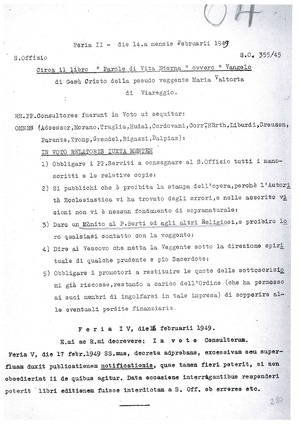
This record of decisions regarding the work of Maria Valtorta being published by the Servite Fathers concerns three decisional levels: the Censorship Office which issued 5 proposals to stop it and condemn it (February 14), the leaders of the Holy Office who approved them (February 16), and the Holy Father who retained only 4 (February 17).
French Translation[edit | edit source]
The French translation was done by Alexis Maillard in his book available online: Maria Valtorta The Vatican File. We reproduce here the excerpts which we comment on in various articles of the Maria Valtorta wiki.
February 14, 1949: the consultants[1][edit | edit source]
Subject : "Regarding the book "Words of Eternal Life" that is the Gospel of Jesus Christ of the pseudo-seer Maria Valtorta from Viareggio.[2]"
Participants (the consultants):
- Morano,[3]
- Luigi Traglia,
- Aloïs Hudal,[4]
- Mariano Cordovani op,
- Oorr,[5]
- Franz Hürth sj,[6]
- Liburdi,[7]
- Creusen,[8]
- Parente,[9]
- Sebastien Tromp sj,[10]
- Grendel,[11]
- Bigazzi,[12]
- Dalpiaz[13]
Record of decisions:
1) Oblige the Servite Fathers of Mary to hand over to the Holy Office all manuscripts and all their copies.
2) That the prohibition of the publication of the work be published because the Ecclesiastical Authority found errors therein and that there is nothing supernatural in these visions.
3) Forbid Father Berti and the other religious [Servites of Mary] any contact with the seer.
4) Tell the bishop to place the seer under the spiritual direction of a prudent and pious priest.
5) Oblige the promoters of this matter to return the sums of money already collected, while leaving to the Order (which allowed its members to embark on this matter) the responsibility of covering any financial losses.
February 16, 1949: The Holy Office[edit | edit source]
The Most Reverend Eminences have decided: in the same sense as the consultants’ opinion.
February 17, 1949: Pope Pius XII[edit | edit source]
His Holiness [Pope Pius XII], approving the decisions, judged excessive or superfluous the publication of a notification, which however could be made if those concerned did not obey. On occasion, it may be answered to people who ask questions that the publication of the book was forbidden by the Holy Office due to errors, etc.
Value of this decision[edit | edit source]
For Alexis Maillard (p. 48), these five decisions, which sanction the work and the person of Maria Valtorta, would have received the approval of the Sovereign Pontiff, the same who, a year earlier, received the Servites of Mary and encouraged them to continue the publication by seeking a usual imprimatur.
Four main elements contradict his hypothesis of a reversal by the Holy Father:
- The Holy Father retains only four decisions and excludes as "excessive or superfluous" the publication of a notification, an official act of the Holy See, stating "the prohibition of the publication of the work because the Ecclesiastical Authority found errors therein and that there is nothing supernatural in these visions" (point 2 of the record of decisions).[14]
- In 1950, one year later, Pius XII confirms that he thought the work of Maria Valtorta was already published.
- In 1952, the report to the Holy Office by Father Augustin Bea recommends not publishing the work. Thus, the decision could not have been taken. This invalidates in fact the legitimacy of the meeting of Monsignor Giovanni Pepe of February 22, 1949, asking Father Berti not to publish the work as well as to hand over the manuscripts. This also explains why the article of the Osservatore Romano of 1960 commenting on the placing on the Index refers imprecisely and unusually to "memories from about ten years ago". It is therefore wrongly translated as "1949" and confirms that the 1959 Holy Office decision referred only to its own opinion not validated at the time by the Holy Father, as required by law.
- In 1956, 1957, and 1958, contrary to the logic of a formal prohibition or condemnation, the first volumes are published without any intervention from the Holy Office even though it was aware of this fact.[15] The sanction only intervened after the death of Pius XII.
All other decisions concerning the Servites (decisions 2 and 5) and the accompaniment of Maria Valtorta (decisions 3 and 4), however, had their effects. Maria Valtorta suffered greatly from this retaliatory measure which did not stop the communications from Heaven but at the same time she was relieved by the stopping of an uncontrolled publication of the work that the Servites had undertaken with human motives.[16] Publication was able to resume on a new basis with Father Berti and the support of the Pisani publishing house.
Notes and references[edit | edit source]
- ↑ Consultant: theological or legal expert.
- ↑ The subject wording clearly shows that this is not to evaluate a work and its author, already condemned by the February 2, 1949 report by Giovanni Pepe, but to decide on the modalities for stopping its ongoing publication, following the papal audience of February 26, 1948.
- ↑ Monsignor Francesco Morano (1972-1968). He was scientifically minded and versed in legal matters (see his entry on cathopedia).
- ↑ According to Wikipedia "Alois Hudal, born in Graz on May 31, 1885, and died in Rome on May 13, 1963, was an Austrian Catholic bishop, best known for having defended a synthesis between Catholicism and National Socialism until the end and for having facilitated the escape of several Nazi criminals to South America, including Adolf Eichmann, Klaus Barbie, and Joseph Mengele."
- ↑ Possibly Monsignor Joseph M. Corr (1900-1983).
- ↑ Franz Hürth (1880-1963). He was reportedly a trusted advisor of Pius XI and Pius XII. At that time, he was focused on analyzing the works of Father Teilhard de Chardin (source, p. 20). His works were condemned by the Holy Office in 1955 and 1962. However, they are cited today by Benedict XVI and Pope Francis in his encyclical Laudato Si.
- ↑ Father Teofilo Liburdi, O.F.M.
- ↑ Joseph Creusen (1880-1960), Belgian Jesuit. He was a great canonist and a holy priest" according to his close circle.
- ↑ Monsignor Pietro Parente (1891-1986). Eminent theologian, he shifted during the Second Vatican Council from conservative positions to more progressive ones, notably on the collegiality of bishops. He was later made cardinal and became secretary of the newly created Congregation for the Doctrine of the Faith under Paul VI from 1965 to 1967.
- ↑ Sebastiaan Peter Cornelis Tromp (1889-1975). Talented theologian, he was a collaborator of Cardinal Ottaviani during the Council and served as secretary of the theological commission. However, his preparatory documents, too rigid, were rejected by several theologians such as Karl Rahner, Josef Ratzinger, Hans Küng, ...
- ↑ Joseph Grendel, Jesuit
- ↑ Monsignor Cristoforo Bigazzi (1879-1971), a Dominican. He was a "commissioner". The Commissioner of the Holy Office was a senior official of the Congregation, always a Dominican, traditionally from the Lombardy province of the Order of Preachers, by virtue of a privilege granted by Pope Pius V. He was responsible for conducting judicial investigations in criminal cases to be judged by the Congregation as a tribunal.
- ↑ Monsignor Virgilio Dalpiaz (1887‑1950).
- ↑ See F.M. DEBROISE, Comments on "Maria Valtorta, Vatican File" by Alexis Maillard (pp.7-8).
- ↑ The Osservatore Romano article commenting on the placement on the Index highlights elements of the first volume published in 1956.
- ↑ Idem, "The human motives about the work of God" pp. 8-9.