


Investigation on the Events Concomitant to the Resurrection of Jesus
 Cover page of the web publication Cover page of the web publication
| |
| Work Details | |
|---|---|
| Author | Jean-François Lavère |
| Full Title | Investigation on the Events Concomitant to the Resurrection of Jesus - The Gospels Enlightened by the Contributions of Maria Valtorta |
| Publication | 2017 |
| Publisher | Author's web publication |
Faith in the Resurrection rests on the testimony of the evangelists, the apostles, and the disciples. The Church, since Saint Augustine, has always affirmed that the books of Holy Scripture "firmly, faithfully, and without error teach the truth that God wished to see recorded".[1]
For every Christian, the Gospel obviously remains the essential foundation for any study on the Lord's life. We must believe in the information it provides us, even if its truth does not appear at first glance.
Of all the miracles of Christ, the most striking is His Resurrection. It is also the most solid foundation on which the religion He came to establish rests. But if this foundation is overturned, then the entire edifice of the Christian Faith falls into ruin. From the origins of Christianity, "the resurrection" was the central theme of the preaching that Saint Paul addressed to the Romans:"If you confess with your mouth that Jesus is Lord and believe in your heart that God raised Him from the dead, you will be saved".[2]The apostle affirmed to the Corinthians this certainty: "If it is preached that Christ has been raised from the dead, how can some of you say there is no resurrection of the dead? If there is no resurrection of the dead, then Christ has not been raised. And if Christ has not been raised, then our preaching is useless, and your faith is useless. In fact, we would be false witnesses about God, since we testified against God that He raised Christ, while He would not have raised Him if the dead do not rise. For if the dead do not rise, Christ has not been raised either. And if Christ has not been raised, your faith is worthless, you are still in your sins, and those who have died in Christ are lost. If in this life only we have hope in Christ, we are the most miserable of all men".[3]
As long as the Gospel maintains the historical character testified by the four evangelists and acknowledged by the Church since its earliest centuries, it is impossible to make it say anything other than what it announces. Anyone wanting to doubt or deny the Resurrection is therefore forced to assume that the gospels are not historically reliable, especially regarding the Resurrection account. Hence, this account has been the main target of unbelievers' attacks. To that end, the simplest and most effective method is to denounce contradictions among the four evangelists. Some, in their destructive zeal, have even claimed that there is "no coherence among the four accounts, notably concerning the appearances of Jesus on the morning of the Resurrection". Certainly detractors have an easy time as it cannot be denied that the gospels indeed contain multiple points apparently difficult to reconcile... Moreover, it is a fact that attempts to refute those supposed contradictions have not always met the challenge.
To undertake any study related to the events concomitant with the Resurrection, it is essential to have a clear vision of the various gospel testimonies.
Recall of the Facts Reported by the evangelists[edit | edit source]
John 20:1-10
- Mary Magdalene goes to the tomb on Sunday at dawn. She finds the tomb open and runs to inform Peter and John, who then go there. They verify Mary Magdalene's report. They see the tomb is empty and then return "home."
John 20:11-18
- Mary Magdalene, who "had stayed outside," approaches the tomb after Peter and John leave. She sees two angels. Then Jesus appears to her. She returns to inform Peter and John.
Saint John does not specify where Peter, John, or Mary Magdalene lived. It is therefore not possible to estimate the distance or duration of their journeys. Note that according to this testimony, during her two visits to the tomb, Mary Magdalene is alone, and the angels, then Jesus, appear to her only after the two apostles have left.
Luke 24:22-24
- Recalling the morning's events, the disciples on the road to Emmaus report that "some women" disciples went to the tomb at dawn, did not find Jesus' body, and testified "that they had the vision of angels who declared Him alive". Companions having then gone to the place found "what the women had said was true".
This testimony of Saint Luke remains compatible with that of Saint John. For if the apostle only mentions Mary Magdalene, he does not say that she was the only one to go to the tomb that morning.
Luke 23:55 and 24:1-11
- At dawn on Sunday, "the women who had accompanied Jesus from Galilee" go to the tomb carrying aromatics. They find the tomb empty. "Two men in dazzling garments" tell them that the Son of Man has risen. They leave the tomb and report all this to the Eleven and all the others. Mary Magdalene, Joanna, and Mary of Alphaeus testify, and "their other companions also told the apostles". Peter runs to the tomb, "only sees the linen cloths, and leaves amazed at what had happened."
In Luke 8:2-3, Saint Luke more precisely mentions these "women who accompanied Jesus from Galilee", namely: Mary Magdalene, Joanna of Chuza, Susanna of Cana, "and many others". Here he explicitly mentions the presence of Mary Magdalene, Joanna of Chuza, Mary of Alphaeus, and "other companions" whom he does not name. The evangelist also does not specify whether the women stayed together or may have split into several groups.
Matthew 28:1-15
- At dawn on Sunday, "Mary Magdalene and the other Mary" go to the tomb. A great earthquake occurs. An angel rolls away the stone and the guards "became like dead men". The angel reassures them and announces that Jesus is risen. "Leaving the tomb, they ran to bring the news." Jesus then appears to them. While they were on their way, the guards return to town to inform the members of the Sanhedrin.
Saint Matthew focuses his account on Mary Magdalene and Mary of Alphaeus. He indicates that they saw the empty tomb, that an angel spoke to them, then that Jesus appeared to them. His account seems to have somewhat different details from those of Saint John and Saint Luke - for example, the latter mention the presence of two angels, whereas Saint Matthew only mentions one…
Mark 16:1-12
- At dawn on Sunday, "Mary Magdalene, Mary of Alphaeus, and Salome" go to the tomb. They find the stone rolled away and see in the tomb "a young man dressed in a white robe" who tells them that Jesus is risen. Leaving the tomb, "they fled in fear and said nothing to anyone." Jesus first appears to Mary Magdalene, who goes to inform "those who had been with him", but they "did not believe her".
The manuscripts of Saint Mark that have come down to us show several variants and scarcely provide new elements for a better understanding of the events that immediately followed the Resurrection. Note the mention of Salome (wife of Zebedee and mother of the apostles James and John).
By gathering all these gospel testimonies, we note the presence of two apostles: Peter and John, and several women: Mary Magdalene, Joanna of Chuza, Mary of Alphaeus, Salome, and "others" not named, belonging to the group of myrrhbearers.[4] We also note that Mary Magdalene came twice to the tomb, once alone and once accompanied by the two apostles; that some witnesses saw no one near the tomb; others saw an angel; and yet others saw two… The presence of the guards at the moment of the resurrection is no longer mentioned afterward. In these accounts, the chronology of the interventions of the different persons remains confused…
The efforts of researchers to restore an absolutely coherent narrative of the deeds of each protagonist in the minutes following the Lord’s Resurrection have remained almost fruitless to this day. This impotence has given detractors of the gospels a free rein, especially since disparagement is generally more readily accepted than the Truth. At this stage, sticking strictly to the gospel data, we find that these accounts are insufficiently detailed today to allow a precise analysis of the sequence of events. But why would the evangelists have judged it necessary to write more on this topic, when over five hundred eyewitnesses could attest to the accuracy of their writings and to Jesus' Resurrection? A few years later Saint Peter testifies at Caesarea: "God raised him on the third day and granted that he be seen, not by the people generally, but by witnesses God had already chosen - us who ate and drank with him after he rose from the dead.[5]" Then Saint Paul, also recalling these witnesses, told the Corinthians that "most of them are still alive".[6]"
A question then arises[edit | edit source]
- Is it possible to imagine a detailed account of the events that took place at the Resurrection compatible with the gospel testimonies?
Nearly two thousand years separate us now from the day of the Resurrection. During the early years, the testimonies of the disciples, many of whom confirmed them even to martyrdom, were more than sufficient to ensure the rapid spread of Christianity throughout the Roman Empire and beyond. But the elapsed centuries now seem to make these eyewitnesses less audible. As noted by the renowned biblical scholar and theologian Blessed Father G. Allegra: "Nowadays, even Catholic exegetes take the strangest and boldest liberties regarding the historicity of the Infancy Gospel and Resurrection accounts...". Then, noting how Maria Valtorta's work could clarify so many points, he advised: "I invite readers (...) to read the page dedicated to the Resurrection, to the reconstruction of the events of Easter day, and they will see how everything is harmoniously connected, precisely what so many exegetes who follow the historico-theological critical method have tried but not fully succeeded in doing. Such pages do not disturb but rejoice the faithful heart and strengthen faith!"
Following this precious advice, this is what we will now attempt… Indeed, where the Evangelists describe the facts in a few brief verses, Maria Valtorta reports them in great detail, over about twenty pages. A methodical study of such a detailed account should first allow us to demonstrate whether it is plausible or not. Then, if so, we can verify if it is compatible with all gospel testimonies and if it helps to restore their original clarity, somewhat clouded by many modern criticisms.
The facts situated in their spatiotemporal context[edit | edit source]
The first step that seems necessary is to place the facts back into their spatiotemporal context. Curiously, after consulting numerous works on the Resurrection account, I found none addressing this indispensable prerequisite. The most recent archaeological discoveries, satellite views of Jerusalem, and some details provided by Maria Valtorta allow us to draft an accurate map of the locations as they might have appeared at the beginning of the first century. Without this document, it is impossible to analyze with sufficient rigor the gestures and movements of each protagonist, as mentioned not only by Maria Valtorta but also by the Evangelists.
Conversely, once this layout is established, it becomes possible to determine to within a few tens of meters the distances of various routes allowing one to go from the Cenacle to the tomb and back.
Consequently, it is also possible to estimate with good precision the durations required to travel these different paths, whether walking or running.
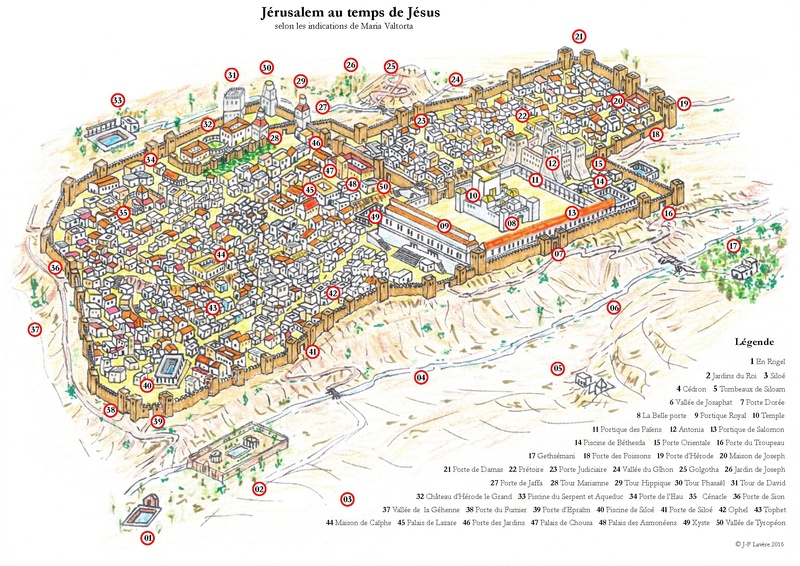
Some comments on this map[edit | edit source]
The locations of the tomb (26), the Judicial Gate (23), the Jaffa Gate (27), and the Cenacle (35) are very precisely known. This is not the case for the Asmonean palace (48), and a fortiori for the palace of Chuza (47). However, archaeologists and historians agree to place these now-lost buildings near the western side of the Temple wall (10), and south of the inner wall which linked the Temple to Herod’s castle (32). The approximation (a few tens of meters) is largely sufficient for our concerns here.
Maria Valtorta’s account perfectly matches these indications. The mystic locates the palace of Chuza (47) near the residence of Herod Antipas (32), and not far from Lazarus’ palace (45), in the residential quarter of Zion. In her narrative, Maria Valtorta also mentions an inner gate unnamed but placed between the Cenacle and the Judicial Gate. This is probably the so-called "Garden Gate," located by historians between Herod’s castle and the Temple, on the now-disappeared inner wall.
Three main routes can be identified to go from the Cenacle (35) to Joseph of Arimathea’s tomb (26):

- (in blue) Remaining intra muros up to the Judicial Gate (23). This route is the longest (1150/1200 m, requiring between 10 and 17 minutes). It is the path taken by the holy Women who leave a little before sunrise and hope to reach the Judicial Gate just as it opens.
- The second route (in red), presumably the most direct, runs intra muros along Herod’s castle (32), then exits the city by the Jaffa Gate (27) (900/950 m, traveled in 8 to 14 minutes).
- Third option (in yellow), exit the city and go along the walls from outside (925/975 m, taking between 8 and 14 minutes). This path is barely longer than the previous one and may be the fastest as it is sheltered from the crowds circulating in the city. This is the path the apostles will take to escape the crowd’s mockery during their pilgrimage back from Calvary a few days later.
Maria Valtorta’s account confronted with the gospels[edit | edit source]
Illustration video capsule[edit | edit source]
| The Morning of the Resurrection: disciples' comings and goings minute by minute, according to Maria Valtorta | |
|---|---|
| Timely analysis of the disciples' movements on the morning of Christ’s Resurrection. The evangelists’ accounts, brief and seemingly contradictory, turn out to be perfectly compatible, complementary, and credible in light of Maria Valtorta’s detailed Resurrection narrative.
Text: Jean-François Lavère - Animations: Jean-Marcel Gaudreault - Production: Emmanuel Gaudreault | |
Minute-by-minute account[edit | edit source]
Preparations[edit | edit source]
Matthew 27:62-66: "The next day, the day after the Preparation, the chief priests and the Pharisees gathered before Pilate and said, 'Sir, we remember that this impostor said while he was still alive: "After three days I will rise again." Therefore give orders for the tomb to be made secure until the third day, lest his disciples go and steal him away and tell the people, "He has risen from the dead," and the last imposture will be worse than the first.' Pilate said to them, 'You have a guard; go, make it as secure as you can.' So they went and made the tomb secure by sealing the stone and posting the guard."
- Saint John Chrysostom states that Saint Matthew wrote his gospel first for converted Jews. This likely explains why he mentions the presence of guards at the tomb, as members of the Sanhedrin had spread the rumor that the disciples had stolen Jesus’ body during the night. The other evangelists say nothing about this matter, which no longer concerned their audiences. A first-century apocryphon, the Gospel of Peter, also mentions the presence of guards.
According to Maria Valtorta: As soon as the Sabbath ended, the Women spent the night preparing the aromatics as customary. Very early Sunday, April 9, 30 (Julian calendar[7]), just before sunrise, a few minutes before 5 a.m., they leave together from the Cenacle to finish what time had prevented them from completing on Friday night.
Mark 16:1: "When the Sabbath was over, Mary Magdalene, Mary the mother of James, and Salome bought spices to go and anoint him."
- Saint Mark is the only one to provide this precision. As he addressed Gentiles in Rome or Alexandria, unfamiliar with Jewish customs, he needed to justify to them why the Women disciples came to the tomb immediately after the Sabbath to anoint the body.
"[...] it is a rather cold dawn. They put on their mantles and they take large sacks into which they put the vases of the balm. Mary stands up and looks for Her mantle. But they all crowd round Her convincing Her not to come."[8]Mary Magdalene manages everything firmly and efficiently. She persuades the Virgin Mary, too exhausted, to stay at the Cenacle. Peter remains withdrawn
"to some secluded corner to bewail his sin. John remains near the door. But he does not say anything. He would like to go as well. But he makes the sacrifice of remaining with the Mother."[9]
Eighteen minutes before the Resurrection[edit | edit source]
Maria Valtorta:"The women go out taking a lamp. (…) The Magdalene is the last to go out, after a last kiss to the Mother Who remains."[10]There are five: Mary of Alphaeus, Mary Salome, mother of the apostles John and James, Mary Magdalene, Martha, and Susanna.
Matthew 28:1: "After the Sabbath, at dawn on the first day of the week, Mary Magdalene and the other Mary went to look at the tomb." - Mark 16:2: "Very early on the first day of the week, they (i.e., Mary Magdalene, Mary, mother of James, and Salome) went to the tomb at sunrise." - Luke 24:1: "On the first day of the week, at dawn, the women went to the tomb, carrying the aromatics they had prepared." - John 20:1: "On the first day of the week, Mary Magdalene went to the tomb early in the morning; it was still dark."
Maria Valtorta:"The women, in the meanwhile, after leaving the house are walking close to the wall, shadows in the shade. They are silent for some time, all muffled up and frightened in so much silence and solitude Then, recovering confidence seeing that the town is complete in calm, they group and dare to speak."[11]
- They have a little over 700 m to cover before reaching the inner wall, which will take about ten minutes.
«Will the Gates be already open?» asks Susanna. «Certainly. Look over there at the first market-gardener who is going in with vegetables. He is going to the market» replies Salome."[11]Mark 16:3: "They said to one another, ‘Who will roll away the stone from the entrance of the tomb?’"
Eight minutes before the Resurrection[edit | edit source]
Maria Valtorta: They reach the inner wall, from which they can see market gardeners entering the city through the Jaffa Gate.
- Historians attest that an important market was held on the hill of Zion, near Herod’s castle, as Maria Valtorta’s account indicates here.
“«Will they say anything to us?» asks Susanna again. «Who?» inquires the Magdalene. «The soldiers, at the Judicial Gate. There… only few people are going in and even fewer are coming out… We shall rouse suspicion…» «So? They will look at us. They will see five women going towards the country. We could be also people who, after celebrating Passover, are going back to their villages.»"[11]Mary Magdalene’s companions are fearful of passing through the ill-reputed Judicial Gate. So Mary Magdalene decides: she will go ahead alone. Martha and Mary of Alphaeus go to fetch Joanna, who the day before had wished to accompany them. Meanwhile, Salome and Susanna wait outside the wall, watching the surroundings.[12]
"Let us do this. I will go ahead and have a look. You will follow me with Johanna. I will stand in the middle of the road, should there be any danger, and you will see me. And we will come back. [...]"[12]Then she adds, addressing her fearful sister Martha:
"«Salome and Susanna will wait for you near the Gate, outside the walls. And then you will all come together along the main road. Goodbye.»"[12]
Seven minutes before the Resurrection[edit | edit source]
"And Mary Magdalene cuts other possible comments short, as she goes away quickly with her bag full of balms and her money in her breast. She flies, so fast she goes along the road, which is becoming more delightful in the first pink shade of dawn."[12]
- Under these conditions, it takes her two to three minutes to reach the Judicial Gate.
"She goes through the Judicial Gate, to be quicker. And no one stops her…"[12]
Five minutes before the Resurrection[edit | edit source]
Maria Valtorta: Her four companions head toward Joanna’s palace, located about 200-220 meters to the east."The others watch her go, then they turn their backs to the crossroads where they were, and they take another one, narrow and dark, which near the Sixtus opens out into a wider road, where there are some beautiful houses."[13]
- The Xystus was a large colonnaded square situated between the Temple and Herod Antipas’ palace, to the east of the Zion district.[14]
Two minutes before the Resurrection[edit | edit source]
"They part again, Salome and Susanna proceed along the road, while Martha and Mary of Alphaeus knock at the iron door and show themselves at the little window (eye-hole) half opened by the porter.They enter and go to Johanna, who already up and all dressed in a very dark violet garment that makes her look even paler, is preparing some oils with her nurse and a maidservant.
«Have you come? May God reward you. But, if you had not come, I should have gone by myself… To find comfort… Because many things have remained upset after that dreadful day. And, in order not to feel alone, I must go against that Stone and knock and say: 'Master, I am poor Johanna… Do not leave me alone, You, too…'»"[13]
A few moments before the Resurrection[edit | edit source]
"«I am going, Esther.»«May God comfort you!»
They leave the mansion house to join their companions. It is at this moment that the short but strong earthquake takes place, creating a panic again in the people of Jerusalem, still terrorised by the events of Friday. The three women retrace their steps precipitately, and they remain in the large hall, among maidservants and servants who are howling and imploring the Lord, fearing new shocks…"[13]
At the moment of the Resurrection[edit | edit source]
In Joseph’s garden[edit | edit source]
"In the vegetable garden all is silent and glittering with dew.[15] (…) The guards must have lit a little fire during the night, because there are ashes and half-burnt fire-brands on the ground, and they must have played and eaten, because scattered around there are remains of food and some small clean bones, which have certainly been used for some game, like our dominoes or our children’s games of marbles, which are played on a coarse board traced on a path. Then they became tired and left things as they are now, and they tried to find more or less comfortable postures to sleep or to keep watch."[16]
- The last star has just faded with the dawn, which identifies the time precisely as 5:10 a.m.
"In the clear sky, where to the east there is now a completely rosy zone, which is spreading out more and more widely, but where, however, there are no sunbeams as yet, a very bright meteor appears, coming from unknown depths, and it descends like a sphere of fire of unsustainable splendour, followed by a glowing trail, which perhaps is nothing but the persistence of its brightness in our retinae. It descends at a very high speed towards the Earth, shedding such an intense phantasmagoric light, frightful in its beauty, that the rosy light of dawn vanishes, outshone by such white incandescence.Matthew 28:2-3: "Suddenly there was a great earthquake; an angel of the Lord came down from heaven and rolled back the stone and sat on it. His appearance was like lightning, and his clothing white as snow."The guards, astonished, raise their heads, also because with the light there comes a mighty, harmonious, solemn rumble that fills the whole of Creation with its roar. It comes from heavenly depths. It is the alleluia, the angelical glory, that follows the Spirit of’ Christ, which is returning to His glorious Flesh.
The meteor clashes on the useless closure of the Sepulchre, tear it off, throws it on the ground, and it strikes with terror and noise the guards placed as jailors of the Master of the Universe, producing with its return to the Earth a new earthquake, as it had cause one when this Spirit of the Lord fled from the Earth. It enters the dark Sepulchre that becomes all bright with its indescribable light and while it remains suspended in the still air, the Spirit is infused again into the Body, motionless under the funereal bandages..[17] (…)
The guards are there, shocked… The corrupt powers of man do not see God, whereas the pure powers of the universe – the flowers, herbs, birds – admire and venerate the Mighty One, Who passes by in a halo of His own Light and in an aureola of sunlight."[18]
In front of the entrance to Joseph’s garden[edit | edit source]
"…The Magdalene, instead, is just on the border of the path that takes one to the vegetable garden of Joseph of Arimathea, when she is caught in the powerful and also harmonious roar of this heavenly sign [...] Mary of Magdala is almost grazed and thrown on the ground by it. She bends for a moment whispering: «My Lord!» and then she straightens up like a stalk after the wind has passed by, and she runs towards the vegetable garden even faster.[19]
Near the inner wall, in Jerusalem[edit | edit source]
"…In the meantime Susanna and Salome, after leaving their companions and reaching the walls, are caught in the earthquake. Frightened, they take shelter under a tree and remain there, torn between their desire to go to the Sepulchre or to run to Johanna’s."[20]
- Susanna and Salome are then about fifty meters north of Joanna’s palace and about 250 meters from the Judicial Gate.
One minute after the Resurrection[edit | edit source]
In front of the entrance to Joseph’s garden[edit | edit source]
"She (Mary Magdalene) enters it quickly, and goes towards the sepulchre in the rock as fast as a bird that is chased and is looking for its nest. But, no matter how fast she runs, she cannot be there when the heavenly meteor acts as a lever and as a flame on the seal of lime, placed in a reinforcement for the heavy stone, or when with the final crash the stone door collapses, causing such a shake that joins the one on the earthquake, which, although of a short duration, is so violent that it knocks the guards down as if they were dead."[19]Matthew 28:4: "The guards shook with fear and became like dead men."
"When Mary arrives, she sees the useless jailors of the Triumpher thrown on the ground like a sheaf of mown corn. Mary Magdalene does not associate the earthquake with Resurrection. But looking at the spectacle, she thinks it is a punishment of God for the desecrators of Jesus’ Sepulchre, and she falls on her knees saying: «Alas They have stolen Him!»"[19]
- At this moment, Mary Magdalene does not approach the tomb, does not look inside, and so does not see an angel.
At the Cenacle[edit | edit source]
Maria Valtorta: At the same instant, Jesus appears to His Mother."The closed window is opens with a violent banging of the heavy shutters, and with the first ray of the sun, Jesus enters.::The gospels do not mention this encounter, but many Fathers have considered it highly probable.[22] And Saint John Paul II somewhat validated this passage from Maria Valtorta. Quoting Sedulius,[23] the pope considered it "legitimate to think that Mary was probably the first person to whom the risen Jesus appeared" (Audience of 21 May 1997).Mary, Who has been shaken by the noise and has raised Her head to see which wind has opened the shutters, sees Her radiant Son: handsome, infinitely more handsome than He was before suffering, smiling, lively, brighter than the sun, dressed in a white garment that seems woven light, and Who is advancing towards Her.
She straightens Herself up on Her knees and crossing Her hands on Her breast, She says with a sob that is joy and grief: «Lord, God». And She remains thus, enraptured in contemplating Him with Her face all washed by tears, but made serene, pacified by the smile and by the ecstasy."[21]
Two minutes after the Resurrection[edit | edit source]
"She (Mary Magdalene) is really disconsolate and weeps like a girl who has come, being sure that she would find her father whom she was looking for, and instead finds the house empty. She then stands up and runs away to go to Peter and John. And as she thinks of nothing but of informing the two, she forgets to go and meet her companions and remain on the road [...]"[19]
- Deeply troubled, she runs back toward the Cenacle, forgetting her companions…
Recovered from their emotion, Susanna and Salome decide to go to the tomb as agreed by passing through the Judicial Gate. "But love overcomes fear and they go towards the Sepulchre."[20]
- Running, Mary Magdalene will reach the Judicial Gate in two minutes, while it will take a little over three minutes for her companions.
Four minutes after the Resurrection[edit | edit source]
Mary Magdalene runs through the Judicial Gate and heads straight toward the Cenacle, "as far as a gazelle she goes back the road she came, she passes through the Judicial Gate [...]"[24]
Five minutes after the Resurrection[edit | edit source]
Susanna and Salome reach the Judicial Gate and, not seeing Mary Magdalene, who just passed through, continue tremblingly on to the tomb.
Six minutes after the Resurrection[edit | edit source]
Still running, Mary Magdalene passes through the Garden Gate and speeds towards the Cenacle "flies through the streets, which are a little more crowded [...]"[24]
Eight minutes after the Resurrection[edit | edit source]
Arriving at the tomb, Susanna and Salome discover the guards still fainted, the tomb open and luminous. They dare not approach further."They are still frightened when they enter the garden and see the senseless guards… they see a bright light come out of the open Sepulchre. Their fright increases and reaches its climax when, holding each other’s hand to pluck up courage, they peep in from the threshold and in the dark sepulchral cave, they see a bright most beautiful creature, that smiling kindly greets them from the place where it is standing: leaning on the right hand side of the anointment stone, which, grey as it is, disappears behind so much incandescent brightness. They fall on their knees, utterly astonished. But the angel speaks to them gently: «Be not afraid of me. I am the angel of the divine Sorrow. I have come to rejoice at its end. The sorrow of the Christ, His humiliation in death is over. Jesus of Nazareth, the Crucified Whom you are looking for, has risen from the dead. He is no longer here! The place where He was laid is empty. Rejoice with me. Go. Tell Peter and the disciples that He has risen and will precede you in Galilee. You will see Him there for a short time, as He said.»"[20]Matthew 28:5-7: "The angel said to the women: ‘Do not be afraid, for I know that you seek Jesus who was crucified. He is not here; He has risen, just as He said. Come, see the place where He lay. Then go quickly and tell His disciples: He has risen from the dead and is going ahead of you into Galilee. There you will see Him.’"
Mark 16:4-7: "Looking up, they see that the stone, which was very large, has been rolled away. Entering the tomb, they see, seated at the right, a young man dressed in white. They are frightened, but he tells them: ‘Do not be afraid! You seek Jesus of Nazareth, the crucified? He is risen; He is not here. Here is the place where He lay. Now go, tell His disciples and Peter: "He goes before you into Galilee; there you will see Him, as He told you."’"
Luke 24:2-3: "They found the stone rolled away from the tomb. They went in but did not find the Lord Jesus’ body.""The women fall with their faces on the ground, and when they raise them, they run as if they were chased by a punishment. They are terrorised and they whisper: «We shall die now! We have seen the angel of the Lord!»Matthew 28:8: "They left quickly from the tomb, filled with both fear and great joy, and ran to tell His disciples."They calm down a little in the open country and they consult with each other. What are they to do? If they relate what they have seen, they will not be believed. If they say where they come from, they may be charged by the Judaeans with the murder of the guards. No. They cannot say anything to friends or to enemies…
Fearful, dumbfounded, they go back home along a different road."[20]
Mark 16:8: "They went out and fled from the tomb, trembling and bewildered. They said nothing to anyone because they were afraid."
- Thus Susanna and Mary Salome seem to decide to return by the countryside, going along the outer wall, perhaps to avoid being seen. They have just under 1000 meters to cover, which will take them between 14 and 15 minutes to get back to the Cenacle.
Ten minutes after the Resurrection[edit | edit source]
The guards come out of their stupor. They decide to alert the Temple. It takes them about ten minutes to get there.
Twelve minutes after the Resurrection[edit | edit source]
Mary Magdalene arrives out of breath at the Cenacle."[...] she rushes against the door of the hospitable house and knocks at it furiously. The mistress opens the door to her.John 20:2: "She ran to Simon Peter and the other disciple, the one Jesus loved, and said, ‘They have taken the Lord out of the tomb, and we do not know where they have put him.’"«Where are John and Peter?» asks Mary Magdalene panting.
«There» says the woman pointing at the Supper-room.
Mary of Magdala enters and as soon as she is in, standing before the two astonished men, and in her voice, kept low out of pity for the Mother, there is more anguish than if she had shouted, she says: «They have taken the Lord away from the Sepulchre! I wonder where they have put Him!» and for the first time she staggers and is unsteady, and in order not to fall, she holds on whatever she can.
«What? What are you saying?» ask the two.
And panting she replies: «I went ahead… to buy the guards… so that they would let us be. They are there like dead bodies… The Sepulchre is open, the stone is on the ground… Who? Who did it? Oh! come! Let us run…»’[24]
Thirteen minutes after the Resurrection[edit | edit source]
Peter and John immediately set off running.Mary follows them for a few steps. Then she goes back. She seizes the mistress of the house, she shakes her, violent in her far-sighted love, and she shouts in her face: «Mind you do not let anybody go to Her (and she points at the door of Mary’s room). Remember that I am your mistress. Obey and be silent.» Then she leaves her aghast and joins the apostles, who are striding towards the Sepulchre…"[24]
Twenty minutes after the Resurrection[edit | edit source]
The guards are now at the Temple where they give the alarm and report.
Twenty-two minutes after the Resurrection[edit | edit source]
John, followed by Peter, arrives at the tomb.
- Running, John has covered the distance from the Cenacle in under ten minutes. Peter joins him after a few seconds.
John 20:3-4: "So Peter went out with the other disciple to the tomb. They both ran, but the other disciple outran Peter and reached the tomb first."
Twenty-three minutes after the Resurrection[edit | edit source]
Peter and John find the tomb empty."And John, who runs fast is the first to arrive at the Sepulchre. The guards are no longer there and neither is the angel.John 20:5-10: "He bent over and saw the linen cloths lying there, but he did not go in. Then Simon Peter came along behind him and went straight into the tomb. He saw the linen cloths lying there, as well as the cloth that had covered Jesus’ head, not lying with the linen cloths but rolled up in a place by itself. Finally, the other disciple, who had reached the tomb first, also went inside; he saw and believed. (They still did not understand from Scripture that Jesus had to rise from the dead). Then the disciples went back to their homes."John, timid and sorrowful, kneels down at the open entrance to venerate and get some indication from the things he sees. But he only sees, heaped on the floor, the linen cloths placed on the Shroud. «There is really nothing, Simon! Mary has seen accurately. Come, come in, look.»
Peter, who is breathless after so much running, goes into the Sepulchre. On the way he had said: «I will never dare to approach that place.» But now he thinks only of finding out where the Master may be. And he calls Him also, as if He might be concealed in some dark corner.
At this early hour in the morning it is still very dark in the deep Sepulchre, which receives light only from the opening of the entrance, where John and the Magdalene now cast a shadow… And Peter finds it hard to see, and has to help himself with his hands to ascertain what the situation is… He touches, trembling, the table of the anointment, and feels that it is empty…
«He is not here, John! He is not here!… Oh! come here! I have wept so much that I can hardly see in this poor light.»
John stands up and goes in. And while he does so, Peter discovers the sudarium in a corner, folded diligently and within it the Shroud rolled up carefully.
«They have really abducted Him. The guards were not here for us, but to do that… And we have let them do it. By going away, we have allowed that…»
«Oh! where will they have put Him?»
«Peter, Peter! This… is really the end!»"[25]
Luke 24:12: "But Peter got up and ran to the tomb; stooping and looking in, he saw the linen cloths by themselves, and went home, amazed at what had happened."
At the same moment Susanna and Salome return to the Cenacle. They dare not speak of what they have just experienced."They go in and take shelter in the Supper room. They do not even ask to see Mary… And in there they think that what they have seen is nothing but a deception of the Demon. Humble as they are, they conclude that «it is not possible that they have been granted to see the messenger of God. It is Satan who wanted to frighten them to send them away from there.» They weep and pray like two little girls frightened by a nightmare…"[20]
Twenty-four minutes after the Resurrection[edit | edit source]
At Johanna’s palace[edit | edit source]
Gradually reassured by the return of calm, Mary of Alphaeus, Martha, and Joanna finally decide to join their companions. They leave the palace and head for the Judicial Gate."… The third group, that of Johanna, Mary of Alphaeus and Martha, when they see that nothing new is happening, decides to go where their companions are certainly waiting for them. The go out into the streets, where by now there are frightened people, who comment on the new earthquake connecting it with the event of Friday, and see also things which do not exist.«It is better if they are all frightened! The guards may be so as well and will raise no objection» says Mary of Alphaeus. And they walk fast towards the walls.
But while they are going there, Peter and John, followed by Magdalene, have arrived at the garden."[26]
- They will be able to pass through the Judicial Gate in four to five minutes and be at the tomb three minutes later.
At the tomb[edit | edit source]
"The two disciples come out looking annihilated. «Let us go, woman. You will tell the Mother…»«I am not going away. I am staying here… Somebody will come… Oh! I am not coming… There is still something of Him here. The Mother was right… To breathe the air where He was is the only relief left to us.»
«The only relief… Now you also can see that it was nonsense to hope…» says Peter.
Mary does not even reply to him. She crouches on the ground, close to the entrance, and weeps, while the others go away slowly."[25]
"She then raises her head and looks inside, and through her tears sees two angels, sitting at the head and at the foot of the anointment stone. Poor Mary is so stupified in her fiercest struggle between hope that is dying and faith that does not want to die, that she looks at them like one whose mind is completely blank, without even being surprised. The strong woman, who has resisted everything like a heroine, has nothing left but tears.Mary turns to see what they look at and sees a very beautiful Man, and I don’t know how she does not recognize Him immediately.«Why are you weeping, woman?» asks one of the two shining young boys, because they look like very beautiful adolescents.
«Because they have taken away my Lord and I do not know where they have put Him.»
Mary is not afraid to speak to them. She does not ask: «Who are you?» Nothing. Nothing amazes her any more. She has already suffered everything that can astonish a human being. Now she is only a broken thing that weeps without strength or reserve.
The angelical youth looks at his companion and smiles. And so does the other. And in a flash of angelical joy they both look outside, towards the garden all in bloom with millions of corollas that have opened at the first sunshine on the closely planted apple-trees of the orchard."[27]
"A Man Who looks at her pitifully and asks her: «woman, why are you weeping? Whom are you looking for?» It is true that Jesus is dimmed out of pity for the woman, whom emotions have exhausted and who might die from sudden joy, but I really wonder why she does not recognise Him.John 20:11-18: Mary Magdalene was standing outside the tomb weeping. While she wept, she bent over to look into the tomb; she saw two angels in white, sitting where the body of Jesus had been lying, one at the head and the other at the feet. They asked her, ‘woman, why are you weeping?’ ‘They have taken away my Lord,’ she said, ‘and I do not know where they have put him.’ After she said this, she turned around and saw Jesus standing there, but did not realize it was Jesus. Jesus said to her, ‘woman, why are you weeping? Whom are you seeking?’ Thinking he was the gardener, she said, ‘Sir, if you have taken him away, tell me where you have laid him, and I will take him.’ Jesus said to her, ‘Mary!’ She turned toward him and cried out in Hebrew, ‘Rabbouni!’ (which means Teacher). Jesus said, ‘Do not cling to me, for I have not yet ascended to the Father. Go instead to my brothers and tell them, "I am ascending to my Father and your Father, to my God and your God."’ Mary Magdalene went to the disciples with the news: ‘I have seen the Lord!’ and told them that he had said these things to her.And Mary sobbing says: «They have taken my Lord Jesus! I had come to embalm Him while awaiting His resurrection… I gathered all my courage, my hope and my faith around my love… and now I cannot find Him any more… Or rather, I put my love around faith, hope and courage to defend them from men… but all in vain! Men have abducted my Love and with it they have deprived me of everything… O my lord, if you have taken Him away, tell me where you have put Him. And I will get Him… I will not tell anybody… It will be a secret between you and me. Look: I am the daughter of Theophilus, Lazarus’ sister, but I am on my knees before you to implore you, like a slave. Do you want me to pay you for His Body? I will do so. How much do you want? I am rich. I can give you as much gold and as many gems as it weighs. But give it back to me. I will not denounce you. Do you want to strike me? Do so. Until I bleed, if you wish so. If you bear Him a grudge, let me expiate it. But give Him back to me. Oh! don’t make me wretched with this misery, my lord! Have mercy on a poor woman!… Do you not want to do it for me? Then, do it for His Mother. Tell me! Tell me where is my Lord Jesus. I am strong. I will take Him in my arms and I will carry Him like a child to safety. Lord… lord… you can see it… for three days we have been struck by the wrath of God for what was done to the Son of God… Do not add Desecration to Crime…»
«Mary!» Jesus shines in calling her. He reveals Himself in His triumphant brightness.
«Rabboni!» Mary’s cry is really the «great cry» that closes the cycle of death. With the first one, the darkness of hatred enveloped the Victim with funereal bandages; with the second, the lights of love increased His brightness. And Mary stands up as her cry fills the garden, she rushes to Jesus’ feet and would like to kiss them.
Jesus moves her away, hardly touching her forehead with the tips of His fingers: «Do not touch Me! I have not yet ascended to My Father in this appearance. Go to My brothers and friends, and tell them that I am ascending to My Father and yours, to My God and yours. And then I will come to them.» And Jesus disappears, absorbed by an unsustainable light."[28]
Twenty-six minutes after the Resurrection[edit | edit source]
"Mary kisses the ground where Jesus was and she runs toward the house."[29]
- She likely does not go back through the Judicial Gate but rather takes the shortest way out through the Jaffa Gate. Running, it will take her about twelve minutes, and she will nearly catch up to Peter and John near the Cenacle.
Twenty-seven minutes after the Resurrection[edit | edit source]
Peter and John pass through the Judicial Gate and head toward the Cenacle.
Twenty-eight minutes after the Resurrection[edit | edit source]
Mary of Alphaeus, Martha, and Joanna pass through the Judicial Gate. They come within less than a minute of meeting Peter and John going the opposite way!
Thirty minutes after the Resurrection[edit | edit source]
Peter and John are now at the Garden Gate, walking toward the Cenacle.
Thirty-one minutes after the Resurrection[edit | edit source]
Mary of Alphaeus, Martha, and Joanna arrive at the tomb. They see the two angels, as they later testify. Maria Valtorta does not mention this scene.
Thirty-three minutes after the Resurrection[edit | edit source]
Mary of Alphaeus, Martha, and Joanna run back toward the Cenacle, which they will reach in eleven minutes.
Thirty-eight minutes after the Resurrection[edit | edit source]
Peter and John arrive at the Cenacle, closely followed by Mary Magdalene."She goes in like a rocket, because the main door is half open, to let the master pass, who is going to the fountain; she opens the door of Mary’s room and drops on Her breast shouting: «He has risen! He has risen!» and she weeps happily."[29]Mark 16:9-11: "Risen on the morning of the first day of the week, Jesus appeared first to Mary Magdalene, from whom he had cast out seven demons. She then went to announce the news to those who had been with him, grieving and weeping. When they heard that Jesus was alive and that she had seen him, they refused to believe it."
Forty-four minutes after the Resurrection[edit | edit source]
Mary of Alphaeus, Martha, and Joanna arrive breathless in turn at the Cenacle."And while Peter and John rush there, and Salome and Susanna, still frightened, come from the Supper room and listen to her narration, Mary of Alphaeus with Martha and Johanna come in, from the street, and out of breath they say «that they have been there as well, and they saw two angels, who said that they were the Guardian of the Man God and the angel of His Sorrow, and ordered them to tell the apostles that He had risen from the dead.»"[29]Luke 24:4-8: "While they were perplexed, two men stood before them in dazzling clothes. They were terrified and bowed their faces to the ground. They said to them: ‘Why do you seek the living among the dead? He is not here; He has risen. Remember what He told you while He was still in Galilee: “The Son of Man must be delivered into the hands of sinful men, be crucified, and on the third day rise again.”’ They then remembered His words.
“And as Peter shakes his head, they insist saying: «yes. They said: “Why are you looking for the Living One among the dead? He is not here. He has risen from the dead, as He said when He was still in Galilee. Do you not remember? He said: ‘The Son of man is to be delivered into the hands of sinners to be crucified. But on the third day he will rise from the dead."[29]Luke 24:9-11: "When they returned from the tomb, they reported all these things to the Eleven and to all the others. It was Mary Magdalene, Joanna, and Mary the mother of James; the others who accompanied them told the apostles the same things. But the reports seemed to them like nonsense and they did not believe them."
"Peter shakes his head saying: «Too many things during these days! They have been upset.»The Magdalene raises her head from Mary’s breast and says: «I have seen Him! I have spoken to Him. He told me that He is ascending to the Father and then He will come. How handsome He was!» and she weeps as she had never wept, now that she no longer has to torture herself to oppose the doubt rising from every side.
But Peter and John are very doubtful. They look at each other and their eyes say: «Women’s fancy!»
Then also Susanna and Salome dare to speak. But the very inevitable difference in the details of the guards that first are there like dead bodies and then are not there, of the angels that sometimes are one and sometimes are two and did not show themselves to the apostles, of the two versions concerning Jesus’ coming here or His preceding His disciples in Galilee, makes the doubt, and more than that, the persuasion of the apostles grow stronger and stronger.
Mary, the blessed Mother, is silent, supporting the Magdalene… I do not understand the mystery of this maternal silence."[30]
Forty-six minutes after the Resurrection[edit | edit source]
"Mary of Alphaeus says to Salome: «Let the two of us go back there. Let us see whether we are all intoxicated…» And they run out. The other women remain there, quietly derided by the two apostles, near Mary Who is silent, engrossed in a thought that each interprets in a personal manner, and no one realises that it is ecstasy."[31]
- Walking briskly, Mary of Alphaeus and Salome can make the round trip in thirty minutes. On the way, they will notice that the city is in turmoil and that the guards are beginning to spread the version dictated by the Sanhedrin.
One hour fifteen minutes after the Resurrection[edit | edit source]
"The two elderly women come back: «It is true! It is true! We have seen Him. He said to us, near Barnabas’ vegetable garden: “peace to you. Be not afraid. Go and tell My brothers that I have risen from the dead, and that they should go within a few days to Galilee. We shall be together again there”. That is what He said. Mary is right. We must inform those who are at Bethany, Joseph, Nicodemus, the most faithful disciples, the shepherds, we must go and do, and do… Oh! He has risen!…» and they all weep happily."[31]Matthew 28:9-10: "Then Jesus met them and said, ‘Greetings!’ They came to Him, took hold of His feet, and worshiped Him. Then Jesus said to them, ‘Do not be afraid. Go tell my brothers to go to Galilee; there they will see Me.’"
- Jesus having now returned from Heaven in his glory clothes, Mary of Alphaeus and Salome were able to touch Him, unlike Mary Magdalene forty minutes earlier.
“«You are mad, women. Grief has upset you. The light has seemed an angel to you. The wind, a voice. The sun, the Christ. I do not criticise you. I understand you, but I can only believe what I have seen: the open empty Sepulchre, and the guards who have run away with the stolen Corpse.» «But if the very guards say that He has risen! If the whole town is in a turmoil and the Princes of the Priests are mad with rage, because the guards have spoken while running away terrified! Now they want them to say something different and they are paying them for that. But it is already known. And if the Judaeans do not believe in the Resurrection, they do not want to believe, many other people do believe…»"[31]Matthew 28:11-15: "While they were going, some of the guards went into town to tell the chief priests everything that had happened. After meeting with the elders and consulting, they gave soldiers a large sum of money, saying, ‘Say, “His disciples came during the night and stole him away while we were asleep.” If this reaches the governor’s ears, we will satisfy him and keep you out of trouble.’ The soldiers took the money and did as they were instructed. This story has circulated among the Jews to this day.’'"
“«H’m! Women…» Peter shrugs his shoulders and is about to go away.Luke 24:22-27: "In fact, some women from our group amazed us. At dawn, they went to the tomb but found no body. They came back to tell us they had even had a vision: angels who said He is alive. Some of our companions went to the tomb and found things just as the women had said; but they did not see Him. Then He said to them: ‘O foolish men! How slow of heart to believe all that the prophets have declared! Was it not necessary that the Christ should suffer these things and enter into His glory?’ Then beginning with Moses and all the prophets, he explained to them what was said in all the scriptures concerning Himself."Then the Mother, Who still has on Her heart the Magdalene, who is weeping like a willow-tree in a downpour, for her too great joy, and who kisses Her fair hair, raises Her transfigured face and says a short sentence: «He has really risen. I have had Him in My arms and I kissed His Wounds.» She then bends over the head of the passionate woman and says: «yes, joy is even stronger than sorrow. But it is only a grain of sand compared to what will be your ocean of eternal joy. You are blessed because you made your spirit speak above reason.»
Peter dare not deny any longer… and with one of those sudden changes of the old Peter, who is coming back to light again, he says and shouts, as if the delay depended on the others and not on him. «Then, if it is so, we must let the others know. Those spread out in the country… look for them… take action… Come on, get a move on. If He really should come… let Him at least find us», and he does not realise that again he confesses that he does not believe blindly in His Resurrection."[32]
"Jesus Christ is no longer dead: He is risen. His resurrection is the guarantee of our own resurrection. His wounds are no longer bleeding; they now shine within Him and open for us access to eternal and glorious life. (…) Whoever promises us anything less promises us nothing. And whoever awaits this and already lives it feels irresistibly compelled to use all means, including technical and political ones, to incorporate into earthly society all it can receive now of the marvelous unity, fraternity, and bliss of God’s City."
Abbot Andrew the Apostle Richard, in L'Homme Nouveau of 21 November 1965
What to Conclude from this Investigation?[edit | edit source]
The contradictions or incompatibilities that some critics thought they saw in the Resurrection accounts given by the evangelists seemed to them good reasons to deny the Gospel’s historicity. Thanks to the detailed account transmitted to us by Maria Valtorta, it seems proven that these alleged contradictions are only apparent.
The Evangelists told the Truth![edit | edit source]
This is what the Church has always affirmed throughout the centuries. Regarding the events concomitant with the Resurrection, Maria Valtorta gives us an abundance of new elements that support this proclamation. A careful and scrupulous analysis of her account[33] makes possible a detailed and timed "reconstruction" of the episodes immediately following Our Lord's Resurrection, and this prompts several comments:
- First, this account shows that a narrative of the facts fully compatible with the different gospel testimonies can be presented, thus clearing up their supposed contradictions or inconsistencies. The analysis of Maria Valtorta’s account proves it is at least "plausible," with no detail that could cast doubt on the Gospel’s veracity. All gospel verses naturally, harmoniously, and chronologically fit into Valtorta’s account, which fully satisfies reason and strengthens faith in the truth of the four evangelists’ testimony.
- The complexity of the numerous protagonists’ movements shows the impossibility for the evangelists to report them in a few brief verses. And as I stressed at the beginning of this study, they had no reason to burden their narrative with details their readers would find useless, since many witnesses attested to the truth of these facts at the time. Maria Valtorta shows us that each evangelist freely chose to relate only the facts that seemed most significant and convincing for the audience he addressed.
- Maria Valtorta’s meticulous description of the events she mystically and mysteriously witnessed illustrates Jesus’ affirmation in the God at Work:
"And the purpose of this Work is also to clarify certain points that a number of circumstances has covered with darkness and they thus form dark zones in the brightness of the evangelic picture [...] "[34]
In a previous booklet, I tried to show how Maria Valtorta’s text can indeed shed light on research relating to dating Jesus’ life, as is the case here for the Resurrection. Some hesitate to consider elements drawn from private revelation on the grounds that they cannot constitute "proof." Let us meditate on what Dom Guéranger wrote on this subject. Commenting on the writings of Marie d’Agréda, but his remarks can equally concern Maria Valtorta’s account:"God knows many things that we actually ignore; nothing prevents Him from revealing them if He sees fit. And if the story given to us by those to whom He wanted to manifest something contains nothing contrary to the Church’s Doctrine, one is free, without doubt, not to give assent; but one should have direct evidence to accuse the person of recklessness, especially if their holiness remains incontestable."[35]
"Do not stand with compasses and small measuring instruments, with microscope and human science, with pedantic reasoning of scribes trying to measure, compare and discuss whether John has spoken the truth and to what extent this or that is true."[36]And again:
"Are your proud thoughts not upset by such questions which rise towards the realms of Truth, closer and closer to it, and find a reply only in a humble heart full of faith?"[37]
Notes and references[edit | edit source]
- ↑ Dei Verbum no. 11.
- ↑ Romans 10:9.
- ↑ 1 Corinthians 15:12-18.
- ↑ The myrrhbearers in the Orthodox tradition are the holy women who brought perfumes and fragrant spices (myron) to Christ’s tomb after His crucifixion, to anoint His body.
- ↑ Acts 10:40-41.
- ↑ 1 Corinthians 15:6.
- ↑ The Julian calendar is the solar calendar instituted by Julius Caesar in Ancient Rome. It was used in Western Europe until 1582 when its drift from actual time by 10 days was eliminated in one go by Pope Gregory XIII, giving birth to our current calendar. This explains, for example, the difference between Christmas dates in the Catholic and Orthodox churches that retained the old calendar.
- ↑ GRM 616.6/7.
- ↑ GRM 616.7.
- ↑ GRM 616.9.
- ↑ 11.0 11.1 11.2 GRM 619.1.
- ↑ 12.0 12.1 12.2 12.3 12.4 GRM 619.2.
- ↑ 13.0 13.1 13.2 GRM 619.3.
- ↑ Flavius Josephus, Jewish Antiquities L 20, chap. 8, 11; Jewish war L 6, III,2; VI, 2 and VIII, 1.
- ↑ GRM 617.1.
- ↑ GRM 617.2.
- ↑ GRM 617.3.
- ↑ GRM 617.6.
- ↑ 19.0 19.1 19.2 19.3 GRM 619.4.
- ↑ 20.0 20.1 20.2 20.3 20.4 GRM 619.6.
- ↑ GRM 618.1.
- ↑ St Ambrose (Libr. Ultim. De Virginibus cap. III, about 397): "Mary saw the resurrection of the Lord; she saw it first...". See also St Anselm, St Bonaventure Meditations on the Life of Jesus ch. 86 ("While she prayed thus and shed tears of tenderness, suddenly the Lord Jesus appeared, clothed in garments of dazzling white"). Francisco Suarez (1548-1617) and Baronius also mention this "old tradition," traceable in the apocryphal (and Gnostic) Gospel of Bartholomew, from the 5th century, chap. IX, 1-3 to XI, 3.
- ↑ Sedulius, a 5th-century poet echoing an oral tradition passed by Saint John, Carmen Paschale, 5, 357-364.
- ↑ 24.0 24.1 24.2 24.3 GRM 619.5.
- ↑ 25.0 25.1 GRM 619.8.
- ↑ GRM 619.7-8.
- ↑ GRM 619.9.
- ↑ GRM 619.10.
- ↑ 29.0 29.1 29.2 29.3 GRM 619.11.
- ↑ GRM 619.11-12.
- ↑ 31.0 31.1 31.2 GRM 619.12.
- ↑ GRM 619.12-13.
- ↑ Note that this study required several weeks of verification and analysis, while Maria Valtorta wrote these twenty pages of "testimony" in only three days (February 21, 1944, and the first two days of April 1945)!
- ↑ GRM 652.
- ↑ Dom Guéranger, Mary of Agreda, Lecture no. 27.
- ↑ GRM 464.20.
- ↑ GRM 487.6.