


Osservatore Romano (12/01/1961)
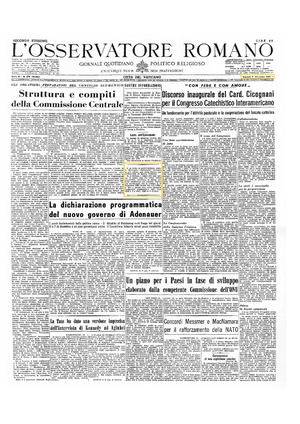
The Osservatore Romano (O.R.) of this date carries a brief note extending the Indexing, pronounced on December 16, 1959 and commented on in the O.R. of January 6, 1960, to a new edition in preparation. This second edition, in ten volumes, will span from 1961 to 1967.[1]
Context[edit | edit source]
This brief note must be placed in the context of the visit to the Holy Office of Father Corrado Berti where he had been "summoned" a year earlier, in December 1960.
There he met a new commissioner, Father Marco Giraudo, a Dominican.[2] Seeing that he could calmly dialogue this time,[3] he reported to him the words pronounced in audience by Pope Pius XII in 1948, and provided him a photocopy of attestations on Maria Valtorta's writings drafted by three consultants of the Holy Office: the future Cardinal Augustin Bea, Msgr. Ugo Lattanzi, and Father Gabriel Roschini. Father Berti recounts the rest:"Father Giraudo, who was unaware of the words of Pius XII and the attestations of these three persons of the Holy Office itself, received Father Berti several times afterward. After consulting his superiors and reflecting on the attestations, he pronounced these words: 'Continue publishing this second edition. We will see how the world receives it.'".[4] And so The Poem was published, and continues to be published, not only by order of Pius XII, but also with the approval of the Holy Office (1961)[2]".
It is therefore with the verbal authorization of the commissioner of the Holy Office (who had reported to his hierarchy) that the second edition continued. This anecdote perhaps explains the form and content of this extension of condemnation, sober and moderate, which contrasts with the grandiloquence of the first one.
Between December 1960, when Father Berti was summoned to the Holy Office (several times thereafter), and the brief note of December 1, 1961, an anonymous article (an unusual practice) appeared in Civiltà Cattolica on July 1, 1961 (issue 2665) which wrote a virulent indictment concerning the second edition:"(This work is) a monument of childishness, fantasies, and historical and exegetical falsehoods, diluted in a subtly sensual atmosphere due to the presence of a swarm of Women following Jesus. A monument, in short, of pseudo-religiosity."
The statement[edit | edit source]
Reconstructed Italian text[edit | edit source]
"È in corso di pubblicazione, senza il necessario imprimatur, un opera in più volumi, dal Tituslo Poema dell’Uomo-Dio di Maria Valtorta. Si avvertono i fedeli che tale opera, la quale non ha alcun valore scientifica, riproduce la stessa materia contenuta nel quattro volumi già condamanati dal S. Offizio il 16 dicembre 1960 (A.A.S. vol. LII | 1960 | p. 60) e perciò essa deve ritenersi parimente condamnata (cfr. Can. 1398 § 2 e Can. 1399 n. 5 C.I.C.)"
Indicative French translation[edit | edit source]
« Il est actuellement en cours de publication, sans l’imprimatur requis, une œuvre en plusieurs volumes intitulée Le Poème de l’Homme-God de Maria Valtorta. Les fidèles sont avertis que cette œuvre, qui n’a aucune valeur scientifique, reprend la même matière que celle contenue dans les quatre volumes déjà condamnés par le Saint-Office le 16 décembre 1960 (Acta Apostolicæ Sedis, vol. LII | 1960 | p. 60). Par conséquent, elle doit être considérée comme également condamnée (cf. Can. 1398 § 2 et Can. 1399 n. 5 du Codex Iuris Canonici). »
English translation[edit | edit source]
"A multi-volume work titled The Poem of the God-Man by Maria Valtorta is being published without the necessary imprimatur. The faithful are warned that this work, which has no scientific value, reproduces the same material contained in the four volumes already condemned by the Holy Office on December 16, 1960 (Acta Apostolicae Sedis, vol. LII | 1960 | p. 60), and therefore it must be considered equally condemned (cf. Can. 1398 § 2 and Can. 1399 no. 5 CIC)."
Comments and hypotheses[edit | edit source]
This statement gives the impression of minimal effort, out of step with what is presented as a serious and public disobedience, almost a challenge. The Holy Office had promised sanctions (November 29, 1948) if Father Corrado Berti continued to deal with the work (which was the case here[5]) and had summoned him (February 22, 1949) to this effect.[6] But nothing happened to him thereafter.
On the other hand, the mention that the work "has no scientific value" is surprising and seems marginal (this is not a canonical motive for condemnation). It is almost certainly an allusion to the preface of the first volume released at this date: it was written by Luciano Raffaele, general secretary of the Italian Society of Parapsychology.[7] This was an unfortunate stratagem devised by Father Corrado Berti to present Maria Valtorta's visions as a parapsychological phenomenon. Maria Valtorta opposed such an idea.[8] This initiative was soon withdrawn.
It is still unknown (2025) what motivated the new summons of Father Corrado Berti, nor who commissioned it (Father Marco Giraudo evidently discovers the file). These elements should undoubtedly be linked to the creation, after the death of Pius XII (October 1958), of a new Maria Valtorta dossier which therefore probably did not contain the whole history, notably that related to Pius XII's position that Father Marco Giraudo discovered along with those of his supporters. These events must however have been remembered. It is conjectured that a Vatican authority recalled them and was behind this new meeting leading to the verbal authorization to print.
The hypothesis of Msgr. Giovanni Battista Montini (Paul VI)[edit | edit source]

Among all possible hypotheses, one may focus on Msgr. Giovanni-Battista Montini, future Paul VI, the very one who abolished the Index. He had been Substitute for General Affairs at Pius XII’s Secretariat of State (of whom he was a daily close associate) during the troubles with the Holy Office. Appointed archbishop of Milan on December 12, 1954, he was no longer in office at the Vatican in 1960 but remained a figure listened to and consulted by John XXIII. The pope regularly consulted him, especially on international affairs, episcopal appointments, and the preparation of the future Second Vatican Council. Cardinal G.B. Montini could only have read about the Indexing in the Osservatore Romano and must have raised the support of the late Pope at the Vatican which probably triggered the "diplomatic" intervention mentioned here.
This hypothesis is further supported by the following five points:
- Fact: He was the Pope who transformed the Holy Office into the Congregation for the Doctrine of the Faith (1965) and suppressed the Index (1966).
- Hypothesis: In 1960, it was Msgr. Domenico Tardini, long-time colleague of Msgr. Giovanni Battista Montini, who was the Secretary of State of Pope John XXIII for a little longer. He was also aware of the Valtorta affair and the request for imprimatur from Pius XII (October 25, 1948). Informal communication must have been facilitated.
- Testimony: Father Corrado Berti reports that during an approximately one-hour interview with his secretary, Msgr. Macchi, he learned "with great astonishment that it was said and repeated that the work (of Maria Valtorta) was not on the Index". He was therefore aware of the episode.
- Fact: Moreover, Msgr. Macchi confided to him, in the same context, that Paul VI, then archbishop of Milan, had partially read Maria Valtorta,[9] appreciated her, and ordered the book for the major seminary.
- Fact: He had sent a letter of encouragement to Father Gabriel M. Roschini for his laudatory work on "The Virgin Mary in the writings of Maria Valtorta".
The "repentance" of the Holy Office[edit | edit source]
This "repentance" of the Holy Office mentioned later by Msgr. Mario Crovini in a chance meeting with Emilio Pisani in 1982 should undoubtedly be dated to this time and context. As substitute of the Supreme Congregation of the Holy Office and first censor of the Catholic Church, he was an aide to Cardinal Alfredo Ottaviani. He confided: "We immediately repented for having put the Work of Maria Valtorta on the Index." He must have known a lot, notes E. Pisani, "but a slip-up on my part stopped him, and he said nothing more. I still regret it!" The minimal publication of the brief note appears to be a consequence without shedding light on the causes.
Notes and references[edit | edit source]
- ↑ Reissue of this second publication on Internet archives.
- ↑ 2.0 2.1 Father Corrado Berti: sworn statement (1978).
- ↑ This was not the case during his previous summons where he was not allowed to speak.
- ↑ In her notebooks, dated May 12, 1949, Maria Valtorta noted: "Look, my every bitterness (following the attempt to destroy the work), every sorrowful look at the future changes into rejoicing, because I am told that I will see the Work approved but will die before it is published." (The Little Notebooks, May 12, 1949).
- ↑ COLLECTIVE - Maria Valtorta, What to think? CEV, 2024: Testimony of Emilio Pisani, pp. 31 to 34.
- ↑ Holy Office - Attempt to destroy the work of Maria Valtorta (1949), Chronology of events.
- ↑ COLLECTIVE, Maria Valtorta, What to think?, CEV, 2024, p. 34.
- ↑ In a dictation of February 8, 1949, Jesus said to Maria Valtorta: "Nobody would ever allow the Work that I have given you to be dressed up as “scientific”. In this case science could only be explained as a pyschic phenomenon, in other words satanic." (The Little Notebooks, February 8, 1949).
- ↑ Pope Francis also did this when he was a cardinal in Argentina.