


Alphaeus of Jacob
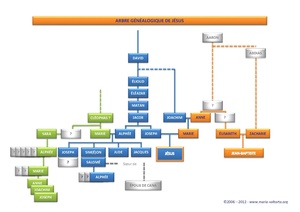
A Judean of the race of David, he was probably born in Bethlehem, like his younger brother Joseph. Following political troubles, they emigrated about thirty years ago to Nazareth in Galilee:[1]
Thaddaeus (one of his sons) recalls the paternal goods of Judea from which they were expelled, losing much of their fortune.[2]
This paternal uncle of Jesus is the elder brother of Saint Joseph, about fifteen years his junior. He married a Galilean: Mary, daughter of Cleophas. They had four sons whom the Gospels call the "brothers" of Jesus, according to the usage of the time: Joseph, Simon, Jude, and James.
The first two, Joseph and Simon, were married with children. Their Wives are the "sisters" of the Lord. The latter two, Jude and James, are among the twelve apostles.
Alphaeus is not to be confused with Clopas or Cleophas as propagated by a long tradition. On this point, see the paragraph below.
Character and appearance
At the beginning of Jesus' public life, he is 80 years old. His authoritative and stubborn character does not improve. His illness makes him cantankerous. His younger brother Joseph, husband of the Virgin Mary, died a few years earlier, so he claims to have a say in the conduct of his nephew Jesus.
His conflict with Jesus
Alphaeus opposes Jesus whom he considers mad, a cause of scandal for the family. He is joined in this by his two eldest sons, Joseph and Simon.
This acrimony tortures his Wife and the two youngest sons, who were already believers.[3]
Oscillating between curse and gratitude, old Alphaeus makes life miserable for those around him.[4] This is an opportunity to measure the dedication of the Virgin Mary and the compassion of Jesus: this attitude does not discourage them.
He dies in the month of August 27, the first year of public life. This death frees James from his filial obligations, enabling him to join his brother Jude following Jesus.
"Alphaeus has died in my name," Jesus told them to calm the anguish caused by their father's hostility towards Jesus.[5] The other two sons of Alphaeus, Joseph and Simon, would join Jesus only later, after long questioning.
His name
Two etymologies compete:
- Alphaeus (Halphaï), a name of Semitic or Aramaic origin.
- Alphaeus, Greek transcription of the Aramaic name Chalphi[6]
Where is he mentioned in the work?
GRM 25 GRM 38 GRM 51 GRM 57 GRM 93 GRM 95 GRM 99
Cleophas or Alphaeus?
The phrase in John 19:25, according to which "Near the cross of Jesus stood his mother and his mother's sister, Mary the wife of Cleophas, and Mary Magdalene", has led to assumptions and wild speculations. In the Golden Legend, Jacobus de Voragine constructs a genealogy ending with Anne, the mother of the Virgin Mary, having had three husbands, from whom she had a second Mary, wife of Alphaeus and mother of four sons: James, Joseph, Simon, and Jude.
If the conclusion is true, the reasoning is skewed by the assertion of Eusebius of Caesarea, speaking of Simon, second bishop of Jerusalem:
He was, it is said, a cousin of the Savior. Hegesippus[7] indeed relates that Clopas was the brother of Joseph.[8]
This "it is said" which turns into a reliable source is the danger of extrapolations from an isolated piece of data.[9] St. Jerome's Vulgate, like the New Vulgate of 1979, both say the same:
stabant autem iuxta crucem Iesu mater eius et soror matris eius Maria Cleopae et Maria Magdalene.
They do not specify the relationship, which can be validly translated as wife of Cleophas or as daughter of Cleophas, the latter being the interpretation adopted by Maria Valtorta. This last explanation naturally makes simple and coherent the assertion that among the "brothers" of the Lord was the apostle James, son of Alphaeus.
Notes and references
- ↑ In 35 BC, the Hasmonean revolt against the Herodians broke out. The former were the ruling dynasty descending from the Maccabee brothers who drove out the Greek Seleucids, profaners of the Temple. The latter were supporters of Herod the Great who seized power by assassinating his Hasmonean wife. See the genealogical tree. It follows that the ancestors of Alphaeus and Joseph, the foster father of Jesus, must have been supporters of the legitimate Hasmonean dynasty.
- ↑ GRM 404.4
- ↑ GRM 95.5
- ↑ GRM 100.3/6
- ↑ GRM 253.3
- ↑ 1 Maccabees 11:70
- ↑ Hegesippus (born about 115 in Jerusalem and died in 180) was a 2nd-century Christian writer whose history and writings are mainly known through what Eusebius of Caesarea reports in his Ecclesiastical History, as Hegesippus’ writings have disappeared.
- ↑ Eusebius of Caesarea, Ecclesiastical History, 3.11. 'Eusebius of Caesarea' (c. 260 – c. 339/340), theologian and historian, was born in Palestine, and is nicknamed the 'Father of Ecclesiastical History'.
- ↑ John 19:25