


Nazareth

Inhabitants or natives[edit | edit source]
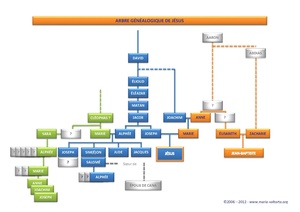
Jesus and his family[edit | edit source]
Jesus, the Virgin Mary, his mother, Saint Joseph, his foster father, Anne and Joachim, his maternal grandparents, Alphaeus of Jacob, his uncle, Alphaeus of Simon, his nephew.
His cousins[edit | edit source]
James son of Alphaeus, the apostle, Joseph of Alphaeus, Jude son of Alphaeus (Thaddeus), the apostle, Simon of Alphaeus.
The inhabitants[edit | edit source]
Alphaeus of Sarah, Asa the donkey-driver, Ishmael the donkey-driver, Benjamin, Eliakim,[1] Esther and Samuel the unworthy son, Simeon, Levi the synagogue leader.
Description[edit | edit source]
The house of the Holy Family[edit | edit source]
"'There is Your house, Mary' says Joseph, pointing with his whip to a little house which is just under the edge of an undulation of the hill. Behind the house there is a lovely large kitchen garden all in bloom, at the end of which there is a small olive-grove. Behind the olive-grove there is the usual boundary hedge of hawthorn and cactus. The fields that once belonged to Joachim, are farther beyond… 'As You can see, very little is left for You' says Zacharias. 'Your father’s illness was a long and expensive one. Also the expenses to repair the damage done by the Romans were heavy. See? The road took away the three main rooms and the house was cut down in size. In order to enlarge it, without excessive expenses, a part of the mountain was adapted, where the grotto is. Joachim kept his supplies there and Anne her looms. You will do as You think best.'"[2]
"And Joseph shows Her his work: 'See? I dug a hole here to gather the rain water, because these vines are always thirsty. I cut off the oldest branches of this olive tree to strengthen it and I transplanted these apple trees because two of them had withered. Over there I planted some fig trees. When they grow up they will shelter the house both from the excessive heat of the sun and from inquisitive people. The pergola is the old one. I only changed the rotten poles and I did some trimming. It will give You a lot of grapes, I hope. And here, look» and he leads Her proudly towards the side of the hill at the back of the house, which limits the northern side of the garden, «here I dug a grotto and I have reinforced it and when these little plants take roots, it will be almost identical to the one You had. There is no spring… but I hope to convey a little stream there. I will work in the long summer evenings, when I come to see You…'"[3]
"Coming from the Sephoris countryside one enters Nazareth on the north-eastern side, that is, on the highest and rockiest side. The entire amphitheatre, on the terraces of which Nazareth is spread, appears when one reaches the top of the hill, which is the last one coming from Sephoris and which slopes down rather steeply through ravines towards the town. If I remember correctly, because a long time has passed and many mountain places are alike, the spot where Jesus is, is the precise one where his fellow-citizens tried to stone Him, but He stopped them with his power by walking through them."[4]
A stone bench is set against the wall of the house.[5]
In GRM 85.2, Jesus himself describes Galilee and his town.
Notable events[edit | edit source]
The Annunciation to Mary (divine conception of Jesus).[6]
The disbelief of the Nazarenes[7] turned into hostility during the Passion:
"Oh! no. Many, even from Nazareth, insulted him. It is known. What a shame!"[8]
His name[edit | edit source]
תנצר (Nasareth).;[9] Nazareth (Naşèrèt) may mean "verdant" or "keeper" - Other names: Nazara, Nasirah, En Nasira, Japhia, Mash-had, en-Nasirah, Nazerat, Nazareth of(in) Galilee, Yafti en Nasra.
Where is it mentioned in the work?[edit | edit source]
GRM 2 GRM 4 GRM 5 GRM 7 GRM 14 GRM 16 GRM 18 GRM 19 GRM 26 GRM 27 GRM 31 GRM 37 GRM 38 GRM 39 GRM 39 GRM 42 GRM 44 GRM 57 GRM 89 GRM 93
GRM 100 GRM 101 GRM 105 GRM 106 GRM 150 GRM 156
GRM 264
GRM 303 GRM 312 GRM 313 GRM 336
GRM 433 GRM 434 GRM 435 GRM 436 GRM 437 GRM 439 GRM 440 GRM 442 GRM 478
GRM 562 GRM 566 GRM 596 GRM 599
GRM 632
Learn more about this place[edit | edit source]

Notebooks 1943[edit | edit source]
Relics given by Heaven:
"Can you say that I have not loved this land, where I have brought the relics of my life and my death: the house in Nazareth where I was conceived in an embrace of luminous ardor between the Divine Spirit and the Virgin, and the Shroud where the sweat of my Death imprinted the sign of my pain, suffered for humanity?"[10]
.jpg)
According to the work of Maria Valtorta, these two relics would therefore be authenticated. Regarding the House of Nazareth, this concerns the translation of this Holy House of Loreto, in Italy, in the 13th century. The website mariedeNazareth.com[11] explains this point: it involves the maritime transfer from Palestine to Italy, by the Angeli family, of the house of Nazareth during the conversion of the Nazarenes to Islam. The importance of the event and the similarity of "Angéli" with the angels, would have given rise to a legendary story.
Excerpt from the Geographical Dictionary of the Gospel According to Maria Valtorta, by Jean-François Lavère:
The village of the Holy Family
The village in which Jesus lived thirty years of his earthly life is well certainly mentioned, by the evangelists and in the Acts of the Apostles. It is also very present, in Maria Valtorta's text. From the first chapters she gives a brief overview. "the white village can be seen amongst the green of the trees, with its houses scattered up and down the sweetly undulating slopes, gently declining in some cases, more steep in others."[12]
Then, it is Jesus Himself who praises the charms of his village to his new disciple Simon the Zealot: "And My Nazareth! All ready to be kissed by the sun, all white and green, charming, between the two giants of the Great and Small Hermon, and the pedestal of mountains supporting the Tabor: a pedestal with sweet green slopes, which raise their lord, often covered with snow, up towards the sun. The Tabor is so beautiful when the sun shines on its top, which then becomes pinkish alabaster, whereas on the other side, Mount Carmel is the hue of lapislazuli in certain hours of great heat [...] And further down, to the south, is the fertile flowery plain of Esdraelon".[13]
Though not mentioned in the Old Testament, Nazareth was not really an "insignificant village",[14] as it is evidenced by recent findings, that the village of Jesus extended over four or five hectares, and included about forty households. Its population, at Jesus' time, is estimated at around 400 inhabitants. Nazareth was essentially an agricultural village.[15]
Gallery[edit | edit source]
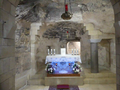
The house of Mary, Nazareth, in 2022.

Under the Basilica of the Annunciation, Nazareth, in 2022


Explore[edit | edit source]
• 32° 42’ 07’’ N / 35° 18’ 12’’ E
• +370m/410m
Notes and references[edit | edit source]
Article partially based on the Geographical Dictionary of the Gospel According to Maria Valtorta, by Jean-François Lavère.
- ↑ GRM 562.
- ↑ GRM 14.3.
- ↑ GRM 14.5.
- ↑ GRM 433.1.
- ↑ GRM 101.1.
- ↑ GRM 16.
- ↑ GRM 106.
- ↑ GRM 632.
- ↑ Hebrew alphabet on croixsens.net.
- ↑ Notebooks 1943, July 22.
- ↑ Archived article February 2, 2015.
- ↑ GRM 57.1
- ↑ GRM 85.2.
- ↑ John 1:45-46
- ↑ See especially the findings of 1996/1997 Stephen Pfann and Yehudah Rapuano, On the Nazareth Village Farm Report.