


Mar (Msgr.) Benoît Gregorios and Maria Valtorta

Born in 1916 and died in 1994, Benoît Mar Gregorios (Varghese Thangalathil by birth) was a Primate of the Syro-Malankara Catholic Church and a Council Father. The foundation of this Church of Kerala (India) is said to trace back, like others, to the apostle Thomas.
The Syro-Malankara Catholic Church[edit | edit source]
It is one of the 23 Eastern Catholic churches, in full communion with Rome, but with its own liturgy and organization, rooted in its history.
Tradition holds that the apostle Thomas arrived on the Malabar coast around the year 52 and founded several Christian communities. It is certain that an organized Christian community existed in this region from the earliest centuries, linked to trade between the Near East and India. These Christians were in contact with the Syriac-speaking churches of Mesopotamia, from which they received their liturgy, their sacred language (Syriac[1]), and part of their theology and ecclesiastical organization. In these churches, prelates and saints bear the name "Mar," an Aramaic word meaning "Lord," found in the expression "Maranatha" (Lord, come!) which concludes the Book of Revelation.
The arrival of the Portuguese (Vasco da Gama, 1460?–1524), who sought to Latinize these churches, provoked a split between the Syro-Malabar Church, which joined Rome, and another branch that moved away from it. Some of these dissidents rejoined Rome in the twentieth century (1932) under the impetus of Metropolitan Mar Ivanios (1882–1953), who became the Primate of the Syro-Malankara Church until his death. He had in the meantime founded the congregation of the Imitation of Christ (O.I.C.) and a hermitage (ashram) which Benoît Gregorios, his successor, joined.
The see of the Syro-Malankara Church is in Thiruvananthapuram (or Trivandrum), capital of Kerala. The Syro-Malabar Catholic Church, the older one, has its see in Ernakulam (Kerala). Cardinal Antony Padiyara was its head at the time.
Opinion on the Work of Maria Valtorta[edit | edit source]
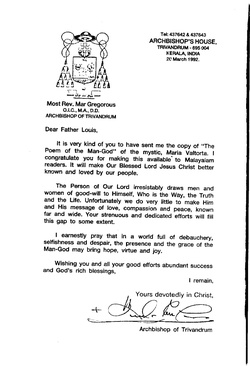
20 March 1992
Dear Father Louis,
It is very kind of you to have sent me the copy of “The Poem of the Man-God”[2] of the mystic, Maria Valtorta. I congratulate you for making this available to Malayalam readers.[3] It will make Our Blessed Lord Jesus Christ better known and loved by our people.
The Person of Our Lord irresistably draws men and women of good-will to Himself, Who is the Way, the Truth and the Life. Unfortunately we do very little ta make Him and His message of love, compassion and peace, known far and wide. Your strenuous and dedicated efforts will fifi this gap to some extent.
I earnestly pray that in a world full of debauchery, selfishness and despair, the presence and the grace of the Man-God may bring hope, virtue and joy.
Wishing you and all your good efforts abundant success and God’s rich blessings,
I remain,
Yours devotedly in Christ,
Archbishop of Trivandrum
Notes and references[edit | edit source]
- ↑ Syriac is an Aramaic dialect that spread with the emergence of Christianity.
- ↑ Known today under the title The Gospel as Revealed to Me.
- ↑ Malayalam is a local language of India, spoken primarily in Kerala.