The Presumed Private Revelation of Maria Valtorta
 See also:
In 2008, concluding the synod on the Word of God in the Life and Mission of the Church[1], the bishops summarized private revelations in a simple phrase buried in a resolution entirely devoted to sects[2]. They proposed "to help the faithful to properly distinguish the Word of God from private revelations." This negative phrasing, which does not say what private revelations are, was given a positive spin by Benedict XVI in his post-synodal exhortation Verbum Domini of September 30, 2010. He goes beyond the terse formula used by the bishops to specify what they are. Indeed, it is in this second approach that true discernment lies, and this is precisely what the pope does in the second part of §14 of his exhortation:
"The criterion for establishing the truth of a private revelation is its orientation towards Christ himself. When it leads us away from Him, then it certainly does not come from the Holy Spirit, who leads us to the Gospel and not away from it. Private revelation is a help to faith, and it proves credible precisely because it refers to the one public revelation."
He cites the terms of his theological commentary (end of document) published ten years earlier. This thought is therefore a constant. Establishing the truth, as a private revelation, of the work of Maria Valtorta is thus to evaluate:
- whether it is oriented towards Christ or turns away from Him,
- whether it leads to the Gospel or diverts from it,
- whether it refers to the one Public Revelation or purports to free itself from it.
Seven characteristics to judge its authenticity.[edit | edit source]
Benedict XVI, in his post-synodal exhortation, recalls the affirmation of the Dogmatic Constitution on Divine Revelation Dei Verbum § 2 by Paul VI (November 18, 1965): Jesus Christ is "the mediator and fullness of all Revelation". The author of the Brief Warning extracts from the same document a quotation that he opposes to the writings of Maria Valtorta:
"Thus God, who spoke long ago, ceases not to converse with the Bride of his Beloved Son, and the Holy Spirit, through whom the living voice of the Gospel resounds in the Church and, through the Church, in the world, leads the faithful into the whole truth and causes the word of Christ to dwell in them richly (Ibid, § 8)."
This dogmatic constitution could not have been better chosen for the discernment of Maria Valtorta's readership as it demonstrates, several years before these texts, their extreme pertinence.
1 - Degree of conformity to the canonical Gospel.[edit | edit source]
The work of Maria Valtorta covers the entirety of the 373 narrative units (pericopes[3]) of the canonical Gospel, without omission, without incoherence, without contradiction, since Jesus had only one life on Earth and not four as there are evangelists. The work of Maria Valtorta thus adopts a fidelity to the eternal Gospel that is not found in any of the popular lives of Jesus, which rely almost exclusively on a few selected verses, whereas Maria Valtorta's work covers 98.5% of the 3,781 Gospel verses[4]. Thus, there is no room in this narrative for imagination or supposition of another gospel.
More than modern essays on the life of Jesus which cut references to the Bible, Maria Valtorta’s work refers to it, in accordance with the teaching of the Magisterium recalled by Pius XII in his encyclical Divino Afflante Spiritu (1943)[5]
2 – Degree of biblical apprehension.[edit | edit source]
Moreover, the work includes implicit or explicit reference to 1,166 chapters of the Bible out of the 1,334 that compose it[6], i.e. 87% of the whole. This covers all its 73 books and all 150 Psalms.
While the canonical Gospel quotes 113 verses from the Old Testament (Bible before Jesus), David Amos, a reader, listed in Maria Valtorta’s work 3,133 appropriate verses from the Septuagint (Greek translation of the Torah used at Jesus’s time), sweeping almost all its 46 books.
Therefore, Maria Valtorta’s work accomplishes structurally and centrally this "typological reading[7]" which alone preserves "the unity of the Divine Plan[8]" and which is illuminated from the Gospel. This largely explains the strong attachment of readers to this work which leads them so vividly and extensively to the Holy Scripture[9], in which they find "the strength of their faith, the nourishment of their soul, the pure and permanent source of their spiritual life"[10].
3 - Faithfulness of the work to the Church’s traditional teaching.[edit | edit source]
Furthermore, as Jesus explicitly indicates in Maria Valtorta[11], the Church has truly been willed, from the beginning, such as it is in its structure, Doctrine, foundations and sacraments, contrary to a destructive contemporary school that sees all this as a progressive human construction. Analogously, Creation was made by God in its fullness[12] and entrusted to men for management so that they inhabit and make it fruitful, likewise the Church.
Thus, the reader of Maria Valtorta is guided towards a perception of the fullness of Revelation and understanding of its concretization: the Church.
In this case, how to suspect the work of wanting "to complete" the Public Revelation since it only explains what exists, and how to suspect it of announcing a "new" revelation since it rests only on its foundation?
4 - Proven faithfulness of the author to the Church.[edit | edit source]
As Cardinal Lercaro said regarding Padre Pio, Maria Valtorta suffered like him for the Church, but also by the Church[13]. These sufferings were caused as much by the overzealous humanity of the Servites in charge of promoting the work, as by that of some members of the Holy Office averse to it. Both were disobedience: the former to Jesus’s instructions, the latter to the Supreme Pontiff’s opinion. One must know the sum of efforts and trials that Maria Valtorta needed - including the Invisible Stigmata - to be the "instrument" willed by God, to share the extreme pain that was hers facing these attitudes. Bedridden and orphaned, she came to offer the only thing she still had: her spirit.
The letter she wrote to Msgr. Carinci, a close associate of Pius XII who was her supporter, illustrates well the dismay that, yesterday as today, overwhelms the faithful facing certain backroom maneuvers:
"I was taught that the pope is infallible in judging faith and morals, that he is the supreme head of the Church and the common father of all Catholics. I was taught that the most excellent bishops receive the fullness of the priesthood, and thus the enlightenment of the Holy Spirit, and so their judgment is illuminated by God. This is what my religion teachers taught me with catechism, and it is what I have always believed and still believe. Then the Divine Master taught me that the Holy Spirit cannot give contradictory inspirations about a single thing, being the unique inspiring Spirit. […] And further, He taught me that this is why, constituting His Church, He took Peter and made him head and wished for him to perpetuate until the end of the ages so that the word of the head, in case of dispute, would be pronounced to end all disputes. Finally, He told me, and repeats incessantly, that he to whom the election after Peter made another Christ can only recognize the Christ who speaks in the doctrinal pages of the work […] Now, here is what is happening is in open opposition to all this, and it is as if the whole world, the world of my absolute faith in the Church's teachings, were collapsing and it creates a painful stupor in my soul which remains shaken[14]".
This letter was read to Pius XII who emphasized the rectitude of the author’s soul.
5 – An inspired work to better understand.[edit | edit source]
Forty-five years before the Catechism of the Catholic Church, Jesus specifies what the gift of the work is relative to the canonical Gospel:
"The work which is given to men through little John [Maria Valtorta] is not a canonical book. But it remains an inspired book which I am giving to help you understand certain passages in the canonical ones and especially to comprehend what my time as Master was like and know Me‑I, the Word, in my words."[15]
Here we find the definition of CCC § 67:
"[The role of private revelations] is not to "improve" or "complete" the definitive Revelation of Christ, but to help live it more fully at a certain moment in history."
And the article adds:
"Guided by the Magisterium of the Church, the sensus fidelium knows how to discern and preach what in these revelations constitutes an authentic call of Christ (or of his saints) to the Church."
The synergy of parallel reading.[edit | edit source]
Legitimately, the author of the Brief Warning feared that readers of Maria Valtorta might get lost in an individual search for meaning, like a reprise of the ancient prohibition that placed the Bible itself on the Index: the faithful were not to possess one and the Old Testament was largely absent from the Liturgy. But, as this article indicates, readers of Maria Valtorta are "guided" by ten authoritative theologians (including three popes), by 12 saints or founders of Church movements, by the Gospel which they (re)discover almost fully, by the reference to 87% of the Bible, by constant reference to the Catechism which summarizes everything, by exegetical, historical or scientific tradition, to name a few… and by their spiritual director when they have one. Thus, Maria Valtorta’s readers have more than guides; they walk, in this pilgrimage through time following Jesus, between sure rails.
The unpublished facts are an enrichment.[edit | edit source]
Certainly, Maria Valtorta’s work includes facts not mentioned in the Gospel (John 20:30 | John 21:25), but they are all coherent. These additional words, these complementary facts, are not unique to Maria Valtorta but to Tradition which reports agrapha (words of Jesus not mentioned in the four Gospels) or established facts:
- The veil of Veronica, honored at the 6th station of the Way of the Cross, is not mentioned in the Gospel.
- Dismas the good Thief is celebrated on March 25, but he is anonymous in the Gospel.
- St. Anne and St. Joachim are ignored in the infancy Gospels, but the Church honors them, etc.
Among the 736 characters described in Maria Valtorta’s work, 250 are confirmed by historical and Talmudic sources. Not to mention the 20,000 remarkable points identified to date (2024) across all scientific disciplines.
Maria Valtorta wrote much, it is true, but this is the lot of many mystical writings: St. Veronica Giuliani (1660-1727) wrote 22,000 manuscript pages constituting Il Tesoro Nascosto (The hidden Treasure); the Blessed Concepción Cabrera de Armida (1862-1937) wrote 65,000 pages comprising 66 volumes.
6 – A work that cannot be explained merely humanly.[edit | edit source]
No best-selling book on Jesus has such reliability and breadth in its foundations. It is impossible to rewrite the Gospel in its coherence, since the Bible is the very Word of God. Whoever attempts it would quickly stumble on their own contradictions. Jesus says so and the work proves it: it supports and explicates the Tradition which transmitted to us the eternal Gospel; it does not alter it, atrophy it, or transform it[16].
Can we find another work written by a single person that so closely overlaps the Holy Scriptures and was recorded in such a short time: three years and three months, i.e., the duration of Jesus’s public life?
Moreover, Maria Valtorta’s work places the events reported by the four canonical Gospels in a perfectly chronological and coherent sequence. This is an unprecedented achievement since, for nearly two millennia, no one had managed to place the 373 episodes (pericopes) of the four canonical Gospels on an ordered and precise chronological timeline of Jesus’s life, corroborated by historical sources and Scriptural indications.
The Gospel as Revealed to Me relates all episodes of the four Gospels, but without commentary. They are presented only in the concrete purity of what is seen and heard as at the time. There are no ancillary historical or theological explanations, except for Jesus’s scattered catecheses, which He gives with authority without reference to a human author.
7 – A fundamentally evangelizing work.[edit | edit source]
The work therefore does not belong to human works on the life of Jesus, but to "revealed lives" as known in Church history, notably with the Mystical City of Mary of Agreda (1602-1665) and the Visions of Anne Catherine Emmerich (1774-1824), both having, to varying degrees, received visions of Christ's life and Heaven’s comments.
One might fear that such closeness to the canonical texts, combined with new visions or revelations, might lead readers to abandon the canonical Gospel for Maria Valtorta’s work, confusing source and channels. But the two are linked and cooperate to quench the thirst of seekers.
The author of the Brief Warning misunderstood why Valtorta sites published parallels between the Gospel of the day, as offered by the Church, and the corresponding text of Maria Valtorta. It is because one guides the reading of the other, which in turn distinctly illuminates it on many points that puzzle many exegetes. There is no opposition, no incoherence: there is an ordering, but a single origin. The reader experiences that it is not one or the other, but both.
As detailed above, those who delve into the 651 chapters of the work come out with 98.5% of the canonical Gospel illuminated by 87% of the Bible. Heaven neither contradicts itself nor regulates itself: it preaches in praise and thanksgiving.
In summary.[edit | edit source]
Seven characteristics establish the truthfulness of the work:
- It almost entirely overlaps the canonical Gospel (98.5%),
- It integrates astonishing biblical coherence (87%),
- It promotes fidelity to the Church’s traditional teaching,
- Its author demonstrated faithfulness to the Church in trials,
- The unpublished developments of the work do not distort the Gospel,
- The work cannot be attributed solely to a human origin,
- It manifestly contributes to evangelization.
Degree of recognition: wait and see.[edit | edit source]
We have a natural tendency to believe that our own conviction is Church judgment since we seek, and find, here and there opinions that align with us: "Maria Valtorta’s Work is recognized, proof...", "No, it is condemned, proof..."
This forgets that between cautious approval and a relatively rare condemnation, there is monitoring. This is by far the most widespread situation. To understand it, one must also return to the Magisterium texts.
In November 1974, the Congregation for the Doctrine of the Faith (heir of the Holy Office) had to reflect on the growing flow of "problems relating to alleged apparitions and associated revelations". Unable to keep up with the pace of these manifestations, it decided to proceed more pragmatically by publishing a vade-mecum with a general position of principle as follows:
- Today more than ever, news of these apparitions spreads rapidly among the faithful through the media (mass media). Furthermore, the ease of travel favors the frequency of pilgrimages. Also, the ecclesiastical Authority must pronounce quickly in this matter.
- On the other hand, contemporary mentality, as well as the requirements of science and critical investigation, makes it more difficult, if not impossible, to reach judgments as quickly as in past investigations ("constat de supernaturalitate", "non constat de supernaturalitate"). It is therefore more delicate for the Ordinary (= local bishop) to authorize or prohibit public worship or other forms of devotion by the faithful.
For these reasons, so that the devotion aroused in the faithful by such facts may manifest itself in full communion with the Church and bear Fruits that allow the Church to later discern the true nature of the facts, the Fathers considered that the following practice should be promoted in this matter.
To achieve greater certainty about an alleged apparition or revelation, it will be for the ecclesiastical authority to:
- first judge the fact according to positive and negative criteria (set out later in the text);
- then, if this examination leads to a favorable conclusion, permit certain public manifestations of worship or devotion, while observing them with the greatest prudence (equivalent to the formula: "pro nunc nihil obstare" ("for now nothing stands in the way"));
- finally, in the light of time and experience (especially the abundance of spiritual fruits produced by the new devotion), make, if appropriate, a judgment on the authenticity and supernatural character."[17]
However, in the new "Procedural Norms for the discernment of Presumed Supernatural Phenomena", the judgment on authenticity and supernatural character has been limited to be reserved only to the pope’s initiative.[18]
If Maria Valtorta’s work received a favorable reception from Pius XII and his entourage, it also underwent a barrage of opposition leading to its being placed on the Index of Forbidden Books shortly after the death of the Sovereign Pontiff. These two currents, quite usual with private revelations, led to monitoring: neither opposing nor supporting actions have yet come to a conclusion.
No one knows God’s plan for the work of Maria Valtorta. Only "the light of time and experience" will reveal it according to the above text and the prophecy of Gamaliel, cited in the epigraph (Acts 5:38-39). If some restrict themselves to "recognized" private revelations, they must not forget this evident truth: before being recognized, they were not. However, from the start, they were authentic. Recognition only made them manifest, which is why the Church, in Scripture’s continuation, observes spiritual fruits. How can one gather them if they are not cultivated and are neglected?
Maria Valtorta’s visions address our time and have universal scope. Until when will they serve God’s plan? On whom, on what and how? Only God knows, and Maria Valtorta who now rests in His embrace.
Besides the intimate conviction of its readers, we only have the prophecy received by Don Ottavio Michelini (1906-1979):
"This work [of Maria Valtorta], a source of serious and solid culture, is destined to great success in the renewed Church.[19]
Oppositions… including seven false ideas.[edit | edit source]
The oppositions encountered by the main work of Maria Valtorta, The Gospel as Revealed to Me, are a blessing. Indeed, these oppositions, whether on theological grounds or material data, have always provoked debate (sometimes very lively) leading to deeper exploration of the points raised, thus revealing the nuggets contained in this inspired work.
It must be said that often these oppositions are guided by condescension toward "this literature" and its credulous public in need of marvels. Forgive us for recalling here that condescension is the socially polished form of contempt, before which it is difficult to remain impassive.
Censorship was an important component of Church structures. But condemnation (which was not in Jesus's primary intentions[20]) sometimes gives the doubly illusory feeling of being the very power of God and being so because of one’s own perfection. For this reason, the Church, in reforming the Holy Office, subject to scandalous methods[21], replaced censors with pastors:
"But because perfect love casts out fear (1 John 4:18), the protection of the faith will be better assured by an office charged with promoting doctrine, which will give new strength to the heralds of the Gospel, while correcting errors and gently bringing back to the right path those who have strayed. Furthermore, the progress of human culture, whose importance for religion must not be neglected, wants the faithful to follow more fully and lovingly the directives of the Church if they clearly see the reason for the definitions and laws, at least as far as possible in matters of faith and morals"[22]."
John Paul II, promulgating the Catechism of the Catholic Church, which contains "an exposition of the Church’s faith and Catholic Doctrine, attested or enlightened by Holy Scripture, apostolic Tradition, and ecclesiastical Magisterium", specified its orientation:
"Pope John XXIII had assigned the principal task of better guarding and explaining the precious deposit of Christian Doctrine, in order to make it more accessible to the faithful of Christ and all men of good will. For this, the Council was not to first condemn the errors of the time but rather to calmly show the strength and beauty of the Doctrine of faith.[23]."
With this dual perspective, we can recall the following facts, also developed elsewhere on this site:
1. The placing on the Index of forbidden books is the only condemnation affecting Maria Valtorta’s work. The only one appearing in the Acts of the Holy See (AAS). It was abolished in law and consequence six years later.
2. The "moral value" that this condemnation retains is a warning to each conscience, the sole judge, without imposing its choice on others.
3. The official reason for the condemnation was a disobedience[24] to an obligation of imprimatur now abolished as well for this type of work (1975)[25].
4. The Osservatore Romano article commenting on it is an authoritative opinion that finds no formal fault with faith or morals and cites none of the historical errors it mentions.
5. The 1985 letter from Cardinal Ratzinger, as Prefect of the congregation, gives a very clear authoritative opinion but not a prohibition. The cardinal later (1990s) read Maria Valtorta’s work himself and, finding nothing to object to, authorized its distribution, which was judged a "good book."
6. The Italian bishops’ conference letter (1992), which grants conditional imprimatur, reiterates the Catholic Church’s position on private revelations: they are not to be believed as Catholic Faith, but as prudent human faith[26]. It is advice to the reader, not a judgment on the work.
7. Finally, let us recall the contradictions of the opponents who, like the prophet Balaam charged with cursing Israel’s tents, could only bless them (Numbers 23:11). These unwittingly praised the qualities of the Work.
- The censors of the Holy Office placed it on the Index for a (supposed) lack of imprimatur, but reading the Osservatore Romano article commenting it, it was an all-out fire aimed to reduce it to ashes. However, they could only mention three times the exceptional theological value of this work: Jesus there makes "theological expositions in terms a professor today would use"; the Virgin Mary gives lessons "of a Marian theology updated according to the most recent studies of current specialists"; and Maria Valtorta’s work contains a "great display of theological knowledge." How, then, to attempt to show that a work worthy of all the pontifical universities of theology in Rome could be harmful enough to warrant prohibition?
- More recently, a young French theologian also attempted to strike the final blow with a 50-page documented critical study. But in the conclusion of his introduction, he notes in the same paragraph this surprising double contradiction: "many testify to having found faith through reading Valtorta […] It is thus against the nature of faith to refer to sources that have nothing divine."[27] If reading Maria Valtorta brings many to faith, why destroy it? And if it gives faith to so many, why would it be a source with "nothing divine"?
High theological quality, ... many returns to faith, ... these are confirmed by theologians and saints.
For: the endorsement of authoritative theologians.[edit | edit source]
The conformity of Maria Valtorta’s work to Public Revelation was the first thing to be verified. Authoritative theologians studied it in part or whole. In any case, enough to give a public opinion engaging them.
They also evaluated the coherence of unpublished facts with the canonical Gospel, as well as original opinions expressed. Indeed, one function of private revelations is to highlight particular points of Revelation[28]: Maria Valtorta’s is no exception.
It is notable, for some, the difficulty in entering into the many descriptions that characterize Maria Valtorta’s work. This disorienting aspect is precisely what strikes her readers by the ability of these descriptions to make the evangelical narratives so vivid and current.
Authoritative theologians also assessed the interest of the work for evangelization and therefore its effectiveness in announcing the Good News by the spiritual fruits engendered. On this point, they were joined by several bishops worldwide.
1. Pius XII. Exceptionally for such a subject, he granted an audience[29] to the three promoters of Maria Valtorta’s work, at the end of which he asked for its publication "as is," leaving the reader free to attribute its origin. His words, noted on leaving the audience, have been made public three times by Fr. Berti[30], without denial or correction. The Sovereign Pontiff had himself read the work in typescript form. This favorable opinion on its publication has been attested by several consistent testimonies[31].
Already as Cardinal Eugenio Pacelli, Pius XII had shown bold judgment in this field:
- On March 25, 1930, he wrote, in the name of Pius XI, a letter supporting Father Marie-Joseph Lagrange, Dominican founder of the Biblical school of Jerusalem, for his book The Gospel of Jesus Christ, though condemned in its method by Benedict XV[32].
- In 1937, he received Luigina Sinapi (see next section) who two years earlier had announced, on behalf of the Virgin, his future election to the Pontificate (1939) and the Marian apparitions of Tre Fontane (1947). Once pope, he regularly received Luigina Sinapi at the Vatican.
- In April 1938, he prefaced "A call to Love" containing the revelations of Sister Josefa Menendez.
The beatification processes of these three people have been opened.
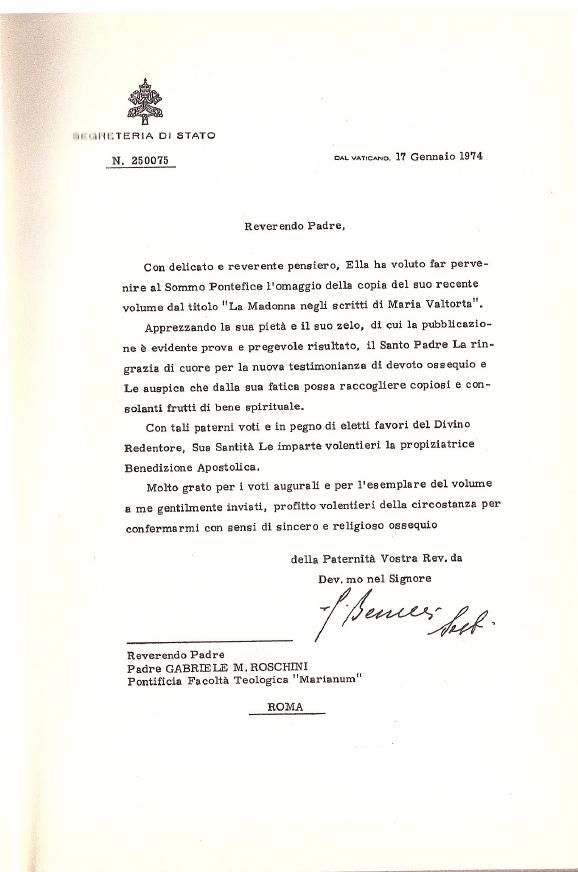
2. Cardinal Giovanni Battista Montini (Paul VI) was Pius XII’s right hand during the period when the Holy Office sought to suppress Maria Valtorta’s work. As Archbishop of Milan (1954-1963), he had the opportunity to read the first of the four volumes then and ordered it for the Milan Grand Seminary. As pope, he sent Father Roschini, author of a laudatory book on Maria Valtorta’s work, a letter of encouragement[33]. This pope abolished the Index of forbidden books (1966).
3. Cardinal Josef Ratzinger (Benedict XVI). It may surprise to find Cardinal Ratzinger cited among positive testimonies, given the publicity of his adverse 1985 letter, but there was an unexpected follow-up: a reader of the magazine L'Homme Nouveau, he read articles the Abbé Andrew the Apostle Richard published on Maria Valtorta. The cardinal asked the editor-in-chief, who complied, for a moratorium so he could check some points. A year later, he thanked him and said he could resume articles and their publication, as nothing opposed it. Two magazine staff confirmed this, including journalist Geneviève Esquier who published her attestation.
In 1992, the publisher, unaware of this correspondence, went to the Holy Office palace, where a secretary acquaintance informed him that "upstairs," the opinion on Maria Valtorta’s work had changed, and was now considered "a good book"[34]. This secretary informed the Italian bishops’ conference of this positive change, prompting its letter allowing the publisher to continue publication, on condition of reading the work as human faith (Maria Valtorta’s work) not Catholic faith (divine origin).
Msgr. Danylak, Apostolic Administrator of the Greek Catholic Church of Canada, attests in his imprimatur dated February 13, 2002 that Cardinal Ratzinger "in private letters recognized this work 'is free from doctrinal or moral errors'." He does not specify the source but it is thought to be Vatican.[35].
The original letter from Cardinal Ratzinger with the magazine is currently being sought.
In the last year of his pontificate, Benedict XVI beatified two overt promoters of Maria Valtorta’s work.
4. Msgr. Alfonso Carinci (1862-1963). This prelate was a close associate of Pius XII. He had solid experience in discernment of heavenly things. Indeed, as Secretary of the Congregation for Sacred Rites (currently for the cause of saints), he supervised 200 beatification processes and 62 canonizations including St. Pius X, whose confidant he was. He corresponded with Maria Valtorta and twice traveled from Rome to Viareggio.
He, along with the future Cardinal Bea then confessor of Pius XII, advised submitting Maria Valtorta’s typed manuscripts to the Pope. In his letter of January 17, 1952, addressed to the pope, he stated criteria characterizing licit private revelations:
"There is nothing in it contrary to the Gospel. This work rather contributes to a better understanding of its meaning […] The words of Our Lord are in no way opposed to His Spirit."
He further praised this heavenly gift (thanking the Lord for granting it), obtained at the price of suffering, and endorses the doctrinal conformity of the work ("doctrinally and spiritually so elevated"), while deeming certain descriptions superfluous.
5. Father Corrado Berti, from 1960, annotated the entire “Il poema dell’Uomo-Dio” (The Gospel as Revealed to Me). He attests that, in her visions, Maria Valtorta used about 600 biblical references and that he himself mentioned some 7,000 in his footnotes and theological appendices (total 5,675). Father Berti taught dogmatics and sacramental theology at the Marianum Pontifical Faculty of Theology. He read all Maria Valtorta’s writings.
6. Msgr. Ugo Emilio Lattanzi (1899-1969). Professor of fundamental theology, Dean of the Lateran's Faculty of Theology (1960-1968) and peritus (expert theologian) at Vatican II where he worked in the commission established at Cardinal Ottaviani’s request to propose a conciliar text on the Church[36]. Consultant to various Vatican congregations and organizations, member of the Pontifical Academy of Theology.
He pronounced in favor of Maria Valtorta’s work, recognizing its theological value. He studied it for "more than a year"[37], for an imprimatur request, at Msgr. Fontevecchia's behest, bishop of Sora and his compatriot and friend. He found nothing opposed to the Catholic faith and concluded a preternatural source, though he was not sensitive to the descriptions that so attract readers. Likewise, he was puzzled by some original positions but did not explore them:
"I consider it absolutely impossible that the woman who is its author, a woman of lower than average culture, could have written such a quantity of pages with a pen without having been influenced by a preternatural power. These volumes contain splendid pages in thought and form […] While there are scenes where the Lord and the Virgin Mary show themselves true to themselves, a few others are perplexing. Likewise, next to pages of extraordinary theological depth, there are unusual expressions I do not see how to harmonize with common Doctrine. […] I am convinced that reading these volumes, after revision, could bring more than one indifferent soul to quench their thirst at the source of living water: the Holy Scriptures.[38]"
Msgr. Michele Fontevecchia (and his successor) would have granted Imprimatur to the work if the Holy Office had not prevented it.
7. Father Gabriele M. Roschini (1900-1977). Renowned mariologist, consultant (confirmed theologian) at the Holy Office and founder of the Marianum Pontifical University of Theology. He discovered Maria Valtorta’s complete works late. What he wrote in the introduction to his book The Virgin Mary in the Writings of Maria Valtorta sums it all up:
For half a century, I have worked on mariology: studying, teaching, preaching and writing. I had to read countless Marian writings of all kinds: a true Marian library. But I feel obliged to candidly admit that the mariology emerging from Maria Valtorta’s published and unpublished writings was a true discovery to me. No other Marian writing, not even the sum of all I had read and studied, had been able to give me such a clear, vivid, complete, luminous, and fascinating idea of Mary, masterpiece of God - both simple and sublime - as Maria Valtorta’s writings.
This corroborates what, to mock it, the Holy Office censors said 14 years earlier:
"[The Holy Virgin] is everywhere, always ready to give lessons in Marian theology updated according to the most recent studies of current specialists."
8. Msgr. Angelo Mercati (1870-1955), Prefect of the Vatican Archives from 1925 to 1955. His brother, Cardinal Giovanni Mercati, was Prefect of the Vatican Library. Both served under Popes Pius XI and Pius XII. Msgr. Angelo Mercati read 600 pages of Maria Valtorta’s work, the most dogmatic ones, and told Father Berti in 1950:
"I was professor of dogmatic theology for eighteen years, and I must acknowledge this is a perfectly canonical work, in every respect. I was stunned. I do not know what to say. I have for years only dedicated myself to history and I remain deeply impressed by the multitude of news, details, etc. spread throughout the volume you gave me. I have now a clear idea of the work. I do not need to read more. I have had occasion to deal with the writings of Mary of Agreda and Anne Catherine Emmerich. The book you presented belongs to the category of private revelations. The work must be printed with imprimatur, accompanied by a declaration stating that the Church does not intend to pronounce judgment but only permits printing because it contains nothing reprehensible."[39]
9. Msgr. Piergiacomo De Nicolò (1929-2021). This Apostolic Nuncio, archbishop of Martana (Umbria), presided over the October 12, 2011, 50th anniversary of Maria Valtorta’s death under Benedict XVI’s pontificate. The ceremony took place in the cloister chapel of the Santissima Annunziata in Florence, a stronghold of the Servites of Mary who rendered, on this occasion, a strong tribute to their tertiary. Msgr. De Nicolò stated, among other things, at the end of his homily:
"Maria Valtorta’s work - where dogmatic and moral errors are absent, as many have noted - has for about half a century enjoyed a broad and silent diffusion among the faithful (about thirty translations into foreign languages) of all social classes worldwide, and without particular publicity. The sublimity, height, and wisdom of its content have produced many fruits of goodness and conversion; even people caught up in the world’s whirl and afar from Christian faith, but desiring solid certainties, have opened to reunion with the Absolute, with the God of Love, and found there a full confirmation of the Church’s bi-millennial teaching."
Msgr. De Nicolò’s funeral took place in St. Peter's Basilica in Rome, presided over by Secretary of State Cardinal Pietro Parolin, the Supreme Pontiff’s right hand since 2013.
10. Abbé René Laurentin (1917-2017). A prelate of Benedict XVI (quoted several times in one of his works), he was a French theologian and exegete, notably specialist in Marian apparitions. He was consultant to the preparatory theological commission and expert at Vatican II. Member of the Pontifical Theological Academy Marianum among others, he co-wrote three books on the Maria Valtorta case. At the end of the first, he wrote:
"Maria Valtorta emerges and commends herself to many titles […] Her life of long suffering lived in total abandonment to God testifies to her holiness. She does not diverge in any way from the Gospel, nowhere contradicts it, nor adds strange teachings and remains conforming to the Spirit of the Gospel. Furthermore, she is the one who adds to the Gospel’s narrated episodes other unknown ones, although they easily fit around the Gospel without contradiction or rupture. This also argues in favor of her faithfulness […] She gathered the broadest endorsements at the top, including that of Pius XII, who discreetly protected her from the Holy Office […] However, Maria Valtorta’s narrative is not a fifth Gospel.[40]."
In summary.[edit | edit source]
- The ten authoritative theologians detect no opinion contrary to faith or morals in the work, although some find original positions. Four underline the remarkable doctrinal value (Msgr. Carinci, G.M. Roschini, Msgr. Mercati, Msgr. De Nicolò).
- They highlight the legality of its reading, even its capacity to bring to the Gospel (Msgr. Lattanzi, Msgr. Carinci, Msgr. De Nicolò).
- They detect no new elements contrary to the canonical Gospel, although two are uneasy with its descriptions (Msgr. Lattanzi, Msgr. Carinci).
- They do not pronounce on divine origin (revealed) but on an inspired source (sometimes explicit such as Pius XII "extraordinary origin or not" or Msgr. Carinci "the Lord").
These criteria align with the truth criteria for private revelations demanded by the Church.
For: the endorsement of saints and founders of Church movements.[edit | edit source]
The endorsement of saints (and/or founders of Church movements) is important as it comes from people whose lives testify to fidelity to the Church and the Gospel.
Some only read Maria Valtorta’s work. This is already a tangible sign as a saint does not nourish themselves with harmful or frivolous readings. Others recommended it for reading or distribution.
To our knowledge, no saints have condemned or simply rejected Maria Valtorta’s work, except Saint John XXIII in whose name the placing on the Index was ordered. However, it would be an abuse to believe it was a personal and thoughtful decision. Indeed, the Osservatore Romano article accompanying the censure targeted the "naivety" of several prelates in Pius XII’s entourage, including Cardinal Bea who, appointed thereto by John XXIII, became a pillar of the conciliar reform he undertook at that time.
Here is the procession of saints who had, at one time, Maria Valtorta’s work in their hands:
1. Venerable Pius XII
2. Saint Paul VI, as noted.
3. Saint John Paul II. Father Yannik Bonnet, whose vocation is linked to Maria Valtorta’s work, met three times during his studies in Rome[41] Cardinal Stanislas Dziwisz, John Paul II’s secretary. He testifies[42] that the cardinal assured him of frequently seeing Maria Valtorta’s works on the Sovereign Pontiff’s bedside table.
Pope John Paul II never pronounced on Maria Valtorta’s case. However, he canonized Padre Pio who recommended reading her work and beatified Mother Teresa, a reader of this work whom she carried during her travels.
4. Saint Padre Pio of Pietrelcina (1887-1968). Maria Valtorta benefited from his bilocations’ comfort. It was during one of these that she experienced "the odor of sanctity"[43]. Padre Pio’s opinion on Maria Valtorta’s visions is known in two ways:
To Elisa Lucchi, a penitent asking one year before his death (thus in 1967) for advice on reading "The Gospel as it was revealed to me," Padre Pio responds: "Not only do I permit you to read it, but I recommend it."
But we mostly know his view through Nonna Susanna ("Grandma Suzanne"), a nun who wrote a column under this pseudonym in the magazine "Vita Femminile." In a 1972 letter to the publisher, she testifies that Padre Pio, some months before his death, asked her to read Maria Valtorta’s work and to publish chapters in their magazine. He definitely wanted the magazine to always be available at the Sollievo della Sofferenza Hospital (private hospital founded by Padre Pio in San Giovanni Rotondo). Nine hundred copies were sent there weekly.
5. Saint Mother Teresa of Calcutta (1910-1997). According to the testimonial honor (April 25, 2016) of Father Leo Maasburg, National Director of Pontifical Missionary Works in Austria and Mother Teresa’s confessor for 4 years, Mother Teresa always traveled with three books: the Bible, her Breviary, and a third book. When Father Leo asked what it was, she said it was a Maria Valtorta book. Asked about its content, she simply said: "Read it." Beatified by John Paul II, she was canonized by Pope Francis.
6. Blessed Mother Maria Inès (Arias) of the Most Holy Sacrament (1904-1981). Mexican nun. On July 19, 2001, Sister Maria Uranga confirmed to the publisher that their congregation’s founder, Blessed Mother Maria Inès of the Most Holy Sacrament, had distributed Maria Valtorta’s work in each of the 35 houses she founded, "because she loved it very much." She also gave copies to priests and bishops.
7. Blessed Gabriele M. Allegra (1907-1976). Translator of the Bible into Chinese. He wrote an analysis of Maria Valtorta’s works in which he recognized that they came "from the spirit of Jesus."
"I also note that some of the Lord’s discourses - whose main subjects are only briefly mentioned in the Gospels - are developed in this work (of Maria Valtorta) with a naturalness, with such a thread of thought so logical, so spontaneous, so intrinsically connected to time, place, and circumstances, that I have not found in the most famous exegetes."[44]
And further:
"I find no other work among renowned scripture specialists that complements and clarifies the canonical Gospels so naturally, spontaneously, and with such vividness as does Maria Valtorta’s Poem. The Gospels constantly mention crowds, miracles, and we have some great traits of the Lord’s discourses. In the Poem of the Man-God, however, crowds move, shout, act; miracles, one might say, are seen; the Lord’s discourses, even the most ardent in their conciseness, become vividly clear.What amazes me most is that Maria Valtorta never falls into theological errors; on the contrary, she makes the revealed mysteries easier for the reader by translating them into popular and modern language (...).
Natural gifts and mystical gifts harmoniously combined, that explains this masterpiece of Italian religious literature, and perhaps of world Christian literature."[45]
8. Blessed Luigi Novarese (1914-1984). Msgr. Luigi Novarese served at the Vatican Secretariat of State from 1942 to 1970. It was here he heard of Maria Valtorta’s work from his friend, Msgr. Alfonso Carinci (see above). He founded the Centro Volontari della Sofferenza (Center of the Volunteers of Suffering), which Maria Valtorta joined and which he visited.
Declared Venerable on March 27, 2010 by Pope Benedict XVI, he was beatified May 11, 2013 by Pope Francis.
9. Venerable Giorgio La Pira (1904-1977). Nicknamed "the holy mayor," he was a Christian Democratic deputy and mayor of Florence from 1951 to 1957 and 1961 to 1965. Known for his peace travels and works, Dominican and Franciscan tertiary, he was invited to Vatican II. Declared Venerable by Pope Francis July 5, 2018.
He participated in 1976 in monthly readings where passages of Maria Valtorta’s work were read at the Basilica Ss. Annunziata in Florence, where Maria Valtorta is buried. His testimony on Maria Valtorta’s work in a few lines:
"I have found no theological incorrectness in the work on the Gospel entitled “Words of Eternal Life”; it is an experience of great interest. This is my opinion. Florence, February 12, 1952."
10. The Venerable Luigina Sinapi. (1916-1978). Like Maria Valtorta, she was a lay tertiary Franciscan and Servite tertiary. On May 22, 2009, after a 5-year investigation, the Rome Vicariate (Diocesan Chancery of Rome, Pope’s diocese) submitted her "Positio" (= final report) to the Congregation for the Causes of Saints to initiate her beatification cause.
She had direct access to Pius XII to whom she announced his election and the Tre Fontane apparitions (see above). In 1950, at Jesus's request, she came to the Holy Office to confront its officials about their obstruction to Maria Valtorta’s work. Warning that she intended to reveal this behavior to the Holy Father, she was threatened, including with rape[46].
11. Father Giandomenico Mucci (1938-2020). Jesuit, theologian, and scholar, considered one of the most prestigious writers of La Civiltà Cattolica for 36 years, a semi-official Vatican publication. For 30 years, Father Mucci was spiritual director to the Pontifical Ecclesiastical Academy, Vatican diplomats' school. He is co-founder of the Unprofitable Servants of the good Shepherd movement (SI).
On April 23, 1996, he answered, on behalf of La Civiltà Cattolica director, a reader wondering about the moral value of Maria Valtorta’s Index lifting:
"Since it is clear that Maria Valtorta’s books not only are no danger to your faith, but rather strengthen it, and since your conscience is serene in this reading also due to the comfort of authoritative testimonies you have cited, it seems to me you may continue reading without yielding to doubts or scruples or, even less, to disagreements expressed by some scholars on Maria Valtorta’s work."
Ten years earlier (1986), he had sharply commented on a stupidly hostile book on Maria Valtorta and concluded[47]:
"We believe it will still take time to make a definitive, just, and calm judgment on the entire works of Valtorta, even if we notice with perplexity and dissatisfaction, the essence of pure adherence to written Revelation, this simplicity of word, this mastery of sentiments and imagination, which is the glory and sign of true Catholic mysticism."
12. Sister Maria Veronica Algranati (1901-1985), known as "Grandma Suzanne" (Nonna Susanna), wrote a column in the magazine “Vita Femminile”. Under Padre Pio’s explicit requests, she had to disseminate extracts of Maria Valtorta’s work and read them herself. Arguing she lacked time to read the 10 volumes, Padre Pio told her: "You will read them and listen to me."
She founded the movement of the Daughters of the Most Humble Mother, Servants of Redemption (Figlie di Madre Umilissima, serve della Redenzione).
In summary.[edit | edit source]
These 12 saints or founders of Church movements read the work, sometimes recommending (Pius XII, Paul VI, Padre Pio, Mother Teresa), or defending it (G.M. Allegra, Luigina Sinapi, Fr. G. Mucci), even promoting it (Padre Pio, Mother Maria Inès Arias, Sister Maria Veronica Algranati). Under these circumstances, how can one believe Maria Valtorta’s work builds a schismatic or sectarian Church outside the Church?
To go further[edit | edit source]
Notes and references[edit | edit source]
- ↑ Vatican, October 5 to 26, 2008.
- ↑ Final list of propositions: Proposition 47: The Bible and the phenomenon of sects].
- ↑ A pericope designates an excerpt that forms a literary unit or a coherent thought. Out of 373 pericopes, 111 are unique to a single Gospel, the remaining 262 are common to either three or two evangelists (sometimes four, notably for the Passion). The two infancy Gospels (Matthew 1–2 and Luke 1–2) share not a single episode.
- ↑ Maria Valtorta does not produce a scholastic copy where each Gospel verse would be reproduced in her work. Sometimes she simply refers to its reading, as she does, for example, for Jesus's priestly prayer during the Last Supper (GRM 600.37). Its 26 verses are reported in John 17. This passage is counted in the 98.5% citations. Conversely, some verses are omitted such as those of Jesus’s genealogy in Matthew 1:1-17 and Luke 3:23-38. Only Joseph's grandparents are mentioned by characters, according to Matthew, matching daily life situations. These omissions are counted in the missing verses.
- ↑ Pius XII, Divino Afflante Spiritu On Biblical studies, September 30, 1943, §§ 2 and 3. § 2: "The Holy Council of Trent, in a solemn decree, already declared concerning the Bible that one must recognize "the entire books as sacred and canonical, with all their parts, as they are usually read in the Catholic Church and as they are contained in the ancient edition of the Latin Vulgate" (Sessio IV decree I; Ench. Bibl. n. 45). § 3: "The Church holds the Holy Books to be sacred and canonical not because, being solely of human industry, they were subsequently approved by her authority, nor solely because they contain truth without error, but because, written under the inspiration of the Holy Spirit, they have God as their author and have been handed down as such to the Church" (Sessio III cap. II, Ench. Bibl. n. 62).
- ↑ Edmea Dusio, Biblical index of the work "The Poem of the Man-God", Pisani ed., 1970, quoted by G.M. Roschini, The Virgin Mary in the work of Maria Valtorta, p. 31. THE BIBLE has 1,334 chapters in the version used by Catholics and Orthodox, and slightly fewer in Protestant or Anglican tradition. The New Testament alone comprises 260 chapters in any case.
- ↑ Typological reading characterizes the Christian approach to the Bible. It consists of seeing in the Old Testament (Bible before Jesus) the announcement of the New Testament (Bible with Jesus). There is no separate history. This is why Christians are sometimes called Judeo-Christians. Jesus, in the Gospel, refers to the Old Law which he came to fulfill and not to change. In the Work of Maria Valtorta, many episodes show how Jesus announces his Gospel based on the texts of the Old Testament known perfectly by Judeans and Galileans as part of teaching. This 'typological' approach is an omnipresent feature of Maria Valtorta’s narratives.
- ↑ Catechism of the Catholic Church §§128-129: "The Church […] has enlightened the unity of the divine plan in the two Testaments thanks to typology. This discerns in God’s works in the Old covenant prefigurations of what God accomplished in the fullness of time in the person of his incarnate Son".
- ↑ CCC §131 | Dei Verbum 22.
- ↑ Ibid. | Dei Verbum 21
- ↑ "“The most profound reason for the gift of this work is that in the present time, when modernism, condemned by My holy Vicar Pius X, becomes corrupted in more and more harmful doctrines, the Church, represented by My Vicar, may have further material to fight against those who deny: the supernaturalness of dogmas; the divinity of the Christ; the Truth of the Christ God and Man, real and perfect both in the faith and in the history that has been handed down on Him (Gospel, Acts of the Apostles, Apostolic Letters, tradition); the doctrine of Paul and John and of the councils of Nicaea, Ephesus and Chalcedon, as My true doctrine verbally taught by Me; My unlimited science, as it is divine and perfect; the divine origin of the dogmas of the sacraments of the Church One, Holy, Catholic, Apostolic; the universality and continuity, until the end of time, of the Gospel given by Me and for all men; the perfect nature, from the beginning, of My doctrine that has not been formed, as it is, through successive transformations, but was given as it is: the Doctrine of the Christ, of the time of Grace, of the Kingdom of Heaven and of the Kingdom of God in you, divine, perfect, immutable. The Gospel for all those thirsting for God." (GRM 652).
- ↑ "Nothing is lost, nothing is created, everything is transformed," says a maxim attributed to Antoine Lavoisier.
- ↑ Cardinal Giacomo Lercaro (1891-1976): "What afflicted him most deeply, to the point of making him agonize like the Savior in the Garden of Olives, was not so much that he suffered for the Church […] but that he suffered by the Church […] He felt the bitterness of arbitrary procedures, very harsh, insulting, wicked measures, without reacting, without complaining..." Commemoration of Padre Pio of Pietrelcina, Cathedral of Bologna, December 8, 1968, quoted by Luigi Peroni, Padre Pio, the St. Francis of the 20th century, St. Augustine Ed., 1999, pp. 175/176.
- ↑ Letters to Mons. Carinci {Italian}, January 9, 1949. Being translated into French.
- ↑ Notebooks 1945-1950, January 28, 1947.
- ↑ This is the case with verses deleted in the 1979 Nova Vulgata (official reference of the Catholic Church) and with the disappearance of the phrase "Second-First Sabbath" from Luke 6:1. Maria Valtorta’s visions allow one to understand why she does not explain it herself. Indeed, Jesus at the time did not have to explain what everyone knew.
- ↑ Procedural norms for the discernment of alleged apparitions and revelations – Origin and character of these norms.
- ↑ New "Procedural norms for the discernment of presumed supernatural phenomena" of May 17, 2024. It cancels and replaces the previous norms. See articles no. 11 and no. 23 which generally restrict the right to decide on divine origin to the pope’s dicastery.
- ↑ Don Michelini, Confidences of Jesus to His Priests and Faithful, Parvis ed., p. 285.
- ↑ See, for example: John 3:17 | John 12:47.
- ↑ On November 8, 1963, Cardinal Josef Frings, Archbishop of Cologne (whose theologian was Father Josef Ratzinger) declared in a conciliar assembly, under a thunder of applause: "The procedure of the Holy Office no longer corresponds to our time. It is an object of scandal for many."
- ↑ Paul VI, motu proprio Integrae Servandae, December 7, 1965.
- ↑ John Paul II, Apostolic Constitution Fidei Depositum, October 11, 1992.
- ↑ Maria Valtorta’s work was censored under article 1385, paragraph 1, § 2 of the 1917 Code of Canon Law, in force at the time of Maria Valtorta. It stipulated that no book touching on a religious subject could be published without imprimatur.
- ↑ On March 19, the Congregation for the Doctrine of the Faith published new regulation on the vigilance of pastors of the Church regarding books.
- ↑ Already cited: Cf. the theological commentary of Cardinal J. Ratzinger (Benedict XVI) citing Cardinal Lambertini’s codification (Benedict XIV).
- ↑ Don Guillaume Chevallier, Inspiration in Maria Valtorta, Charitas no. 14, p. 94, March 2021.
- ↑ Verbum Domini § 14: "A private revelation can introduce new expressions, bring forth new forms of piety or deepen old ones. It can have a certain prophetic character."
- ↑ February 26, 1948. Present were Fathers Berti and Migliorini and Cecchin, their superior.
- ↑ 1970: Rome conference; 1978: affidavit; 1980: Dominican review Vita cristiana (Rivista di ascetica e mistica).
- ↑ The three eyewitnesses – Msgr. Carinci, a close associate of Pius XII who corresponded with Maria Valtorta – Luigina Sinapi, familiar with Pius XII who met the Holy Office at Jesus’s request – several prelates worldwide who consider it acquired.
- ↑ Benedict XV, encyclical Spiritus Paraclitus on the 15th centenary of the death of St Jerome, September 15, 1920. His method (exposed notably in The Historical Method (1903)) became official Church teaching notably in Pope Pius XII’s encyclical Divino Afflante Spiritu in 1943 and in Dei Verbum in 1965, already cited. Note that this literary genre, under which Maria Valtorta’s Work falls, was made lawful just before the first visions began.
- ↑ Facsimile of the letter of thanks
- ↑ Emilio Pisani, Pro e contro Maria Valtorta {Italian}, 5th edition, CEV, 2008, pp. 280/281. This book is being translated into French.
- ↑ Msgr. Danylak was in Rome then (2002) and the link between Cardinal Ratzinger’s correspondence and the changed opinion on Maria Valtorta’s work, was only made public about 2010.
- ↑ La Civiltà Cattolica, Ticket 4013, September 2, 2017.
- ↑ Letters to Mother Teresa Maria, Volume 2, p. 287. Automatic translation.
- ↑ Msgr. Ugo Lattanzi, Declaration, Rome, January 18, 1952.
- ↑ Letters to Mother Teresa Maria, Volume 2, p. 287. Automatic translation.
- ↑ Chrétiens Magazine, no. 218, March 15, 2009, special Maria Valtorta issue, p. 7. This article reformulates what he says in La Vie de Marie d’après les révélations des mystiques, Presses de la Renaissance, 2011, pp. 37 to 46.
- ↑ In the 1996/1999 years. Father Yannik Bonnet became a priest late in life, upon widowhood. A Sciences-Po graduate and former director of human relations for a large French industrial group, he is father of seven children. He owes his vocation to discovering Maria Valtorta and spoke of it with the cardinal. He also met the Holy Father three times.
- ↑ May 19, 2017: Interview by Maxime Dalle on Radio Notre-Dame (Ecclésia broadcast) (go to 1’50’’).
- ↑ Notebooks 1943, May 13.
- ↑ Journal of Blessed G. Allegra, Holy Tuesday and Wednesday 1968.
- ↑ Ibid, August 25/26, 1968.
- ↑ Literally: "then they tried to commit carnal violence against her". Converging testimonies of Master Camillo Corsanego (1891-1963), Dean of Consistorial Counselors (Vatican), one of the founding fathers of Italian Christian Democracy, and Lorenzo Ferri, sculptor competitor for the new Holy Door of the Vatican (cf. Letters to Mother Teresa Maria, Volume 2, pp. 292-295 and 299-300).
- ↑ Civiltà cattolica, October 1986, Notes, p.99.