


Mount of Olives


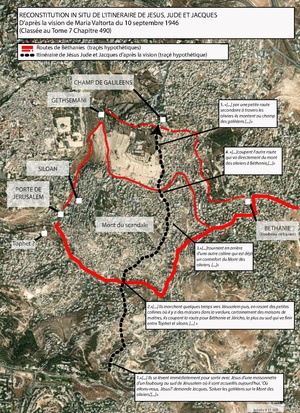
The Mount of Olives is a hill located east of Jerusalem. It is mentioned several times in the New Testament where it is linked to major events of the Passion of Jesus and his Glorification:
- Triumphal entry into Jerusalem: Mount of Olives (near Bethphage).[1] Jesus leaves the Mount of Olives to enter Jerusalem on a donkey, acclaimed by the crowd (Palm Sunday).
- Discourse on the end times: Mount of Olives.[2] On the Mount of Olives, Jesus announces the destruction of Jerusalem and speaks about the end times (this is the "apocalyptic discourse").
- Prayer and agony of Jesus: Garden of Gethsemane (at the foot of the Mount of Olives).[3] After the Last Supper, Jesus goes to the Garden of Gethsemane (at the foot of the Mount of Olives) to pray and there he is arrested.
- Ascension of Jesus: slope of the Mount of Olives, near Bethany.[4] Jesus ascends to heaven from the Mount of Olives (more precisely, near Bethany, on the east side of the mountain).
- At the end of the work, Maria Valtorta places the last dwelling of the Virgin Mary there as well as her assumption into heaven. Maria Valtorta describes this last dwelling as being the house of Gethsemane.
- Maria Valtorta locates there the giving of the Our Father prayer, which the Gospels mention without specifying the location.[5]
- She also mentions a place from tradition: the field of the Galileans, the site of their encampments during obligatory feasts such as the Feast of Tabernacles (Sukkot).
These passages show the importance of the Mount of Olives in the life and teaching of Jesus, notably as a place of prayer, teaching, and preparation for upcoming events.
Location[edit | edit source]
- The Mount of Olives (Har HaZeitim הר הזיתים, in Hebrew) seems to have always been called that.
- 31° 46’ 50’’ N / 35° 14’ 40’’ E
- +815m
Inhabitants or natives[edit | edit source]
As its name indicates, the mount is covered with olive trees. Only the property of Gethsemane, whose name means "oil press", is inhabited. After the Ascension, it is where the apostle John and the Virgin Mary will live. She will experience her Assumption there.
Description[edit | edit source]
Jean-François Lavère describes it thus in his Geographical Dictionary:
"A favored place for prayer and rest, this is where Jesus gathers his eleven apostles (Judas is absent) to teach them the Our Father, on the evening of the Passover of the second year.
'Are we going to Gethsemane?' [...] 'No. Farther up. To the Mount of Olives.' […] 'I am taking you to crown Passover with a rare longed for pearl.' They climb up among the olive-trees, leaving Gethsemane on the right, until they reach the top of the mountain, where the leaves of the olive-trees are rustling in the wind.”[6]
Maria Valtorta provides meticulous descriptions of this famous place.
"The summit of the Mount of Olives is smooth: everything is smooth and pleasant on that mountain: the slopes, the view, the summit. It really inspires peace, clad as it is with olive-trees and silence. [...] But generally it is a place of tranquillity and meditation. On the left hand side, with respect to those facing north, there is a light depression, and then another summit which is even smoother than the previous one".[7]
The seer even manages to convey the atmosphere prevailing in these places, such as when Jesus comes to pray there at early morning.
"The olive-grove covering the mountain brightens very slowly emerging from the shadow, and the trunks, still in the shade, seem to be absent whilst their silvery foliage is visible. Fog seems to be spread over the mountain, but it is only the greyness of the leafy branches in the uncertain morning light."[8]
And it is in this place that Jesus gives his last command to the disciples, just before his Ascension:
"He climbs farther up, as far as the highest summit of the mountain, the one closer to Bethany. [...] 'Go! Go in My Name to evangelize the peoples as far as the ends of the Earth.'"[9]
Notable events[edit | edit source]

During the Second Temple period, fires lit at the summit of the mount signaled the arrival of the new moon of the religious new year.[10] From the 4th century, the mount is dotted with sites and buildings recalling episodes from the life of Jesus:
- The teaching of the Our Father;[11]
- The acclamations of the people upon his arrival in the Holy City;[12]
- The lamentations over Jerusalem;[13]
- Prayer in the Garden of Gethsemane before the arrest on Holy Thursday;[14]
- The ascent to Heaven performed at the summit of the mount.[15]
Its name[edit | edit source]
The mount takes its name from the olive fields that compose it.
Where is it mentioned in the work?[edit | edit source]
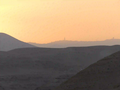
Mount of Olives in 2022 viewed from the East, from the mouth of the Wadi Qelt

Mount of Olives in 2024, viewed from the Cenacle terrace in Jerusalem.


Explore[edit | edit source]
Notes and references[edit | edit source]
- ↑ Matthew 21:1-11 | Mark 11:1-10 | Luke 19:28-40 | John 12:12-19.
- ↑ Matthew 24:3-51 | Mark 13:1-37 | Luke 21:5-36.
- ↑ Matthew 26:30-56 | Mark 14:26-52 | Luke 22:39-53 | John 18:1-11.
- ↑ Luke 24:50-53 | Acts 1:9-12.
- ↑ Matthew 6:7-15 | Luke 11:1-4.
- ↑ GRM 203.1-2.
- ↑ GRM 279.1.
- ↑ GRM 533.1.
- ↑ GRM 638.22-23.
- ↑ Mishnah, Rosh Hashanah 2:4.
- ↑ Eleona or Grotto of the Pater Noster.
- ↑ Sanctuary of Bethphage.
- ↑ Dominus Flevit.
- ↑ Basilica and Grotto of Gethsemane.
- ↑ Chapel of the Ascension.