


Engedi

The oasis on the edge of the Dead Sea, near sources of water hot water.
Inhabitants or natives
Abraham, the synagogue leader, Colombe, his wife, blind and dumb cured, Elisha his son, leper healed.
Description
" And even more wonderful is the fertile aspect of a tableland, about one hundred and fifty metres above sea level, with luxuriant palm-trees and all kinds of trees and vines, and where blue waters flow and a beautiful town has been built, surrounded by a flourishing countryside. [...] they go down a well-kept road towards the sea shore, where they arrive after crossing several cultivated embankments, from which beneficent waters flow in small smiling cascades to nourish all the vegetation as far as the plain, which ends at the beach. Half-way down the hill-side they enter the white town, among rustling palm-trees and sweet-smelling rose-bushes and thousands of flowers of its garden [...]"[1]
"[...] the inhabitants of Engedi built very narrow streets, which look even more narrow because of the projecting eaves and cornices of the dwellings, so that anyone looking up can see only a very thin strip of the deep blue sky. The buildings are tall, most of them being two storey houses [...]”[2]
Notable facts
Healing of the leper Elisha: example of hope maintained in the trial.
Its name
Engedi, En Gedi, Hazazon Tamar, En Gedi - Eyn-Guédi - En-Guédi - Engedi - Ein-Guèdi. עין גדי, the ancient Asason Tamar.
Engedi means “spring of the goat”.
Where is it mentioned in the work?
GRM 389 GRM 390 GRM 391
GRM 566
Learn more about this place
.webp)
Its numerous caves in the Judean desert historically made it a place of refuge. Saul, pursuing David in this region, relieved himself in a cave near the sheep park. David, taking refuge in this cave, took the opportunity to secretly cut off a piece of his mantle to demonstrate his good faith.[3]
Later, Jehoshaphat, reforming king of religion and the State, faced because of this a significant coalition of Ammonites, Moabites, and Edomites. They took Engedi as their base. Jahaziel then prophesied divine intervention, which took place.[4]
An abundant and inexhaustible source of hot water springs from a fountain about 100 m above the base of a huge cliff. The hot water has created an oasis, with lush semi-tropical vegetation, renowned for its palm trees, vineyards, and balsamic plants. Because of this, Engedi has been sung by many poets: Song of Songs 1:14, Ezekiel 47:10, Sirach 24:14.
Excerpt from the Geographical Dictionary of the Gospel According to Maria Valtorta, by Jean-François Lavère:"the garden enclosed, the fountain of the garden"[5]Maria Valtorta’s description of the Engedi site is full of authentic details, many unknown in 1946. It is indisputably to be credited to the authenticity of her visions and deserves serious attention. The apostolic group coming from the Judean desert reaches the oasis via the Wadi David and the ancient Roman road. “they encounter the full view of the Dead Sea displayed before them”,[6] as Maria Valtorta notes, as now proven by many photos taken by hikers.
Jesus states: "This is the ancient Hazazon-Tamar, a name that evokes its beautiful palm-trees".[7] This “hypothesis” was officially formulated only in 1969[8] and it took several more decades to become generally accepted. Jesus presents “the gem of Israel” to his apostles: “Engedi, [...] from which the enemies moved against Jehoshaphat and the children of his people”, […] “the town sung by Solomon”, (…) “It was mentioned by Ezekiel, because it was nourished by the waters of the Lord…”.[7] This is the evocation of the main biblical passages[9] concerning Engedi.
Then, Jesus “starts running down a very steep path, which zigzags down the reddish calcareous rock (…) “A path that would make giddy even the most expert mountaineers”.[7] It is with almost the same words that the famous archaeologist De Saucy describes his arrival at Engedi: “an incredible path named Nakb Aïn Dejedi" ('the hole of Engedi')... it is a very steep descent where one jumps rather than walks from rock to rock (...) this path, almost impassable, is the only one leading to Engedi today”.[10] Is it necessary to specify that the cliff is indeed made of “reddish limestone!”
Maria Valtorta marvels on seeing the caves. “their strange mouths, long or flat, straight or slanting, round or like fissures”.[11] Today, photos prove the extraordinary accuracy of this description!
Similarly, when the seer describes the waterfalls: “Fountains and rivulets are little waterfalls and diamond necklaces”[11]
Then, when Jesus leaves Engedi and heads toward Masada, he does not take “the lower road along the Dead Sea, which I hear is unhealthy and dangerous at night”.[11] The danger of this road is still due today to the crevices caused by erosion of the salt layers.
Much further in the work, the words of an Essene of En Gaddi may surprise: “We also live in that part of the country, awaiting…”[12] Indeed, few authors in 1946 would have made this link between Engedi and the essenes, except by consulting some rare 19th-century writings.
Before 1950, the site was known only by a few scholars thanks to brief biblical mentions and the scant information provided by Pliny, Flavius Josephus, Eusebius of Caesarea, Saint Jerome, and some archaeologists. Forgotten in Byzantine times, Engedi regained notoriety only after 1948/1950, following the discovery of the famous Qumran manuscripts.
Oasis of the Judean desert, on the northwest shore of the Dead Sea. Its numerous caves historically made it a place of refuge. An abundant and inexhaustible source of hot water springs from a fountain about 100 m above the base of a huge cliff.
Gallery

Ein geddi, descent from the plain to the wadi arugot (photo 2023)

Ein geddi, limestone cliffs (photo 2023)

Ein Geddi, the Chalcolithic Temple (photo 2023)
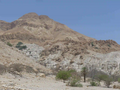
Ein Geddi, entrance to wadi david (photo 2023)
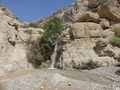
Ein Geddi, small waterfall (photo 2023)


Explore
• 31° 28' N / 35° 23' E
• -230m
Notes and references
Article partially based on the Geographical Dictionary of the Gospel According to Maria Valtorta, by Jean-François Lavère.
- ↑ GRM 389.
- ↑ GRM 390.1.
- ↑ 1 Samuel 24:1-8.
- ↑ 2 Chronicles 20:1-30.
- ↑ GRM 389.2.
- ↑ GRM 389.1
- ↑ 7.0 7.1 7.2 GRM 389.2
- ↑ Z. W. Falk, Journal of Semitic Studies 1969 14, pp. 39-44.
- ↑ Gen 14:7; 1 Sam 24:1-8; 2 Chr 20:2; Song of Songs 1:14; Ezek 47:10; Sir 24:14.
- ↑ De Saucy Dictionary of Biblical Antiquities 1859 p. 66.
- ↑ 11.0 11.1 11.2 GRM 391.1.
- ↑ GRM 464.2.