Face and Appearance of Jesus
 See also: Jesus.


Whether it comes from private apparitions throughout History, or is passed down by millennial tradition, the face of the Christ is known in its main features.
It is probably these constant manifestations that give the similarities in the historical portraits of Jesus. Their number indicates that it is difficult to move from the reality of a vision to its representation by a third party. The disappointment of St. Faustina Kowalska is well known when she saw the portrait of Jesus merciful painted under her guidance. Every representation is evocative and approximate because it cannot truly capture what the gaze or gestures convey.
Under these conditions, what can the visions of Maria Valtorta bring? First, to confirm or not the most popular portraits, then to complete them with specific details and, across time and space, lead to the recognition of Jesus.
The face of Jesus[edit | edit source]
Restored by the artist[edit | edit source]
These two drawings were made by Lorenzo Ferri under the direct guidance of Maria Valtorta. She subsequently hung above her bed the one of the living Jesus. These two portraits can therefore be considered similar to the faces she saw in her visions. What strikes in the portrait of the living Jesus is the emphasis on the gaze. Indeed, in the work, as in the Gospel, this gaze truly reflects the feelings of Jesus.
Later, Lorenzo Ferri represented Christ in a wax high-relief. Lorenzo Ferri's illustrations were published in Valtorta and Ferri, CEV ed., 2012 (334 p.).
| Faces OF Jesus SEEN BY Maria Valtorta | |
|---|---|
| Living Jesus | |
 L. Ferri/Maria Valtorta/Maria Valtorta Heritage Foundation |
 L. Ferri/Maria Valtorta/Maria Valtorta Heritage Foundation |
| Dead Jesus | |
 L. Ferri/Maria Valtorta/Maria Valtorta Heritage Foundation |
 L. Ferri/Maria Valtorta/Maria Valtorta Heritage Foundation |
The face from the Shroud of Turin[edit | edit source]
Maria Valtorta affirms that the Jesus of her visions resembles the one on the Shroud of Turin. In her Autobiography, she writes after receiving, very early in her youth, the first visions of Jesus:"In all the art and religious article shops I have looked for a face of Jesus like the one I saw. But I have never found one. [...] And I always see Jesus with that face, that stature, those Hands. When you gave me that book, Father,[1] on the Holy Shroud, it shook me, for, though it was altered by the sufferings undergone, I saw that face, along with that stature and those Hands...."[2]In one of her comments, Jesus confirms the authenticity of the relics and indicates a way to verify it:
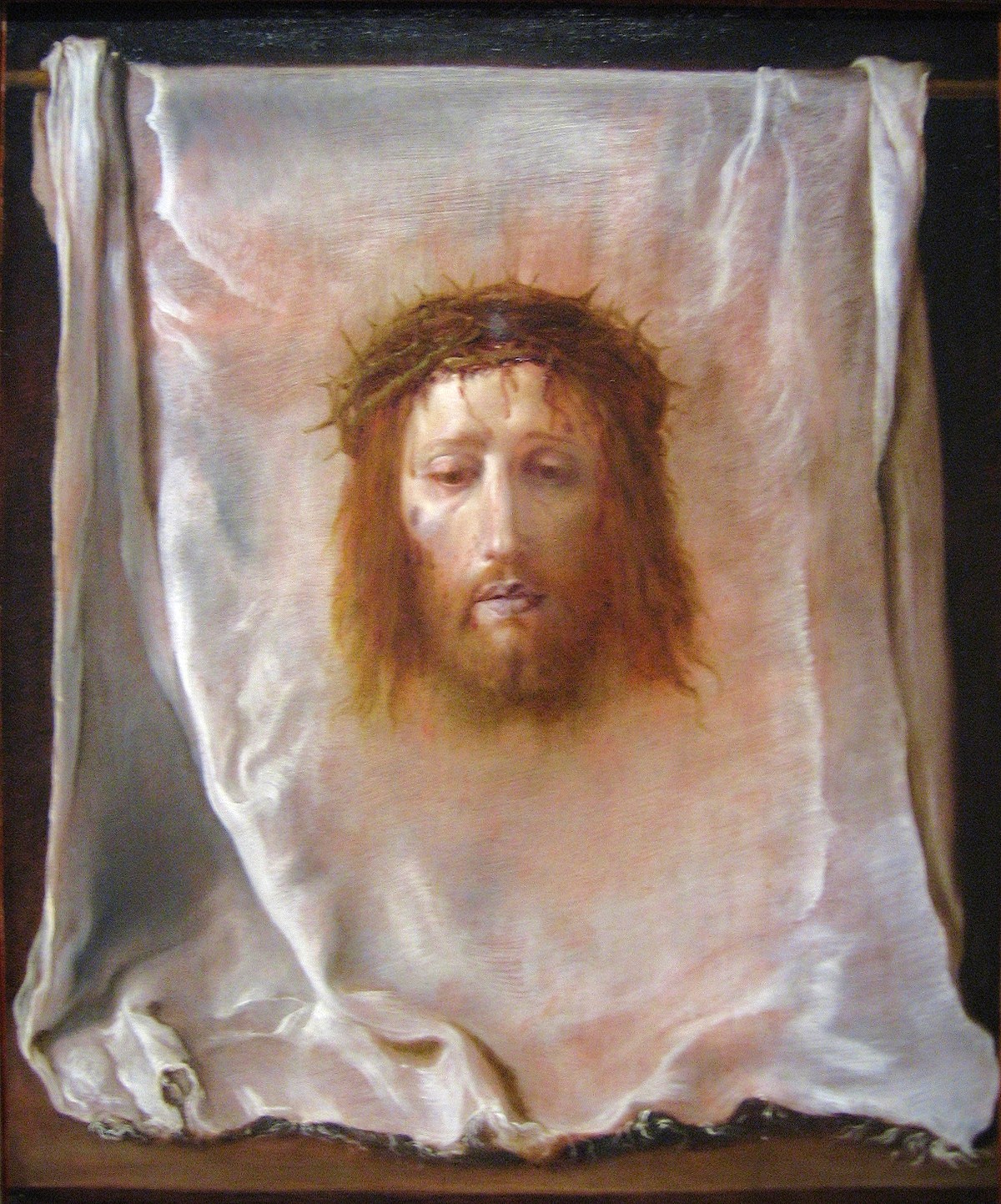
"The veil of veronica is also a goad to your sceptical souls. Since you, o rationalists, o tepid people vacillating in your faith, proceed through arid examinations, compare the face of the veronica with that of the Holy Shroud. One is the face of a living person, the other of a dead one. But length, width, somatic types, form, distinctive features, are identical. Superimpose the images. You will see that they correspond. It is I. I Who wanted to remind you how I was and how I had become out of love for you. If you had not gone astray, if you were not blind, those two faces should be enough to bring you to love, to repentance, to God."[3]Jean-François Lavère carried out this superposition recommended by Jesus from Veronica's veil[4] or the Holy face by Domenico Fetti and the face of the Shroud of Turin.
Veronica's veil or Nikê in the GRM: She knows Jesus well. She heard about him through his disciples and then decided to put her life and possessions at the service of Jesus' poor, which he accepted. Nike acquired a house in Jerusalem, to be close to him and host him with his disciples whenever they came for the Jewish feasts.
At Calvary, she gives the veil to Christ who wipes his face soaked with sweat and blood.[5]
Later, when she sees by miracle the face of Jesus appearing on it, she brings it to the Virgin on the night of Good Friday.[6] This will be a tremendous support for Mary during these terrible moments for her, between the death of Jesus on Friday at 3 p.m. and his Resurrection on Sunday morning.
Thirty points were said to be necessary to merge the two portraits. Three were enough. Here is the astonishing result.
| Face RECONSTRUCTED BY J.-F. LAVÈRE |
|---|
The appearance of Jesus[edit | edit source]
Several descriptions given by Maria Valtorta allow us to make an approximate representation of Jesus:
- during his public life
- after his Resurrection
- during the catecheses given to Maria Valtorta.
- in Glory "seated at the right hand of the Father"
Jesus of the public life[edit | edit source]
Jesus is tall. He is a head taller than his mother; and "a head and neck" taller than his favorite disciple: John. He must have measured approximately 1.80 m (5 ft 11 in). Among the apostolic group, only Judas has an equivalent height. Lorenzo Ferri, in his life-size reconstruction of the Shroud of Turin, gives 1.87 m (6 ft 1 in) for Jesus' height.
He has long hands. Maria Valtorta, during a vision of the Public Life, is intrigued by the healing power of his hand. Jesus then offers it to her and answers her question:"«Master, what is there in your hand which makes everything that touches it be repaired or healed or changed in appearance?»Jesus has "long combed hair, blond-red[8]. Ivory white complexion, dark blue eyes, simple but majestic clothing." Judeans and Galileans differ on hairstyle: Long hair for Galileans, short hair for Judeans. Lorenzo Ferri made a portrait of Jesus based on Maria Valtorta's indications (see above).A very silly question, it’s true, but my Jesus answers it with divine goodness: «Nothing, daughter, except the liquid of my immense love. Look at my hand. Observe it.» And He extends his right hand to me.
I take it with veneration, with my fingertips, on my fingertips. I do not dare to do anything else, while my heart is beating very forcefully. I have never touched Jesus. I have been touched by Him, but I never dared to. I am now touching Him. I feel the warmth of his fingers. I feel his smooth skin, his very long fingernails (long not in terms of jutting out, but in their shape in the last phalanx). I see his long, slender fingers and his markedly concave palm. I notice that his metacarpus is much shorter than his fingers. I observe the embroidery of his veins where his wrist begins."[7]
"And I got lost contemplating his face and observing the smallest details. And I shall repeat them for you once more. His hair parted in the middle of his head and falling in long locks down to his shoulders. Wavy for a full palm's‑length, then ending in a real curl. Shiny, thin, neatly combed, bright blond, with marked coppery tones especially in the final curl. A very high, beautiful forehead, as smooth as a sash, with slightly hollowed temples on which the pale blue veins leave light indigo shadows appearing under the very white skin, with that special whiteness of certain individuals with reddish blond hair: a milky whiteness with a gradation slightly tending towards ivory, but with a very light touch of blue, quite delicate skin resembling the petal of a white camelia, so thin that the slightest vein shows through and so sensitive that every emotion is depicted on it, with more intense paleness and brighter blushes.Details on Jesus' appearance abound throughout the work, but he is described more extensively here:But I have always seen Jesus as pale, only a little tanned by the sun, which He liberally assimilated during his three‑year passage through Palestine. Mary, on the other hand, is whiter, for She was more withdrawn at home, and it is a rosier white. Jesus is ivory white, with that slight reflection of blue.
A long, straight nose, with just a bit of a curve above, near his eyes‑a very handsome, thin, well‑shaped nose. Deep‑set, very beautiful eyes, of the color I have so often described as very dark sapphire. Thick eyebrows and eyelashes, but not excessively so‑long, beautiful, shiny, dark brown, but with a microscopic spark of gold at the summit of each hair. Mary's, on the other hand, are very light brown, thinner and sparser. Perhaps they seem that way because they are much lighter, so light that they are nearly blond. An even, smallish mouth, well‑shaped, closely resembling his Mother's, with lips just thick enough, neither too thin, so as to appear serpentine, nor too pronounced. In the center they are rounded and accentuated in a fine curve, and at the sides they disappear, making the very beautiful mouth seem to diminish out of sight, with its healthy red opening over even, vigorous teeth which are rather long and very white. [...]
Thin, but not gaunt, cheeks. A very narrow, long oval, but quite beautiful, with cheekbones which neither protrude nor recede excessively His beard, thick on his chin and dividing into two curly points, surrounds, but does not cover, his mouth as far as the lower lip and rises, shorter and shorter, towards his cheeks, where, at the level of the corners of his mouth, it becomes very short, limited to leaving a shadow, like a smattering of copper, on the paleness of his cheeks. Where it is thick, the beard is a dark copper color, a dark reddish blond. And so is his mustache, not very thick and kept short, so that it barely covers his upper lip between his nose and the lip and is reduced at the corners of his mouth. Small, well‑shaped ears closely joined to his head. They do not protrude at all."[9]
"Jesus is never sullen, not even when He is more disgusted with something that has happened, but is always majestically dignified and communicates such supernatural dignity to the place in which He moves. Jesus is never a jolly fellow or a complainer laughing coarsely or looking hypochondriac, not even in the moments of greatest delight or deepest depression. His smile is inimitable. [...]During the torture of being betrayed, during the anguish when He sweated blood, and the spasm of His passion, if melancholy overwhelmed the sweet refulgence of His smile, it was not sufficient to cancel the peace, which is like a diadem shining with heavenly gems on His smooth forehead and enlightening His divine person. Neither have I ever seen Him indulge in immoderate merriment. He is not averse to a hearty laugh, when the case demands it, but He immediately resumes His noble serenity. [...]
Whether He moves or speaks, He does so calmly without, however, being sluggish or listless. [...]
But after two years I am not in a position to say precisely what the tone [of his voice] is. I definitely exclude the bass tone and also the light tenor tone. But I am always doubtful whether it is a powerful tenor voice or a perfect baritone voice with a very wide vocal range. I would say that it is the latter because His voice at times takes bronze-like notes, mellow and so deep, particularly when He speaks to a sinner, to lead him back to Grace or He points out human deviations to crowds."[10]
Walking and preaching by day, often praying much of the night, Jesus does not seem affected by hunger, thirst, heat, cold, or harsh seasons.[11]
The Resurrected Jesus[edit | edit source]
According to Maria Valtorta, the resurrected Jesus is both the same and different. This may explain some difficulties his close ones had in recognizing him in his glorified body. The description is mainly made in GRM 630.2.
Jesus of the Catecheses[edit | edit source]
Maria Valtorta does not only have the historical vision of Jesus. She sees and observes him when he appears to speak with her and dictate catecheses."Jesus has been here, in his usual robe of white wool, basically ivory white, so different in weight and shade from the splendid robe appearing to be made of immaterial linen, and so white that it looks like spun light, which covers Him in Heaven. He is here, with his beautiful, long, tapering hands, of a white color tending towards old ivory, with his handsome face, long and pale, where his dominating, gentle eyes shine, of a dark sapphire, with his thick eyelashes of a hazel color sparkling with reddish blond, He is here with his long, soft hair, of a reddish blond more intense at the illuminated points and darker in the depths of its folds."[12]
The Glorious Jesus of Paradise[edit | edit source]
In a vision of January 10, 1944, Maria Valtorta describes the glorious Jesus - not the Jesus-Master she usually sees in her historical visions or the one who speaks with her, but the majesty of the Second Person of the Holy Trinity:"I followed his gaze and saw Jesus. Not the Jesus as Teacher I usually see. Jesus as King. White clothing, but with a luminous, extremely white robe, like Mary's. A robe that seems to be made of light. Most beautiful. Stalwart. Imposing. Perfect. Blazing. In his right hand‑He was standing‑He held his scepter, which is also his standard."[13]
Notes and references[edit | edit source]
- ↑ Father Romualdo Migliorini, her confessor.
- ↑ Autobiography, p.199. Page number is from the French edition.
- ↑ GRM 637.7
- ↑ Veronica's veil (Nikê in the work) is honored in the 6th station of the Way of the Cross even if the Gospel does not mention it. Out of pity, the disciple wipes the face of Jesus carrying his cross. The cloth miraculously preserves the portrait of the wiped face. The certain history of Veronica's veil begins during the pontificate of John VII in 705. On November 23, 1011, Pope Sergius consecrated an altar and a reliquary for it in the Vatican. From the 13th century until the 18th century, the veil's exhibitions were continuous, then the image became practically invisible. Fortunately, around 1615 Domenico Fetti made a painting which is certainly one of the most faithful reproductions of the veil as it could be seen four centuries ago. The veil is kept at Saint Peter's in Rome in the loggia of the Saint Veronica pillar. It should not be confused with the Manoppello veil.
- ↑ GRM 608.9
- ↑ GRM 612.19-20
- ↑ GRM 396.8
- ↑ Maria Valtorta speaks of coppery blond, darker for Jesus and lighter for the Virgin Mary. David, ancestor of Jesus through his mother, was redhead or blond, as the word ‘admoni’ in Hebrew can mean either. The fact that the Bible notes David "had beautiful eyes" (1 Samuel 16:12) may also mean his eyes were blue, an uncommon color, like his hair.
- ↑ Notebooks 1944, April 7.
- ↑ GRM 243.2
- ↑ GRM 579.1-10
- ↑ Notebooks 1944, June 7.
- ↑ Notebooks 1944, January 10.